A Second Chamber in Nearly 40% of the World's Parliaments: Where Does Egypt's Senate Stand?
Of the roughly 190 national parliaments tracked by the Inter-Parliamentary Union, only about 78 to 79 have a second chamber. Why do countries opt for a second chamber at all, and what price do they pay for it? A tour through Washington, Paris, Berlin and London, and where Egypt's Senate stands on that map as it actually is — described, not ranked, with no verdicts on best and worst.
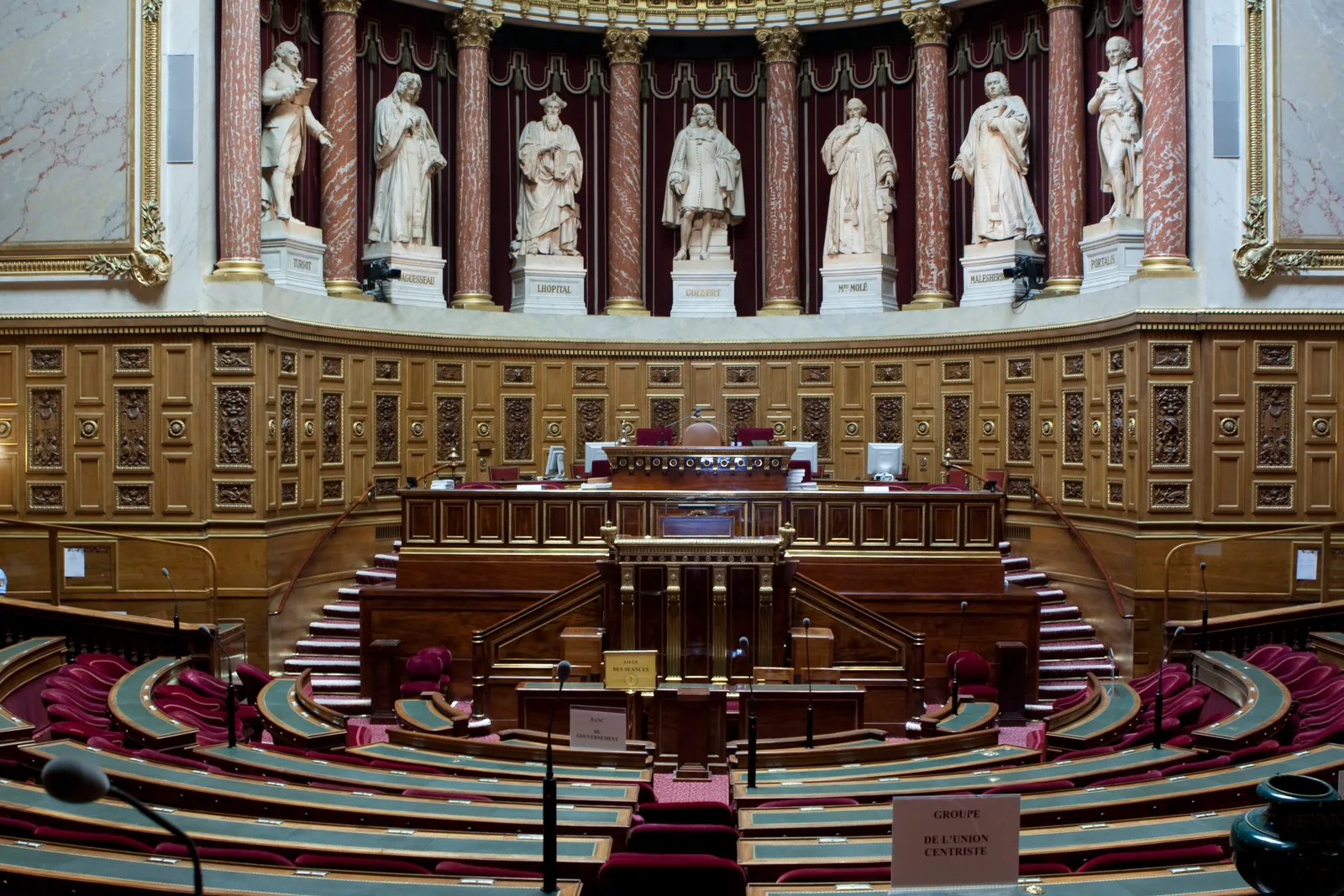
In a small flat in Imbaba, tea cooling on the table, the evening news runs in front of a man just back from his shift. A report says the US Senate has blocked a piece of legislation, followed by one on the French Senate debating a bill, then a quick cut to a chamber with red benches called the House of Lords in London, and finally a local item about Egypt's Senate. Four chambers, and in Arabic translation the name is almost the same word each time. The man puts a simple but weighty question to his son, a law student: is it the same need in every country? The short answer: no. The long answer is this article.
Before getting into detail, it helps to size up the phenomenon. The Inter-Parliamentary Union, the body that brings together the world's parliaments and tracks their data, has counted around 190 national parliaments, of which some 78 to 79 are bicameral and roughly 111 to 112 are unicameral, according to IPU snapshots from 2023 and 2024, as far as we know. By a quick tally, a second chamber exists in about 41 percent of the world's parliaments — less than half — with the majority making do with one. That figure shifts as constitutions change, which is why we always date it rather than treat it as a fixed constant.
The more important question isn't how many countries, but why. The clearest motive in federal states is regional representation. In countries made up of states or provinces, a smaller region fears its voice will be swallowed up in a chamber whose seats are allotted by population alone, so a second chamber emerges in which regions are represented as units rather than as headcounts. That is the logic behind the US Senate, where every state gets two votes regardless of population, and the same logic behind the Canadian Senate, whose seats are distributed across large regional divisions rather than by population share.
The second motive is deliberation — what is sometimes called a chamber of reflection, offering a considered second opinion. The idea is simple: a text that passes before two sets of eyes at two different moments is less prone to error than one that passes before a single eye in a moment of enthusiasm. On this view, the second chamber isn't a rival to the first but an institutional grace period for review. The third motive is diversity of expertise: a chamber that draws in specialists and experienced figures whom mass election campaigns might not carry to office — former judges, doctors, university professors, representatives of particular groups and professions — adding a technical angle to the debate.
All of this comes at a price, and it's only fair to mention it, since the debate over it runs inside the very countries that have two chambers. The first price is time: a longer legislative path, with an urgent bill potentially delayed by months. The second is a visible financial cost — buildings, administrative machinery, budgets. The third is a question of legitimacy: if a second chamber is not directly elected yet still holds the power to block or amend legislation, on what basis does it review the work of a chamber the public elected? That question arises specifically in countries where the second chamber holds that kind of power, not in every bicameral system. That is why several countries ended bicameralism during the twentieth century: New Zealand, whose Legislative Council disappeared as of 1 January 1951; Denmark, which abolished its second chamber, the Landsting, under the 1953 constitution; and Sweden, whose parliament became unicameral as of 1971 — while other countries kept their second chamber and trimmed its powers instead. There is no single answer here, only different choices for different questions.
Let's start the tour in Washington. The US Senate has one hundred members, two for each of the fifty states, serving six-year terms, with roughly one-third of the chamber up for renewal every two years so the whole body never turns over at once. A candidate must be at least thirty years old, a citizen for at least nine years, and a resident of the state they represent at the time of the election. State legislatures used to choose senators until the Seventeenth Amendment was ratified in 1913, after which they came to be chosen by direct election of the voters.
Paris offers an altogether different picture. The French Senate has 348 members, serving six-year terms, with half the chamber renewed every three years. But the ordinary voter does not go to a ballot box to elect a senator; election is indirect, through electoral colleges in each département, about 95 percent of whose members are delegates from municipal councils, joined by members of parliament and members of local and regional councils. The minimum age to stand is 24. In practical terms, a French senator is elected by locally elected officials, which makes the chamber, in the French conception, the voice of the cities, towns and municipalities inside the capital.
Berlin offers a third model unlike either of the other two. Germany's federal council, the Bundesrat, is not an elected body at all: its members are members of the governments of the sixteen states (Länder), sent by their state governments and sitting in that governmental capacity. Voting is by votes, not by heads: 69 votes are allotted among the states by population, with a minimum of three votes per state and a maximum of six, an absolute majority requiring 35 votes and a two-thirds majority 46. As far as we know, each state casts its votes as a single indivisible bloc — meaning a state election in just one Land can shift the balance of the federal second chamber.
London offers a fourth model, the oldest and the strangest to modern ears. The House of Lords is not elected by popular vote at all; most of its members are appointed to life peerages that cannot be inherited, and sitting alongside them are twenty-six senior bishops of the Church of England there by virtue of office rather than appointment. An old chapter closed there as of this writing: the House of Lords (Hereditary Peers) Act 2026 received royal assent on 18 March 2026, ending the membership of hereditary peers with the close of the 2024–2026 session on 29 April 2026. Its legislative powers are limited by the Parliament Acts of 1911 and 1949: it can delay ordinary bills for a year and money bills for one month, no more.
If we set these four snapshots side by side in a mental table, three broad families emerge, plus a case of its own. In the first family, the second chamber is elected directly by voters — Australia and Italy belong here. In a second family, voters do not choose members directly; intermediary bodies do — France and India belong here. In a third family, members are appointed — Canada, where members are appointed on the prime minister's advice and retire at age seventy-five, and the British House of Lords. Alongside these families sits the German case, where there is no election at all, since state governments send their members in a governmental capacity. Cutting across this classification is another, concerning powers: from chambers whose legislative authority nearly equals that of the first chamber, to chambers whose role is limited to delay or advisory opinion.
And where does Egypt sit on this map? Article 250 of the Egyptian constitution provides that the Senate is formed of a number of members set by law, not fewer than 180; Article 251 requires a candidate to be at least 35 years old; Article 252 bars holding membership in both chambers at once; and Article 253 states that the prime minister and ministers are not accountable before the Senate. Under the current composition the chamber has 300 members serving five-year terms: two hundred elected in August 2025 — one hundred by the individual-candidacy system and one hundred by closed party lists — with polling on 4 and 5 August and runoffs on 27 and 28 August, followed by one hundred appointed under Presidential Decision No. 575 of 2025, published in the Official Gazette on 11 October 2025, completing the chamber's membership. In other words, Egypt combines three tracks in a single chamber, with a mandate centered on giving an opinion on matters the constitution specifies, rather than blocking legislation or holding ministers accountable — a descriptive difference that makes the legitimacy question raised over blocking chambers a separate matter from ours. For more detail, see our earlier articles "Egypt's Senate: Composition, Powers and Limits" and "The 2026 Senate: No Elections This Year — Your Guide to the System, the Vote and the Next Term."
What does this tour teach us? That the real question behind every second chamber is not "how many members" or "how much power," but "whom does this chamber represent, and who chooses it." The American answer is: the states, chosen directly by their voters. The French answer is: the municipalities, chosen by their elected officials. The German answer is: the state governments, sitting in person. The British answer is a long historical one, still being gradually rewritten for more than a century. Each country is entitled to choose its own answer according to its makeup and history; our task here is description, not issuing verdicts on best and worst — this is not a comparison suited to a scale.
What remains is that the idea behind all this institutional architecture is one we already know at home, without the grand titles: a second opinion. The man in Imbaba doesn't sign a lease before an experienced relative reads it with him, doesn't accept a serious medical diagnosis before running it past another doctor, and doesn't settle a major family matter before a second sitting, once tempers have cooled. The difference is that when states wanted this second opinion, they didn't leave it to chance — they gave it a chamber and articles in the constitution. Next time that phrase crosses the news ticker, you'll know that behind the single name lie different systems, and that the better question isn't what the chamber is called, but whom it represents and who chose it.
Related Stories

Five Matters on Which the Constitution Requires the Senate’s Opinion, and What It Means for the Chamber to “Notify” It
Article 249 of Egypt’s Constitution limits the Senate’s opinion-giving role to five matters and ends with one sentence: “The Senate shall notify the President of the Republic and the House of Representatives of its opinion on these matters.” A plain reading of who refers a matter, what the text says, what it leaves unsaid, and where readers can check for themselves.
November 9, 2026 · 8 min read

Fourteen Committees, 727 Meetings: Where the Senate's Opinion Is Actually Made
The plenary session is the storefront; the workshop is a room with a long table and stacks of paper. In this non-partisan explainer, we walk step by step through the Senate's fourteen specialized committees: who gets elected in October, how a bill is referred, who is invited to be heard, and how a report is written and then circulated to members at least twenty-four hours before the session.
October 7, 2026 · 8 min read

“A Cold Shot Cures a Cold”: A False Claim, and What Trials Say About the “Power” of the Vein
“Forget the pills, take a shot and you'll be back on your feet” is advice that returns with the first chill of every year. We test two claims: that a “cold shot” cures a cold, and that an injection is inherently stronger than tablets. Verdict: false. The evidence lies in the mixture itself, in randomized trials comparing vein with mouth, and in an official Egyptian guide. The route of a medicine is the doctor's decision alone.
November 22, 2026 · 9 min read