'Crocodile of the Nile': Abdel Latif Abou Heif, the Alexandrian who became Swimmer of the Century
In the summer of 1963 a heavily built man from Alexandria swam sixty miles through the cold water of Lake Michigan over nearly thirty-five hours, with Americans following him from the boats. This is the story of Abdel Latif Abou Heif, three-time world champion and 'Marathon Swimmer of the Century' by the verdict of the International Swimming Hall of Fame, a man whose street name many people know without knowing his story.
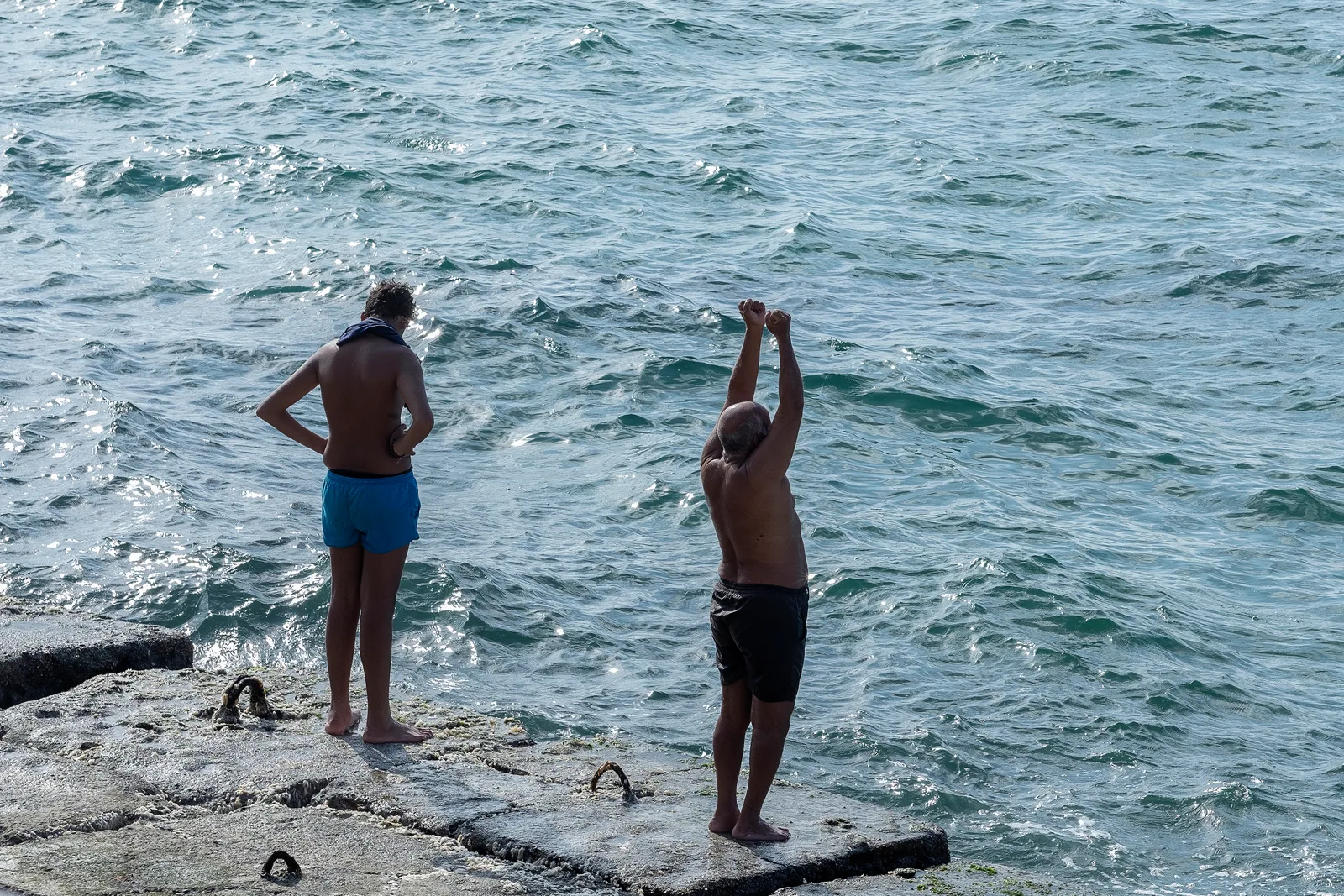
Picture a grandfather standing with his grandson on the Alexandria Corniche on a September afternoon, when the sea starts to settle after the clamour of summer, leaning on the stone seawall and watching the boys leap off the rocks. The grandfather points to the horizon and says that a man from this city once swam a distance no microbus, the shared minivan taxi, could cover on the Agricultural Road, the old Delta highway to Cairo, in under two hours. The grandson laughs and does not believe him. The name passes him every day on a street sign or a club gate without his ever knowing whose it was. This article is an attempt to give that name back a face and a story, because it is one of the greatest sporting stories Egypt has produced, and one of the least often told to today's generation.
Let us begin with the scene that had Americans holding their breath. In the summer of 1963 the water of Lake Michigan stood at 52 degrees Fahrenheit, about 11 degrees Celsius. Into it went a broad-shouldered, heavy-set man from Alexandria, and he swam sixty miles, close to 96 kilometres, over 34 hours and 45 minutes, according to the records of the International Swimming Hall of Fame. More than a day and a half without a break, in water cold enough to kill another man, with boats around him lighting his way, until he walked out on the far shore the winner.
The man was Abdel Latif Abou Heif, born in Alexandria on 30 January 1929 and dead in April 2008 at the age of 79, after a long battle with illness. He was nicknamed the 'Crocodile of the Nile', a label that stuck to him in the international sports press until it became the heading of his page at the International Swimming Hall of Fame. He was not a sprinter in a 50-metre pool but an open-water swimmer, in seas, rivers and lakes, where the opponent is not the clock alone but the cold, the waves, the current and the long tedium.
His personal story is unusual for an Egyptian athlete of the mid-twentieth century. He was educated in England, and the Hall of Fame records that he passed through Eton, a detail for which we found no independent confirmation outside the Hall and those who quote it. What Egyptian sources do establish is that he entered the Sandhurst military academy after his Channel crossing of 1951, when King Farouk rewarded him for the swim with a place there; he graduated in 1956, then served in the Egyptian army, rising to the rank of colonel, and spoke six languages. The Hall describes him physically as around 178 centimetres tall and weighing between 90 and 110 kilograms, with a thick layer of fat that, in the cold waters of the north, was armour rather than a flaw.
He crossed the English Channel three times, according to the British Channel-crossing records. The first was on 28 July 1951, as a 22-year-old student, in 15 hours and 43 minutes. The second was on 2 August 1953, when he started as the lead swimmer of an Egyptian relay team and then carried on to complete the crossing alone, in a time the Channel Swimming Association did not ratify as a record because he had begun as part of a relay. The most famous came on 15 August 1955, when he won the Butlin's international race in 11 hours and 44 minutes, 18 minutes ahead of the American Tom Park. The Channel is cold the whole year round, and its currents push a swimmer off the straight line, so that the distance actually covered is longer than the one measured on the map. Abou Heif did not begin Egypt's presence in that stretch of water; he inherited it. The same records list Ishak Helmy's crossing in August 1928, then the times of Hassan Abdel Rehim and Marei Hassan Hamad in the summers of 1950 and 1951. But Abou Heif turned that presence from the single crossing into a full professional career.
In 1956 he swam 42 miles of the Nile in 17 hours and one minute, according to the Hall of Fame's record. The Nile is not a cold sea, but swimming in it for hour after hour under the Egyptian sun has a harshness of its own, and the distance comes to about 68 kilometres. Alexandria's popular memory has it that the city would pour into the streets to welcome him home from the big races; we pass that on as it is told, because the documented sources we have say only that streets and buildings were named after him, among them one of the city's main beaches, and that the Hall of Fame describes him, in so many words, as 'Egypt's national hero'.
What sets Abou Heif apart from the many athletes remembered for a single famous swim is his staying power. The Hall of Fame says he competed in more than 68 international races of between 30 and 80 kilometres, that he won most of them, and that he finished lower than third in only twelve. Imagine an athlete in any sport climbing the podium in more than fifty of 68 world-level contests, across roughly two decades of competition, and you have the measure of what we are talking about.
In those years marathon swimming was a professional sport with a world federation, founded in 1963, with prize money and a racing season that toured Canada, the United States, Latin America and Europe. Abou Heif was crowned champion of the World Professional Marathon Swimming Federation three times, in 1964, 1965 and 1968. In February 1965 he took part in the first edition of the Hernandarias–Paraná marathon on the Paraná River in Argentina, 55 miles or roughly 88 kilometres, a race still regarded today as the longest marathon swim in the world; the Argentine press recorded that he came in shoulder to shoulder with the Argentine Horacio Iglesias and the two shared first place in a single time of around ten and a half hours, since the current in that river carries swimmers along with its flow.
Official recognition came from the highest bodies in the sport. He was inducted into the International Marathon Swimming Hall of Fame, then into the International Swimming Hall of Fame, and was chosen 'Marathon Swimmer of the Century' by a vote of the latter. In fairness we must warn the reader that, as of the time of writing, sources disagree on the years of these honours, some giving the early 1990s and others the early 2000s, so we confine ourselves here to the honours themselves without their dates. What matters more than the date is that a neutral international body, having surveyed a full century of the sport, placed an Egyptian's name at its summit.
Why, then, do today's young people not know him the way they know the champions of squash and handball? Part of the answer lies in the nature of the sport itself. The professional racing circuit survived into the 1980s; other bodies then succeeded the old federation before the circuit passed to the international swimming federation, FINA, in the 1990s, but through all of that it remained a sport with no television coverage and no crowds beyond the towns that hosted the races, and marathon swimming did not enter the Olympic programme until the Beijing Games of 2008, over a distance of ten kilometres, a few months after his death. The champions of his era had no races broadcast live and no video clips to be passed around, only black-and-white photographs, newspaper cuttings and archives assembled by enthusiasts and sports historians.
Another part of the answer is that distances like these are hard for the mind to picture. When we say a swimmer covered sixty miles in a cold lake, the listener has nothing to measure it against, having never in his life swum farther than from the beach to the shamandoura, the anchored buoy that marks the edge of the bathing area. Perhaps the nearest comparison for an Egyptian reader is to imagine swimming from Alexandria to well beyond Rosetta, almost as far as Burullus, without stopping, in water your hand could not bear to stay in for more than a few minutes.
Still, what we have of his life remains incomplete, and we would rather admit that than fill in the gaps. We do not know for certain how he trained in Alexandria, who accompanied him in the boats, or what he told himself on the second night in Lake Michigan. Foreign sources document his numbers more fully than Arabic ones, and that is a paradox worth dwelling on: a national hero by the Hall of Fame's testimony finds in his own language only a fraction of what he deserves. Perhaps these lines will serve as an invitation to anyone holding an archive or a documented memory to bring it into the light.
It remains to be said that Abou Heif was also a model of a kind of athlete we rarely see now: an educated, multilingual officer who chose the harshest sport in the world and the one with the fewest spotlights, spent nearly twenty years of his life in it in distant waters, and remained to the end a son of Alexandria. No Olympic medal awaited him, because his sport had not yet entered the Games, and no screens carried his races into Egyptian homes; what he reaped was victory itself and the race prizes, and Egypt's name on shores whose people knew nothing of the country but the pyramids.
So if you pass a street in Alexandria that bears his name, or hear it at a club or a swimming pool, stop for a moment and tell whoever is with you what you have read here. And if you have a child with you who is learning to swim and complains that the water is cold at the start of the season, tell him that a man from this city swam for thirty-five hours in water far colder than this, and that the sea in front of the two of you is the same sea he learned in. Forgotten feats need only someone to tell them again, and this time that someone could be you.
Related Stories
From the Steamship Helwan to the Round of 16: Ninety Years of Egypt's World Cup Journey
Only four appearances in nine decades: a sea voyage to Naples in 1934, the summer of Italia '90, the disappointment of Russia 2018, and then the summer of 2026, when Egypt got past the group stage for the first time in its history. A calm reading of what changed each time, away from the heat of the moment, together with a correction of the 1934 scoreline that foreign sources still get wrong to this day.
September 9, 2026 · 7 min read
From Nosseir to Elgendy: A Century of Egypt's Olympic and Paralympic Medals
From El-Sayed Nosseir's gold in 1928 to Ahmed Elgendy's record-breaking title in Paris, and from Fatma Omar to Sherif Osman on the Paralympic powerlifting platform: a century of Egyptian Olympic and Paralympic medals, won above all through strength.
August 18, 2026 · 7 min read
Pharaohs of Handball: How Egypt Joined the World's Elite
Handball belongs to Europe — except in Egypt. Two world championships hosted, a shelf of African titles, a youth world crown and fourth place at the Tokyo Olympics: how the Pharaohs built a school-to-club pipeline that keeps them among the elite.
August 18, 2026 · 6 min read