27 September 1822: The Day the Ancient Egyptians Found Their Voice Again — The Rosetta Stone and Its Key
In a hall in Paris, a 31-year-old read out a letter that gave Egypt's ancient walls back the power of speech after a long silence. From Rashid in 1799 to London in 1802 to the Academy in 1822, then on to Ahmed Kamal Pasha and the dictionary that was never printed in his lifetime, and finally to today's question: will the Stone come home? The story of a key that was lost and found again.
In front of a temple facade in Luxor, or in one of the galleries of the Egyptian Museum, a father stands with his young son before a wall crowded with birds, serpents and wide-open eyes, and the boy asks him, in the Egyptian way, "Hiya di bet'oul eih?" — what does that one say? The father answers as best he can: this is a king's name, this is a prayer to the gods, this is the number of oxen offered in sacrifice. It does not occur to either of them that this simple answer was beyond the reach of all humanity for some fourteen centuries, from the moment the last known hieroglyphic text was carved on the island of Philae in AD 394, and that the walls stayed utterly silent until one particular day in the autumn of 1822.
On that day, 27 September 1822, a 31-year-old Frenchman named Jean-François Champollion stood before the members of the Académie des Inscriptions et Belles-Lettres in Paris and read them a letter addressed to the Academy's permanent secretary, Bon-Joseph Dacier. The letter carried what generations of scholars had failed to produce: the key to a method for reading hieroglyphic writing, which Champollion would go on to complete in the years that followed, proving that these signs were not magical symbols or expressive pictures, as Europeans had believed for centuries, but a writing system that combined signs standing for sounds with others standing for meanings. Ever since that reading, the date has traditionally been regarded as the birthday of Egyptology.
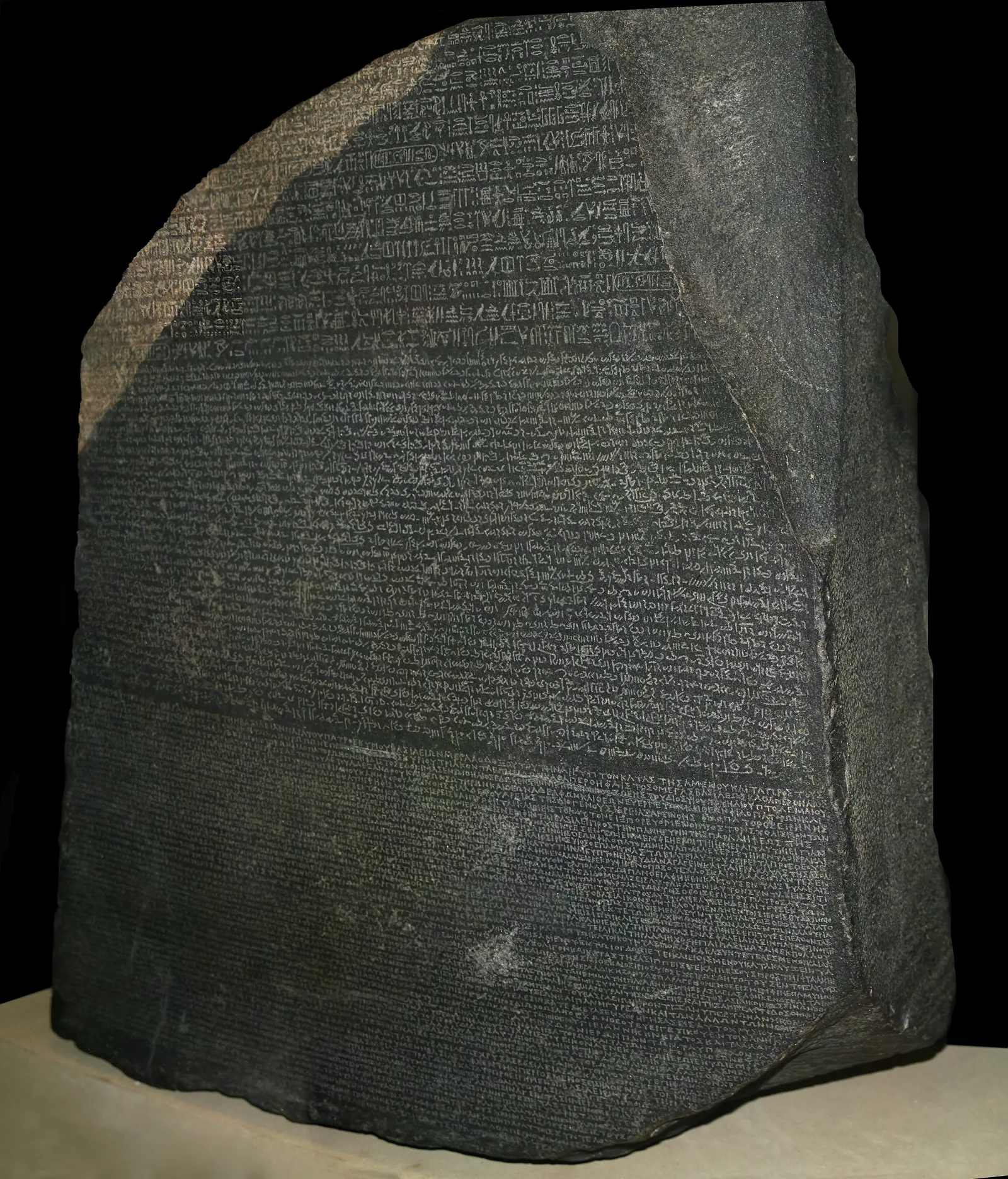
The story begins twenty-three years earlier, on Egyptian soil. On 15 July 1799, during the French expedition to Egypt, French soldiers were fortifying a position near the town of Rashid, known in the West as Rosetta, on the western branch of the Nile, when they came upon a slab of dark stone with broken edges, covered with three blocks of writing in three different scripts. The officers realised this was no ordinary stone. It was taken to Cairo, where the expedition's scholars examined it and made paper copies that were sent to Europe, and it was on those copies that researchers would work in the years that followed.
The stone itself is an official text dating from 196 BC, in the Ptolemaic period, and carries a decree issued by the priests glorifying King Ptolemy V and listing his benefactions to the temples. The decree was written out three times: in hieroglyphs, the script of temples and sacred texts; in Demotic, the script of daily life and contracts; and in Greek, the language of government at the Ptolemaic court. That is where its value lay. The Greek text was intelligible to Europe's scholars, so for the first time they held a text of known meaning side by side with a version of it in the script they could not read.
But the stone did not stay in Egypt. After the French were defeated by the British and the Ottomans, the Treaty of Alexandria of 1801 required the antiquities gathered by the expedition's scholars to be handed over to the British side, and the stone went to London as a spoil of war, settling in the British Museum, where it has remained since 1802. And so the world came to know the stone by the name of the Egyptian town where it was found, while most of that town's own people have never seen it except in pictures.
Before Champollion there were others. The British scholar Thomas Young, a physician and physicist of encyclopaedic range, began his research on copies of the stone in 1814 and succeeded in matching the signs enclosed in oval frames, which we now call cartouches, to the sounds of the name Ptolemy, proving that some signs were to be read phonetically. Other scholars answered partial questions that prepared the way, to the point that Champollion was at times accused of failing to acknowledge what he owed to others, as a lecture given at the Collège de France in 2022, on the bicentenary of the letter, recalled. Great discoveries are rarely one man's leap; they are a ladder climbed by many, with the last of them reaching the roof.
Here a detail deserves to be put in its proper place: the Rosetta Stone did not solve the riddle on its own. The hieroglyphic text on the stone is incomplete, a large part of it having been lost with the broken upper section, about two thirds by the estimate of that same lecture, and by itself it was not enough to build a complete system of reading. What made the difference for Champollion was two things. First, he gathered a large and varied body of hieroglyphic, hieratic and Demotic texts from published plates and museum collections and compared them against one another. Second, he knew Coptic, the last stage of the ancient Egyptian language, which the Egyptian Church had preserved in its prayers. Coptic was the bridge he crossed from sounds to meanings.
A famous story is told of the days before the letter. In mid-September 1822, it goes, after reading the names of Ramesses and Thutmose in copies of inscriptions that had reached him from Egypt, Champollion ran to his elder brother's office and cried "I've got it!" before collapsing from sheer exhaustion; he is said to have been confined to bed for days. We have nothing to confirm its details, but it expresses a deeper truth: that the man had chased the riddle since boyhood, and that the moment the door opened was a genuine outburst of feeling, not a cold deduction.
Yet a legitimate question occurs to the Egyptian reader: where were the Egyptians in all this? The bitter answer is that Egyptology was born European, with European scholars and European museums, while the people of the land remained, for the most part, labourers on the digs rather than partners in the knowledge. That is why the story of Ahmed Kamal Pasha, who died in 1923 and was born around 1849 or 1851 depending on the source, carries a meaning that goes beyond his biography. As a young man he enrolled in the School of the Ancient Egyptian Language, but the path was then closed to him, and he spent years as a French translator at the Ministry of Education and as a teacher of French, before finding a foothold in the Antiquities Service in the early 1880s.
From there Ahmed Kamal rose to become the first Egyptian to hold the post of curator at the Egyptian Museum. He played a part in the investigation of the Deir el-Bahari cache in 1881 and wrote books in Arabic and French. But his greatest work was a dictionary of the ancient Egyptian language in twenty-two volumes, which took him twenty years to compile, explaining each word in Arabic and then in French; his eldest daughter is said to have copied out its pages by hand. He presented it to King Fuad, who granted him the title of Pasha, but the dictionary was never printed in his lifetime. Its manuscripts stayed in his family's possession for decades before they were handed to the Bibliotheca Alexandrina, and according to a report in Al-Ahram's English-language edition in April 2021, the Ministry of Culture had photographed it and printed copies the previous year. As of the time of writing, we know of no complete scholarly edition available to the general reader.
The idea Ahmed Kamal championed was at once simple and profound: that the ancient Egyptian language is no stranger to the Arabic Egyptians speak today, and that many of its words still live on the tongues of the fellahin, the peasant farmers of the Egyptian countryside. Whatever linguists may say about the soundness of his comparisons, the man opened a door that has never closed: that an Egyptian should study his own history himself and write it in his own language. The first Egyptian Egyptologists were trained by him and by the men of his generation.
The file on the stone itself remains open. In October 2022, on the bicentenary of the decipherment, the archaeologist Zahi Hawass launched an international online petition on one of the petition websites calling on the British Museum to return the Rosetta Stone and on the Louvre to return the Dendera Zodiac to Egypt, to be displayed at the Grand Egyptian Museum, asserting that both had left Egypt illegally. Hawass had been raising this demand publicly since 2003, and put it to a UNESCO meeting in 2005 when he was secretary general of the Supreme Council of Antiquities, the same year the British Museum presented Egypt with a replica of the stone, now displayed in Rashid. It should be said plainly that the petition is a personal initiative by Hawass and not, to our knowledge and as of the time of writing, an official request from the Egyptian government. The British Museum, for its part, usually replies that the stone came to it under a treaty; it is a debate of legal and ethical arguments that deserves to be conducted in the language of facts rather than of feuding.
When the anniversary comes round tomorrow, the most important thing about it will be neither Champollion's name nor Young's, but what that letter did for us. Before it, Ramesses was just a statue, Hatshepsut just a temple, the walls of Dendera and Philae just decoration, and the papyri just scrolls that nobody could understand. After it, they had words we could read, complaints we could hear, letters and wills and lawsuits thousands of years old that bear an astonishing resemblance to what we live through today.
So the next time you stand with your son before an inscribed wall in Luxor or a display case in the Grand Egyptian Museum, and read him the small label explaining what the text says, remember that those few lines cost twenty-three years of bewilderment between Rashid and Paris, and a whole lifetime spent by a translator and teacher of French writing a dictionary he never saw in print. And remember that the stone with which the story began is still far from home, and that a grandson's right to read his grandfather's words on his own soil is not a luxury but part of what it means to be Egyptian.
Related Stories
Hassan Fathy: The "Architect of the Poor" Who Built an Architecture from Egyptian Mud That Astonished the World
In an age when air conditioning devours the household budget, the life of Hassan Fathy revives an old question: why did we abandon an architecture that cooled our homes without electricity? The story of the "Architect of the Poor," who built an entire village out of Egyptian mud, wrote a book the world translated, and anticipated the green-building wave by decades.
September 4, 2026 · 8 min read

Taha Hussein: The Blind Boy Who Became Dean of Arabic Literature and Made Education a Right "Like Water and Air"
A blind child from a village in Upper Egypt became the "Dean of Arabic Literature" — and when he took over the Ministry of Education, he turned his own maxim, "education is like water and air," into the 1950 decree that made secondary schooling free. It is a journey that tells every reader: knowledge is a right of citizenship, not the privilege of a class. So how did a man who never saw the light bring it about?
August 28, 2026 · 7 min read

More Than a Match: A Century of the Al Ahly–Zamalek 'Summit' as Egyptian Homes Live It
From the first meeting in 1917 to the 2020 African final, Al Ahly against Zamalek has never been just ninety minutes. It is a date that splits a single living room into red and white and then brings it back together. A calm look at how the two clubs came to be, at their records, and at the rituals of derby day in Egyptian homes.
September 25, 2026 · 6 min read