Nov. 4, 1922: The First Step From 'Wonderful Things' to the Tutankhamun Hall
On this day a hundred and four years ago, workers' picks in the Valley of the Kings uncovered the edge of a step cut into the rock, and a story began that bears no resemblance to treasure tales: the story of a principle that decreed everything inside an intact tomb belongs to Egypt alone. We trace what happened, date by date, and explain how that principle became written law that still governs every artifact pulled from the ground today.
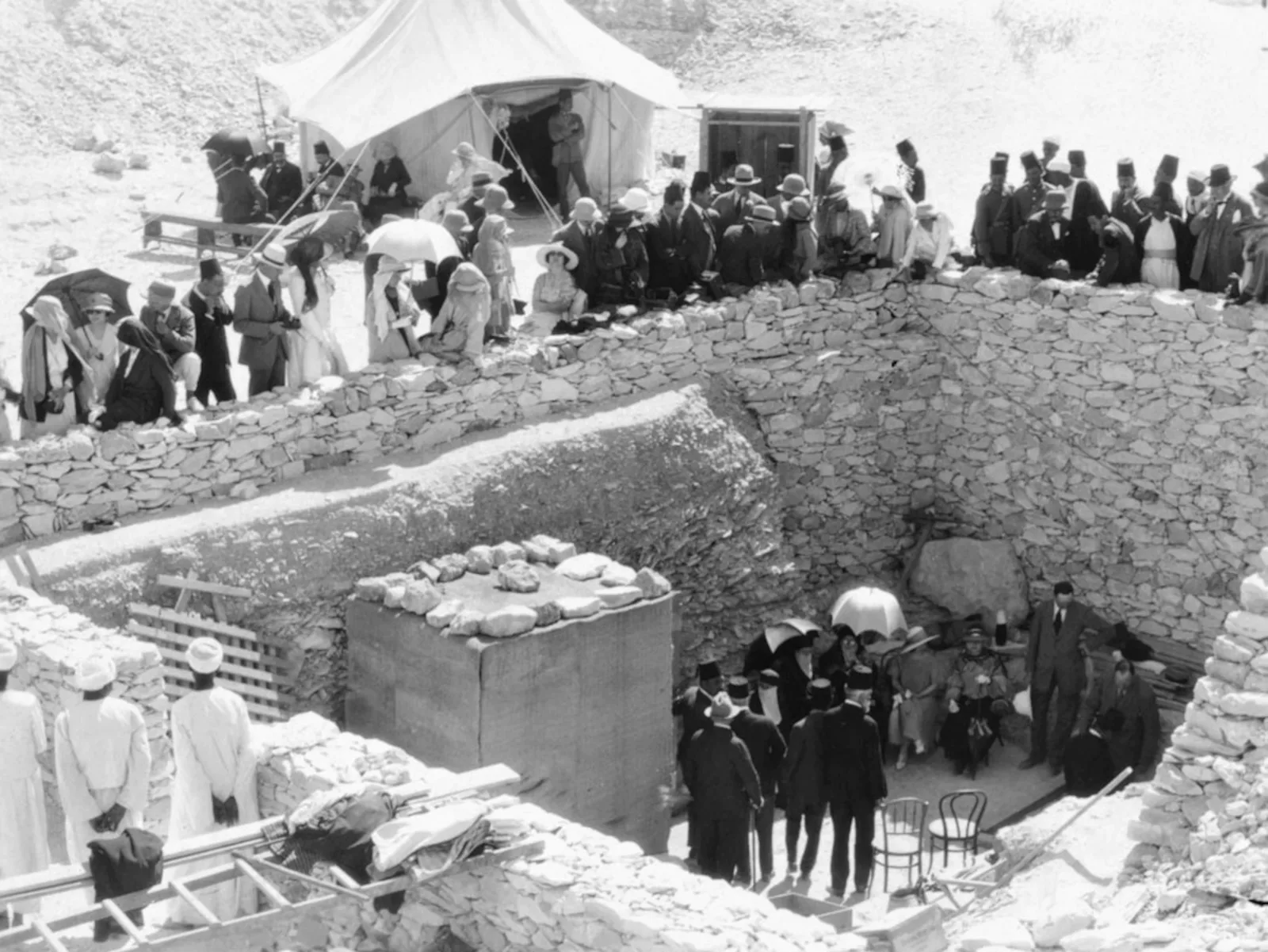
In the Valley of the Kings, on the morning of November 4, 1922, workers on the excavation team were clearing away the rubble of old stone huts piled up near the entrance of the tomb of Ramesses VI when their picks uncovered the edge of a step cut into the rock. There was no gold in the scene, no torches — just dirt, baskets, and a stone surface too level to be natural. A hundred and four years later, a young girl stands at a small kiosk outside her school in any Egyptian neighborhood and buys, for a few pounds, a keychain dangling a golden face with wide eyes and a straight false beard. The face is so familiar we barely notice it anymore: on notebook covers, shop signs, and in the background of news bulletins whenever the Grand Egyptian Museum comes up. Between that stone edge and this metal keychain lies a story worth telling in full.
That edge turned out to be the first of a staircase cut into the bedrock, one that had lain hidden beneath the rubble of huts built by ancient workmen digging nearby tombs, itself sitting atop debris left when the tomb of Ramesses VI was carved out more than a century and a half after Tutankhamun's burial. In other words, it was the leftovers of that ancient labor that had concealed the entrance from tomb robbers and archaeologists alike. The excavation permit belonged to Lord Carnarvon, and the dig was led by the archaeologist Howard Carter, whose season was, by then, effectively his last chance after years without any notable result. A popular story credits the discovery of the step to a water boy who carried water for the workers, but Carter's own records do not support it, and historians still dispute it — so we tell it here for what it is: a widely repeated tale with no conclusive evidence behind it.
What we know with greater certainty comes from the excavation journal Carter kept during the winter season of 1922–1923, held — as far as we know — in the archive of the Griffith Institute at Oxford University. We tried to access its version published online at the time of writing but could not reach the site, so we rely instead on what other sources quote from it: a terse, almost anticlimactic line stating that the first step of the tomb was found that day. Then the work stopped. Carter covered the staircase back up with rubble, sent a telegram to Carnarvon in England asking him to come, and waited. That wait — knowing there is a sealed door beneath your feet, then sitting there guarding it for nearly three weeks — is the truest thing about the whole profession.
Carnarvon arrived in Luxor on November 23, 1922, and on the 26th a small breach was opened in the sealed door. The exchange later repeated around the world — the question of whether Carter could see anything, and his answer that he could see 'wonderful things' — is documented in multiple sources, even if accounts differ slightly on its exact wording. The official opening of the burial chamber itself did not happen that first night, but on February 16, 1923, with Egyptian officials present.
On April 5, 1923, Carnarvon died in Cairo of blood poisoning and pneumonia following an infected small wound, and against that backdrop — fed generously by the press of the day — grew the legend of the 'Curse of the Pharaohs,' which has lived on for a century in newspapers and films. Let us say it plainly: the curse is folklore and cinematic tradition, not scientific fact; a study published in the British Medical Journal in 2002 compared the lifespans of those who attended the tomb's opening with those who did not and found no statistically meaningful difference in mortality. What deserves more attention is that the discovery itself was not the most important thing to happen in those years; what mattered most was a dry, bureaucratic administrative and legal decision that changed the rules of the game forever.
Before 1922, the prevailing system in excavation work was known as 'partage': a foreign mission received a share of the finds in exchange for funding the dig, and so Egypt's antiquities were dispersed to museums around the world under official license. But Carnarvon's permit, like others, carved out one exception: an intact, unrobbed royal tomb, whose entire contents would revert to the government. And that is exactly where the dispute arose — the tomb, officially designated Tomb No. 62 in the Valley of the Kings (KV62), had in fact been entered twice by robbers in antiquity, after which necropolis officials had restored order to it and resealed it officially. Even so, the Antiquities Service, headed by Pierre Lacau, ruled it intact and held firmly to the principle: the tomb's entire contents belonged to the Egyptian government, with no partage and no share for anyone else. In other words, the entire claim rested on a legal interpretation, not on a plain reading of the text.
It did not go smoothly. The dispute between the mission and the Antiquities Service escalated until the tomb was temporarily closed and work halted for months. A settlement in 1924 saw the Carnarvon family relinquish any claim to the tomb's contents while continuing to fund the work, and digging resumed in early 1925 under a new permit issued in Lady Carnarvon's name. In 1930, according to the historical sources available to us, the family received financial compensation for its expenses of roughly thirty-five thousand pounds. The practical outcome was that the burial furniture stayed in Egypt, apart from scattered pieces that later surfaced abroad among what Carter left behind after his death — pieces returned on various occasions, most recently in 2010, when New York's Metropolitan Museum handed back nineteen objects it acknowledged should never have left the country in the first place. This is the single most important moment in the whole story: the first time it was settled, once and for all, that whatever comes out of Egyptian soil stays in Egypt.
Let us remember where the country stood at the time. Egypt had just emerged from the 1919 revolution, the Declaration of February 28, 1922 had granted conditional independence, and the 1923 constitution was being drafted. In that climate, the tomb was not a piece of light entertainment news — it was a matter of public debate in the newspapers and coffeehouses: who owns our past, and who decides where it is displayed? That is why, when we call 1922 a turning-point year, we are not talking about gold, but about the idea that antiquities are part of the state's sovereignty, not a return on foreign investment.
The other side of the story that usually gets forgotten is the sheer scale of the work itself. This was never a matter of 'open the door and see the treasure' — it was ten years of numbering, conservation, and transport. The tomb's contents were catalogued into 5,398 numbered objects, each with its own number and description card, and most of them photographed by Harry Burton, though smaller pieces — estimated in the sources at fifteen to twenty percent of the total — were never photographed. Clearing the tomb was not finished until February 1932. A decade of patience for a few minutes of wonder. And from this comes a lesson that still holds true: an excavation's value lies in its documentation, not its shine, and an object torn from its context loses half its meaning even if it is made of solid gold.
That lesson is now written into law. Egypt's Antiquities Protection Law No. 117 of 1983, and its amendments — including Law No. 91 of 2018 — establishes that antiquities uncovered by any mission, Egyptian or foreign, belong to the state, that archaeological land and property are part of the public domain, and it sets strict limits on disposing of or trading in any artifact, with harsh penalties for smuggling. In other words, what began in 1922 as an administrative decision made in response to a single excavation permit had, sixty years later, become a general rule binding everyone.
This principle has a practical side that concerns ordinary citizens more than they might think. If, while building, digging a well, or renovating an old house, you come across an inscribed stone, a cavity, or an unusual wall, the right course of action is to stop work immediately and notify the nearest antiquities authority or police station; Article 24 of Law 117 of 1983 obliges anyone who accidentally finds a movable artifact to notify the nearest administrative authority within forty-eight hours. Clandestine digging in search of antiquities, on the other hand, is punishable under Article 42 by three to seven years in prison and a fine starting in the hundreds of thousands of pounds, and smuggling an artifact out of the country can carry a life sentence and a fine ranging between one million and ten million pounds following the 2018 amendment. Digging beneath homes also poses a genuine risk to life; and every artifact removed this way loses its context, turning from a document into merely a pretty object with no story left to tell.
As for where the collection finally came to rest, this is the chapter we witnessed with our own eyes. After nearly a century at the Egyptian Museum in Tahrir, the burial furniture moved to the Grand Egyptian Museum on the edge of the Giza plateau, which held its official opening ceremony on November 1, 2025, and opened its doors to the public on November 4, 2025. UNESCO describes the museum as displaying the golden king's collection together in full for the first time since its discovery, and press coverage of the opening describes two halls dedicated to Tutankhamun holding the very same 5,398 numbered objects Carter catalogued. The king himself, however, has remained in his tomb in the Valley of the Kings, inside a climate-controlled case since 2007, along with his stone sarcophagus; anyone who wants to see the golden face in person still has to travel to Luxor.
And so the dates intersect: November 4 marks the anniversary of the discovery of that first step in 1922, and it is also the very day the Grand Museum opened to the public in 2025. A hundred and four years separate the two dates — a journey from a wooden crate carried by train to a climate-controlled gallery where humidity and lighting are measured by instruments. And between them lies a shift in meaning: from 'what share does the financier take?' to 'how do we show what is ours to the world?'
Back to the girl and her keychain. There is nothing wrong with passion starting from a small metal trinket bought for a few pounds. But the story worth telling her is neither the story of the curse nor the story of the treasure — it is a simple, stubborn story: that Egypt decided, at a moment when it was weaker than we might imagine today, that whatever lies beneath its soil belongs to it. If you visit the Grand Museum during the midyear break, or stop by a regional museum in your own governorate, or see a neighbor digging under his house 'because he heard something,' remember that the first step that appeared under the workers' picks in 1922 did not just open a tomb — it opened a principle we still live under every single day.
Related Stories
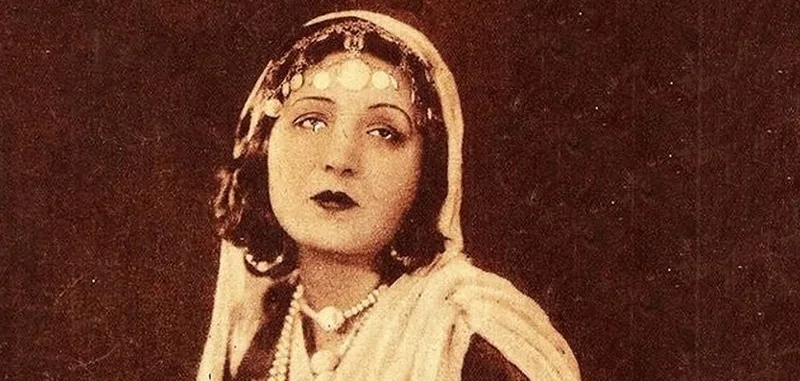
“Laila” (1927): The Film Historians Count as the First Purely Egyptian Feature, Produced by a Woman at Home
In November 1927 a silent film called “Laila” was shown. Aziza Amir produced it and starred in it after turning part of her Garden City home into a studio. It is a story of individual daring, eight years ahead of Egypt’s first fully equipped studio, of an old dispute over who deserves the title of “first,” and of a lesson for any reader with a camera in their pocket.
November 12, 2026 · 8 min read

“A Cold Shot Cures a Cold”: A False Claim, and What Trials Say About the “Power” of the Vein
“Forget the pills, take a shot and you'll be back on your feet” is advice that returns with the first chill of every year. We test two claims: that a “cold shot” cures a cold, and that an injection is inherently stronger than tablets. Verdict: false. The evidence lies in the mixture itself, in randomized trials comparing vein with mouth, and in an official Egyptian guide. The route of a medicine is the doctor's decision alone.
November 22, 2026 · 9 min read
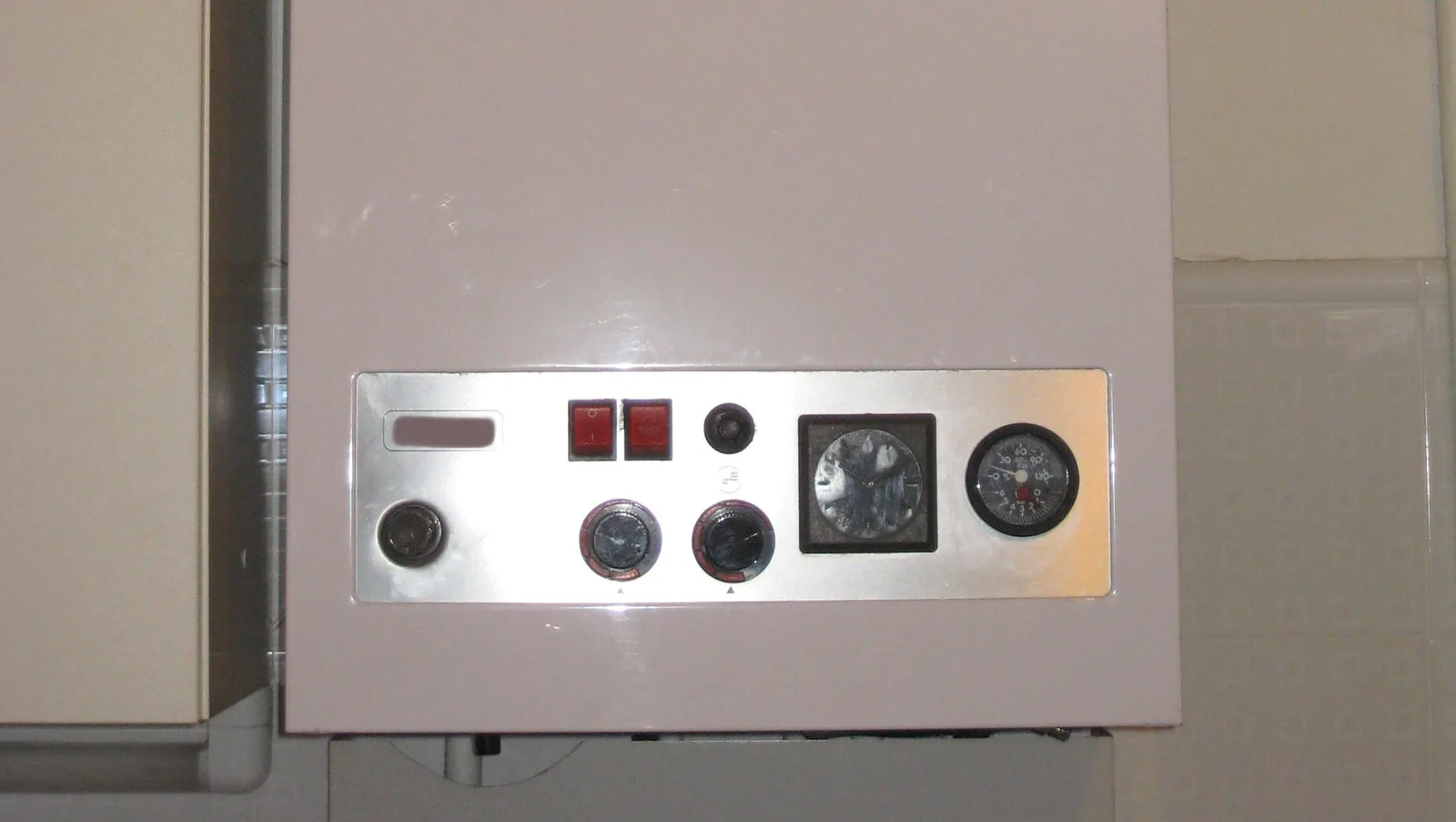
The Silent Killer in the Bathroom: The Danger Is Not the Gas Heater but an Unventilated Room and Neglected Upkeep
With the first cold snap each year, Egyptian homes light their gas water heaters and shut their windows, turning a small bathroom into a room with no fresh air. Carbon monoxide has no colour, smell or taste, and its early symptoms are easily mistaken for a cold or fatigue. Here is what official sources say about the real cause of the danger, and the order of actions in the first minutes that could save a whole family.
November 21, 2026 · 8 min read