“Laila” (1927): The Film Historians Count as the First Purely Egyptian Feature, Produced by a Woman at Home
In November 1927 a silent film called “Laila” was shown. Aziza Amir produced it and starred in it after turning part of her Garden City home into a studio. It is a story of individual daring, eight years ahead of Egypt’s first fully equipped studio, of an old dispute over who deserves the title of “first,” and of a lesson for any reader with a camera in their pocket.

Every day, many people walk past the façades of old movie theaters in central Cairo, some still operating and some shuttered, and few stop to ask a simple question: who opened the first door to this industry in Egypt, with whose money, and where? The answer that many film historians have settled on does not begin with a company, a bank or a ministry. It begins with a private house in Garden City, part of which its owner turned into a studio, and with a silent film called “Laila” that opened in November 1927, about ninety-nine years ago.
Behind the project stood one woman, Aziza Amir, who was its originator, producer and star all at once. The Arab cinema database Elcinema lists the film as 1927, describes it as a silent feature of ninety minutes produced in Egypt, and credits her in five roles at once: acting, writing, producing, directing (alongside Istephan Rosti) and editing. A 2020 profile on the Al Jazeera Net website says she edited the film herself. Her profile there records that she was born on December 17, 1901 and died on February 28, 1952, that her name before fame was Mufida Ghoneim, and that the earliest work recorded for her is a 1926 stage production, “Ali Baba,” which means she came to the camera from the theater.
The project did not begin under the name “Laila.” A 2018 report on the Masrawy news site said the film started out as “Nida Allah” (The Call of God) and that she was encouraged to enter production by the Turkish director Widad Orfi. The Aziza Amir file in the cinema archive of the Bibliotheca Alexandrina says she founded a production company called Isis Film with her husband, Ahmed al-Sharei, appointed Orfi as its artistic director and contracted him to direct her first film. The footage he shot was then shown to a small circle of critics and friends, and the verdict was disappointing. He was asked to cancel the contract, and direction passed to the cinematographer Hassan al-Helbawi and then to Istephan Rosti. The work was reshot, renamed and settled as “Laila.” These are archival and press details, not a surviving production document.
The cast and credits of the final version contain a contradiction that has to be recorded as it stands. Widad Orfi is the author of the story and a co-writer, and he played a role opposite Aziza Amir in the first version, before the reshoot. Elcinema’s notes say the film was reassembled in five reels after his part was cut and reassigned to Ahmed Allam, yet the cast list on the same page still keeps his name in the role of Sheikh Ahmed. Istephan Rosti co-wrote and co-directed the film and also played one of the parts. The cinematography is credited to an Italian named Tulio Chiarini, and the notes say outdoor scenes were shot between the Pyramids and Saqqara and in the streets of Cairo. Technically, then, the film was built on a mixture of foreign and Egyptian expertise, yet the name of the woman who put up the money and played the lead stayed in the director’s box, the seat of artistic decision.
What most surprises a present-day reader in this story is that the house was the factory. The Bibliotheca Alexandrina file says she used part of her Garden City home as a shooting studio, and the 2018 Masrawy report adds that developing and printing were done in the same house. In other words, Egypt in 1927 had none of the infrastructure we now call post-production: no ready laboratories to receive raw film, no shooting stage to rent by the hour, no chain of service providers to contract. Anyone who wanted a film had to build each of those links alone, at home, at her own expense.
The hardest stage was not shooting but reaching the screen. In the account relayed by the 2018 Masrawy report, she at first found no theater willing to show the film, so she rented a hall and screened it herself, and the account names the Metropole cinema in Cairo as the venue of the premiere. This link in the story reaches us essentially through a single press source. The Aziza Amir file at the Bibliotheca Alexandrina does not mention it, and neither does the film’s page on Elcinema, which gives a release date but no theater. So it is recorded here as what it is: a widely repeated account, not an event backed by a published contract. Its substance still matters in itself. The owner of the film had to become its distributor and exhibitor as well, after having been its producer and star.
Accounts of the premiere repeat a story that the poet Ahmed Shawqi, known as the Prince of Poets, was among the audience, and that the economist Talaat Harb attended and said she had succeeded where men had failed. We report the line through those who carried it. It appears in the 2018 Masrawy report, and in the 2020 Al Jazeera Net profile attributed to Talaat Harb at the time of the screening, and the Bibliotheca Alexandrina archive gives a close version in which she had achieved what no man had. The attribution itself is unstable, however: Elcinema’s notes assign praise to the same effect to Ahmed Shawqi rather than Talaat Harb, while the archive gives Shawqi a different remark, in which he hoped this crescent would grow into a beautiful full moon. A contested attribution is reason enough to keep the line within the limits of what its transmitters reported.
Then comes the matter that cannot be ignored: the title of “first” is not settled. In 1927 the film “A Kiss in the Desert” was shot, directed by Ibrahim Lama and starring his brother Badr Lama, and sources differ on when it first opened. Egyptian press accounts and Elcinema’s notes say it was shown in Cairo in May 1927, while the Bibliotheca Alexandrina archive, citing newspapers, says it was not completed until the end of 1927 and was released in 1928. The archive says Ibrahim Lama was born in Chile in 1904, that the two brothers landed in Alexandria in 1924 on their way to Bethlehem and stayed on, and its chronology records their founding of Mina Film in 1926, which it describes as the first film club in Egypt, before they founded Condor Film in an unspecified year.
Even the count is not uniform. The Bibliotheca Alexandrina archive places “A Kiss in the Desert” as the third full-length narrative feature in Egyptian film history, after “In the Land of Tutankhamun” in 1923 and “Laila” in 1927, and notes that the film historian Ahmed al-Hadari refused in his book to treat “A Kiss in the Desert” as the first Egyptian film. That is why the label has to be written precisely. “Laila” is what historians count as the first full-length feature of purely Egyptian production, with Egyptian money, an Egyptian woman leading the project and Egyptian decision-making. It is not, beyond dispute, the first long moving picture made on Egyptian soil. The difference between the two phrasings is what separates carefully written history from a slogan.
What remains is the industrial meaning of the story. Production companies began to appear before “Laila” and after it, among them Isis itself and the two companies of the Lama brothers, but the gap between “Laila” and the first fully equipped studio was eight years. Film-history sources say Studio Misr, built by Talaat Harb and described as the first studio with Egyptian capital, did not open until 1935. The industry did not begin with an institutional decision. It began with an individual gamble that showed the market existed and that audiences would buy a ticket, and the institution then arrived to build on what individuals had proved.
Another point deserves attention: the first name in the producer’s box at this date was a woman’s. The same database lists Asia Dagher in the cast of “Laila,” so the first step on this screen carried more than one woman’s name. This was neither a manifesto nor an organized movement but the result of a practical reality: the door was open to anyone with the nerve to walk through it and the willingness to risk her own money. In founding moments of this kind, room opens up for people who were outside the calculation.
Her record did not end with “Laila.” Elcinema lists acting roles for her stretching from “Bint al-Nil” (Daughter of the Nile) in 1929 to “Amantu Billah” (I Believed in God) in 1952, among them “Bai’at al-Tuffah” (The Apple Seller) in 1939 and “Ibnati” (My Daughter) in 1944. It also credits her with producing “Habbaba” in 1944 and with nineteen works in the writing box. Among the films she wrote later is “Fatat min Filastin” (A Girl from Palestine) in 1948, for which the database lists her under story, screenplay and dialogue. She died in February 1952, by which time Egyptian cinema had become an established industry, with its studios, its stars and its markets across the region.
What survives of “Laila” for today’s audiences is far less than what survives of its name. We know it from databases, press references and film-history books more than from actually watching it, and silent films the world over have lost many prints to the fragility of the film stock and the absence of systematic preservation. The question of the archive is part of the story, not a footnote to it. A film regarded as the starting point of an industry of this size deserves to have everything left of it, even a single still or a poster, preserved, cataloged and made available to anyone who wants to check for themselves.
It is at this very point that the story touches the reader’s life today. The camera that in 1927 required a house converted into a laboratory is now in every pocket, and shooting has become the cheapest part of the process. What has stayed hard is the rest of the road: who finishes the work, who screens it, who gets it to an audience, who preserves it a year later. Those are the links Aziza Amir worked through on her own initiative and with her own money. The lesson is that owning the camera does not mean owning the story; the person who owns it is the one who carries it to the end of the road. The next time you pass an old movie theater in central Cairo, remember that all of this began with a residential house, a roll of raw film and a personal decision that the story would be told, even at its owner’s expense.
Related Stories
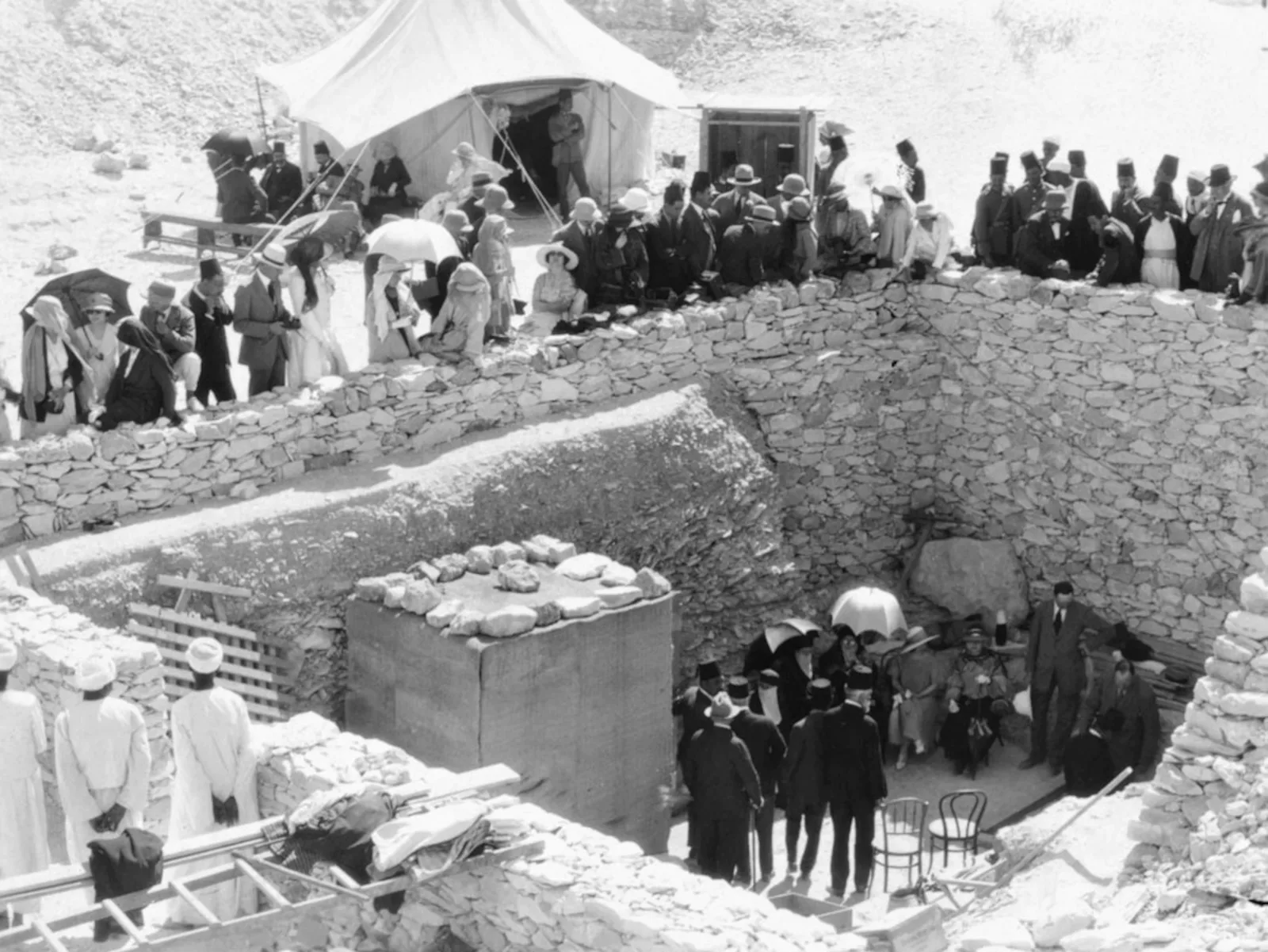
Nov. 4, 1922: The First Step From 'Wonderful Things' to the Tutankhamun Hall
On this day a hundred and four years ago, workers' picks in the Valley of the Kings uncovered the edge of a step cut into the rock, and a story began that bears no resemblance to treasure tales: the story of a principle that decreed everything inside an intact tomb belongs to Egypt alone. We trace what happened, date by date, and explain how that principle became written law that still governs every artifact pulled from the ground today.
November 4, 2026 · 9 min read

“A Cold Shot Cures a Cold”: A False Claim, and What Trials Say About the “Power” of the Vein
“Forget the pills, take a shot and you'll be back on your feet” is advice that returns with the first chill of every year. We test two claims: that a “cold shot” cures a cold, and that an injection is inherently stronger than tablets. Verdict: false. The evidence lies in the mixture itself, in randomized trials comparing vein with mouth, and in an official Egyptian guide. The route of a medicine is the doctor's decision alone.
November 22, 2026 · 9 min read

The Silent Killer in the Bathroom: The Danger Is Not the Gas Heater but an Unventilated Room and Neglected Upkeep
With the first cold snap each year, Egyptian homes light their gas water heaters and shut their windows, turning a small bathroom into a room with no fresh air. Carbon monoxide has no colour, smell or taste, and its early symptoms are easily mistaken for a cold or fatigue. Here is what official sources say about the real cause of the danger, and the order of actions in the first minutes that could save a whole family.
November 21, 2026 · 8 min read