From the 1866 Council to Today's Senate: Egypt's Second Chamber Through History
More than a century and a half ago, Khedive Ismail created modern Egypt's first representative assembly. From the Senate of the 1923 constitution to Sadat's Shura Council and today's restored chamber, we trace the second chamber's journey through Egypt's constitutional history — created, abolished and revived across three distinct eras.
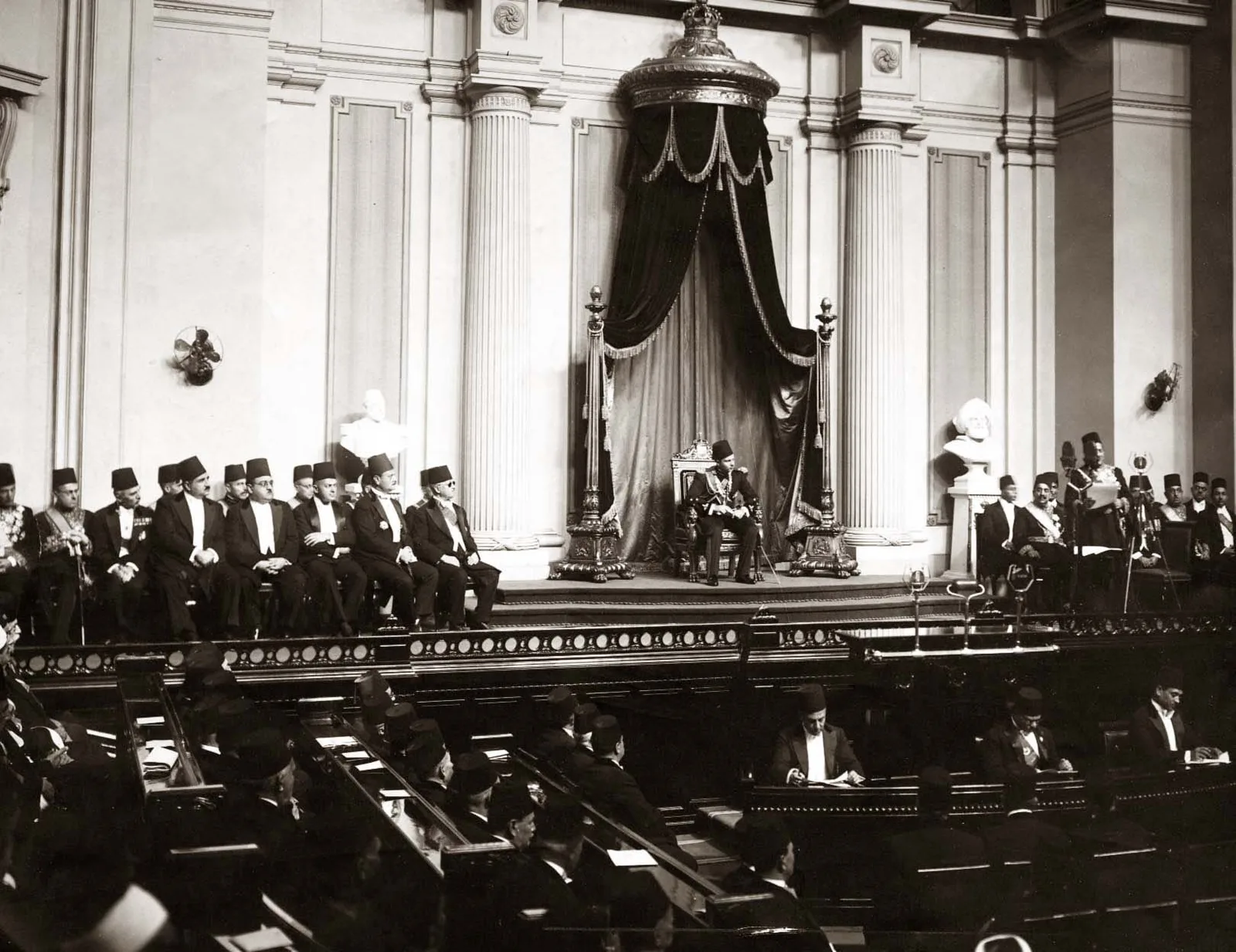
When Egyptians speak of their parliamentary experience, they are speaking of one of the oldest such traditions outside Europe and the Americas. More than a century and a half ago — in 1866, to be precise — Khedive Ismail established the Consultative Council of Deputies, the first representative body in modern Egyptian history, opening a long and turbulent story in which the second chamber has written some striking chapters.
The 1866 council comprised seventy-five members chosen through local notables and village headmen, and its remit was narrowly advisory. Yet it planted the seed of the idea that the country had a voice to be heard in its own affairs. As financial crisis deepened and foreign intervention grew, the council became a platform for bold national demands, a tide that crested with the Urabi movement and its call for a government answerable to the deputies.
After the British occupation of 1882, parliamentary life was constrained for decades. The country made do with bodies of limited powers, the last of them the Legislative Assembly formed shortly before the First World War and suspended at its outbreak, while the demand for a full constitution and parliament stayed alive in the national movement until the revolution of 1919 erupted.
The 1923 constitution, fruit of that revolution, established Egypt's first complete bicameral parliament: a fully elected Chamber of Deputies and a Senate that combined elected members with others appointed by the king, requiring of its members a higher age and public standing or a property qualification — the pattern common among upper chambers around the world at the time.
Throughout the liberal era from 1923 to 1952, the Senate hosted some of the country's most eminent figures of thought and politics, and was a stage for the tug-of-war of the famous triangle: the Wafd with its popular majority, the royal palace, and the British occupation authority. Parliaments were frequently dissolved and constitutions suspended, yet parliamentary life persisted as an entrenched tradition of the Egyptian state.
The July revolution of 1952 ended the old order entirely: the 1923 constitution was abolished and the existing parties dissolved. When parliamentary life returned under the 1956 constitution, it returned with a single chamber, the National Assembly, and unicameralism prevailed throughout the Nasser era and immediately beyond.
The constitutional amendments of 1980, under President Anwar Sadat, revived the idea of a second chamber through the Shura Council — two thirds of its members elected and one third appointed, with advisory competences on major questions, alongside a role in overseeing the national press institutions through the Supreme Press Council.
For roughly three decades the Shura Council lived under a permanent question mark about its usefulness — until its exceptional moment after the January 2011 revolution. Under the 2012 constitution, and following the dissolution of the lower house, full legislative power passed to it for a transitional period, making it a genuine legislature for the first time in its history, before it was dissolved in 2013 and then abolished outright by the 2014 constitution, returning Egypt to a single chamber.
The absence did not last long this time. The constitutional amendments approved by referendum in 2019 restored the second chamber under its old monarchical-era name, the Senate, with first elections held in 2020: three hundred members, a third of them appointed, and advisory competences covering constitutional amendments, the general development plan, treaties and draft laws referred to it.
Comparing the three incarnations — the Senate of 1923, the Shura Council of 1980 and the Senate of 2020 — reveals a clear connecting thread: a chamber intended for deliberation and expertise, always blending election with appointment, with the final legislative word resting with the fully elected lower house, even as the political context of each era differed profoundly.
The debate over bicameralism is a global one, not Egypt's alone. Its advocates see a valve for review and scrutiny, and representation for expertise and interests that general elections do not necessarily produce; its critics see slower lawmaking and added cost. In the Egyptian experience, the verdict ultimately depends on what the chamber actually delivers in studies and opinions that leave a mark on final texts.
And so, when today's senators take their seats, they continue — in name and in idea alike — a story that began more than one hundred and fifty years ago with the Consultative Council of Deputies, passed through the 1923 constitution and Sadat's Shura Council, and keeps the second chamber standing as a witness to the winding course of Egypt's constitutional journey since the nineteenth century.
Related Stories
Parliament's Eye on the Government: From a Briefing Request to a Withdrawal of Confidence — The Oversight Toolkit as the Constitution Drew It
From a question put to a minister to an interpellation that can bring down a government: a practical tour of parliament's oversight toolkit as drawn by the 2014 Constitution and the 2019 amendments — what the House of Representatives can do that the Senate cannot, and how to follow it all for yourself.
September 6, 2026 · 7 min read

Egypt's Senate in 2026: No Election This Year — What Voters Need to Know
No Senate election is scheduled in Egypt for 2026: the current chamber was elected in August 2025 for a five-year term, with the next vote due in 2030. A neutral guide to seats, voter eligibility, polling stations, and results.
August 20, 2026 · 7 min read

Keda Ghalat (That's Just Wrong): Harming an Animal Has Been a Crime Under Egypt's Penal Code Since 1937
A neighbour sets out poisoned bowls beside the school wall; a cart driver beats his donkey across the face to make it haul a load beyond its strength. Many assume that "just an animal" means no law protects it. In fact, Articles 355, 356 and 357 of the Penal Code punish killing, poisoning and harming animals with penalties that go as far as prison. On the eve of World Animal Day, we explain what the law says and what the right thing to do is.
October 3, 2026 · 6 min read