International Translation Day: From the 1835 Alsun School to Egypt's National Center for Translation
On 30 September the world marks International Translation Day, and behind the translated book you carry home from the fair lies a two-century Egyptian story: an Azhar sheikh back from Paris founded Egypt's first modern school for translators in 1835, and committees and projects rose and stalled, until the National Center for Translation was founded in 2006. This is the whole story, and what it means for you.

Amid the crowds at the Cairo International Book Fair, you stand in front of a long shelf and leaf through a book that an Egyptian translated from Russian, Spanish or Japanese. You read the translator's name on the cover, set in smaller type than the author's, and you pay a reasonable price because a government body subsidised the printing. Then you go home and never ask yourself: how did this book reach my hands in my own language? Behind that utterly ordinary moment stands a national project nearly two centuries old, one that began in a small classroom in 1835 and has never stopped, whatever setbacks it has suffered along the way.
Let us go back to that classroom. Boys, most of them chosen from Al-Azhar, as the histories of education under Muhammad Ali record, sit before French books for the first time in their lives. Facing them is a sheikh in his mid-thirties who had returned a few years earlier from Paris, where, by the commonly told account, he had been sent as imam to Muhammad Ali's student mission and from which he came back a translator and a teacher. He is Sheikh Rifa'a Rafi' al-Tahtawi (1801-1873), who that year founded a school known at first as the School of Translators and later as Madrasat al-Alsun, the School of Tongues, or simply Alsun. Its first class graduated in 1839, according to the official page of the Faculty of Al-Alsun at Ain Shams University.
The idea was no cultural luxury. The emerging Egyptian state needed people who could bring it books on history, geography, law, military science and engineering from the languages of Europe, while the medical school at Qasr al-Aini was translating its own reference works in parallel. That was the heart of what al-Tahtawi called for, as can be gathered from his writings: a nation that does not read what others have written remains outside its own age. Thus translation in modern Egypt was born as a function of the state rather than the pastime of individuals, and that is the thread that runs unbroken to the present day.
But the project did not move in a straight line. The first Alsun school lived for some fifteen years, until Abbas I abolished it in 1849 and banished al-Tahtawi to Khartoum. For long decades its name survived only as a memory in the history books, until it was reopened in 1951 as an evening programme for university students. In 1957 a decree established the Higher School of Al-Alsun, which awarded its graduates a bachelor's degree, and on 20 December 1973 Presidential Decree No. 1952 annexed it to Ain Shams University as an independent faculty. That is how the name Alsun, which began in a small classroom, became a faculty that turns out a new generation of translators every year, the ones you see today in courtrooms, at conferences, in translation agencies and at publishing houses.
Between the closure of the first school and its return, Egypt did not stop translating; it tried other formulas. In the first half of the twentieth century the Committee for Authorship, Translation and Publishing, a major non-governmental initiative, brought hundreds of works of philosophy, history and literature into Arabic, and its old editions are still sold at Sur al-Azbakeya, Cairo's famous second-hand book market, as its regulars know, to those who recognise their value. Then, a few years after Alsun's return, came the Thousand Books Project in 1955 under the Ministry of Education, which issued around 600 titles before grinding to a halt at the end of the 1960s, according to what the State Information Service reports from the National Center for Translation and what the sources on the history of publishing in Egypt document.
The same Service records that two further projects were never completed: the first, for the Arab League, supervised by Taha Hussein, and the second, for the General Egyptian Book Organization, supervised by Samir Sarhan. The reasons in each case need not detain us here. What matters more is the observation that every Egyptian generation relaunched the same idea in a new form; whenever one project stalled, another picked it up, as if translation in Egypt were a torch passed from hand to hand.
From the mid-1990s came the National Translation Project, which began work in 1996 as one of the committees of the Supreme Council of Culture, according to the State Information Service. Its ambition was to take translation out of the hands of scattered individuals and into a national plan with a budget, series and carefully chosen titles, and to translate directly from the original languages rather than through an intermediary language wherever possible, as the project declared of itself. In early 2006 it celebrated the publication of its thousandth book, a figure that seemed large at the time and, at the same time, small when set against what other countries were doing.
On that basis a presidential decree in October 2006 established the National Center for Translation as a non-profit national body, turning translation from a project inside a council into a free-standing institution. Among its declared aims, as reported by the State Information Service, were to affirm Egypt's leadership in the field, to raise output to around a thousand books a year instead of a thousand books every ten years, and to open windows of knowledge to the Arab reader across every field, country and language, free of the dominance of any single language or reliance on it alone.
The figures the Service cites in this context, quoting the Center, reveal the size of the gap: countries such as Spain and Italy translate around twenty thousand books a year. As for what the Center has actually achieved, no up-to-date official figure was available at the time of writing. A journalistic analysis of its publications database, published by the newspaper Al-Dostour on 20 May 2026, counted some 1,066 translated books since the end of 2007, an average of roughly 53 a year, very far indeed from the target of a thousand a year, even if those titles include languages that had been all but absent from the Arabic library.
And why do we recall all this on 30 September in particular? Because on 24 May 2017 the United Nations General Assembly adopted Resolution 71/288 on the role of professional translation in connecting nations and fostering peace, understanding and development, and declared this day International Translation Day. The date was chosen because it is the feast of Saint Jerome, who translated most of the Bible into Latin and is regarded as the patron saint of translators. In other words, the whole world celebrates a profession that has borne its patron's name for more than sixteen hundred years, and Egypt had been part of that history long before then.
Arabic has a special stake in the occasion. It is one of the six official languages of the United Nations, alongside English, French, Spanish, Russian and Chinese, which means that every international document is translated into Arabic by professional translators, among them, to the best of our knowledge, graduates of Al-Alsun and of Egypt's other language faculties. Measure the distance and you will find that the road from al-Tahtawi's classroom to the halls of New York and Geneva is shorter than it looks.
Yet celebration is no substitute for the hard questions. The Egyptian translator, by common account in cultural circles and to the best of our knowledge, usually works for a modest fee per page or per word; a book often appears years after it has been delivered; and with some publishers the translator's name is missing from the cover altogether. The problems of choosing titles, of translation rights, and of distribution beyond Cairo and Alexandria remain unresolved, and they are problems that no decree and no international day can fix, only a sustained publishing policy and a reader who asks for the translated book and pays for it.
Translation today, moreover, is no longer just books. The student reading a translated scientific reference, the patient who understands a medicine leaflet in Arabic, the farmer reading the manual for an agricultural machine, and the viewer following a subtitled film on a phone screen all live on the work of translators whose names they do not know. The machine-translation tools in all our pockets make quick comprehension easier, but they do not write a book that lasts, nor carry the spirit of one language into another, and that is precisely what al-Tahtawi, his students and those who came after them did.
So when you return to the book you bought at the fair, pause for a moment over the translator's small name on the cover. That name is the latest link in a chain that began in 1835 in a classroom of boys from Al-Azhar and a sheikh back from Paris, a chain that was broken and then restored, and that passed through a non-governmental committee, a thousand-book project, a presidential decree, a university faculty and a national center. And on 30 September each year you can celebrate in the simplest way: read the book to the end, recommend it to someone else, and remember that the Arabic you are reading it in would never have been wide enough to hold the world without those who translated the world into it.
Related Stories
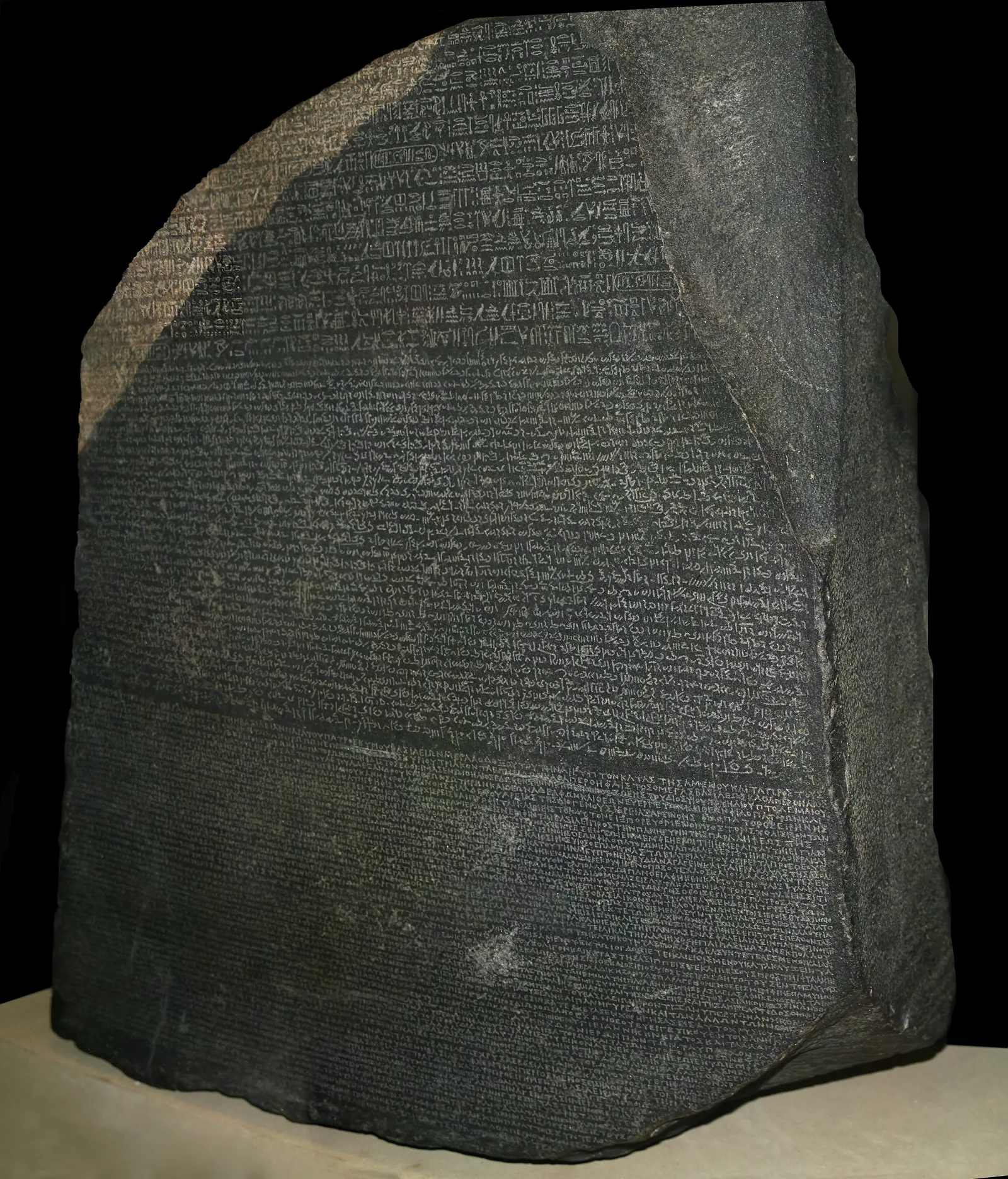
27 September 1822: The Day the Ancient Egyptians Found Their Voice Again — The Rosetta Stone and Its Key
In a hall in Paris, a 31-year-old read out a letter that gave Egypt's ancient walls back the power of speech after a long silence. From Rashid in 1799 to London in 1802 to the Academy in 1822, then on to Ahmed Kamal Pasha and the dictionary that was never printed in his lifetime, and finally to today's question: will the Stone come home? The story of a key that was lost and found again.
September 26, 2026 · 8 min read
Hassan Fathy: The "Architect of the Poor" Who Built an Architecture from Egyptian Mud That Astonished the World
In an age when air conditioning devours the household budget, the life of Hassan Fathy revives an old question: why did we abandon an architecture that cooled our homes without electricity? The story of the "Architect of the Poor," who built an entire village out of Egyptian mud, wrote a book the world translated, and anticipated the green-building wave by decades.
September 4, 2026 · 8 min read

Taha Hussein: The Blind Boy Who Became Dean of Arabic Literature and Made Education a Right "Like Water and Air"
A blind child from a village in Upper Egypt became the "Dean of Arabic Literature" — and when he took over the Ministry of Education, he turned his own maxim, "education is like water and air," into the 1950 decree that made secondary schooling free. It is a journey that tells every reader: knowledge is a right of citizenship, not the privilege of a class. So how did a man who never saw the light bring it about?
August 28, 2026 · 7 min read