The Journey of a Wheat Grain: Four Loaves in Ten Come From Egypt's Soil, the Rest Crosses the Sea
On World Food Day, we trace a single grain of wheat from field and port to the neighborhood oven: how much does the Egyptian farmer produce, what does the state pay him per ardeb, and why has Egypt become one of the world's largest wheat importers — often the largest — despite harvesting ten million tonnes? And what does a "reserve nearing nine months" actually mean? Official figures, and the story of a journey.
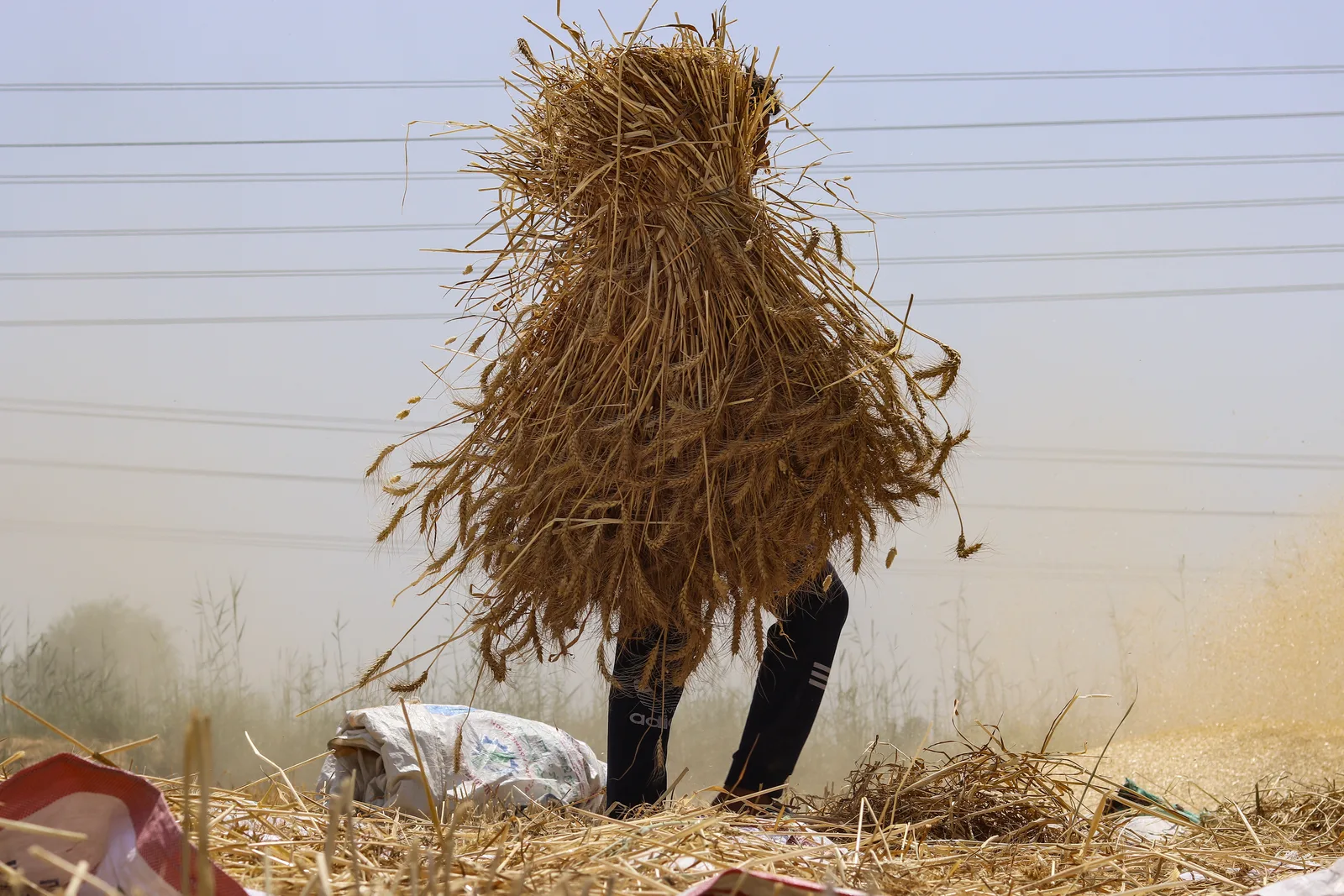
At seven in the morning, before the door opens onto the day's rush, the loaf is set on the kitchen table beside a cup of tea, and the youngest member of the household reaches for it, breaks it in half, and dips one half into a plate of cheese. The same scene plays out, unchanged, in Shubra, in Sohag, in Kafr El-Sheikh, and no one gives it a second thought. Yet it is the end of a long journey: nearly four loaves in every ten begin their story on Egyptian land at the edge of an irrigation canal, while the rest begin in the hold of a ship crossing the sea.
Every year on October 16, World Food Day comes around — the date on which the United Nations Food and Agriculture Organization (FAO) was founded in 1945, an occasion the organization says more than 150 countries mark. This year's theme, as published on the organization's website at the time of writing, is "Innovate Today, Feed Tomorrow" — a call to combine modern solutions with inherited knowledge. The occasion is an opportunity to trace a single grain of wheat, step by step.
The story begins with a simple sum. In its country brief on Egypt issued on June 30, 2026, the FAO forecasts that Egyptian wheat production this year will reach about ten million tonnes — roughly 7% above average — and that Egypt's wheat import needs for the 2026/2027 marketing year will reach about 13.5 million tonnes. The Ministry of Supply, for its part, has set a target of cutting imports to 12.5 million tonnes during 2026, down from 13.2 million tonnes in 2025. The two figures are not contradictory: the first is an estimate for a marketing year, the second a stated target for a calendar year. Adding up the FAO's two figures makes clear the ratio we opened with: of every ten tonnes of wheat entering the Egyptian market, about four are domestic production, and the rest cross the sea.
Egypt's share of the grain typically begins in November, once the weather cools and the land is sown after the summer crop. Through the winter, the farmer walks the field tending irrigation and fertilization while watching the sky, since an early heatwave in March can shave weight off the wheat ear. Then April arrives with the sound of the harvester and the dust of threshing, and the piles of grain become sacks loaded onto a small pickup heading to the nearest shona — a traditional open-air grain store — or silo, where the scale awaits.
At the shona's gate begins the moment the farmer has waited for all season: the weighing and the purity grading. The domestic wheat procurement season officially opened from April 15 to August 15, 2026, with the Ministry of Supply setting the procurement price at 2,500 Egyptian pounds per ardeb — a unit weighing 150 kilograms — at a purity grade of 23.5, 2,450 pounds at grade 23, and 2,400 pounds at grade 22.5. The FAO's brief notes that these prices came in more than 30% above world prices, and that announcing them before the planting season, alongside the distribution of certified seed and subsidized fertilizer, is what pushed farmers to expand the area sown. A commitment was also announced to pay suppliers their dues within 48 hours of delivery — a small detail in official statements, but a large one in the arithmetic of a household living season to season.
That produced a figure that is, to our knowledge, the highest on record: 4.72 million tonnes of domestic wheat were procured in the 2026 season, a rise of nearly 20% over about four million tonnes in 2025. The Ministry of Supply says the figure excludes durum wheat and seed wheat, and that the total after adding them exceeded five million tonnes. The FAO, for its part, attributes the rise in the harvest mainly to the expansion in area sown rather than to a leap in yield per feddan — the Egyptian land unit, equal to about 0.42 hectares.
A guaranteed price set before planting is not merely a financial figure; it is a message to the farmer that his land will not lose out to a competing crop. Every autumn he weighs wheat against clover and vegetables on the basis of return and the cost of seed and fertilizer. When procurement prices move early and clearly, the area sown moves with them the following season; when they are delayed or unclear, part of the land quietly shifts away from wheat, and the domestic share of the loaf shrinks just as quietly.
After the scale comes another battle, called storage. The traditional shona is open-air storage, offering no protection from birds, rodents, weather swings, or insects — hence the shift toward silos. In November 2025, the Prime Minister announced that the state aims to build about fifty new silos across seventeen governorates, adding storage capacity of nearly 1.5 million tonnes, which would raise total wheat and grain storage capacity, once complete, to more than six million tonnes. Every tonne saved from spoilage inside a silo is a tonne Egypt does not need to buy with dollars.
The other half of the journey — the larger half — begins far from the Egyptian field. Ships loaded with wheat arrive at ports, chiefly Alexandria, El-Dekheila, and Damietta, along with Safaga on the Red Sea, which supplies subsidized wheat to Upper Egypt. The cargo is then unloaded into coastal silos and from there to the mills. The FAO says Egypt sources its wheat mainly from the Black Sea region, and the stated reason in its brief is straightforward: competitive prices there. That is why any disruption in shipping or in freight rates shows its effect — after months, not days — on Egypt's import bill.
This is where a phrase that recurs in official statements — a strategic reserve sufficient for months — becomes clear. In June 2026, the Minister of Supply stated that Egypt's strategic wheat reserve exceeds eight months and is approaching nine months of need. The reserve here is not a static quantity sitting in a warehouse, but a span of time bought for negotiation: it gives the state the ability to wait until the world price falls, instead of being forced to buy at its peak. It is, by nature, a moving figure — it rises after the harvest season and falls the further one gets from it.
The question remains: why has Egypt become one of the world's largest wheat importers, and often the largest? The top spot alternates with Indonesia from year to year; the US Department of Agriculture forecast that each would import about thirteen million tonnes in the 2025/2026 marketing year, which is why Egypt is usually described as "often the world's largest wheat importer." The answer lies not in any shortcoming of the farmer, but in the equation itself: a large population, a diet built around bread in most meals, and land confined to a narrow strip around the Nile and its Delta, contested every winter by many competing crops. We explained in an earlier article how the subsidized baladi bread system works — a story that begins after the grain reaches the mill; what concerns us here is the road before that.
The attempt to reverse this equation is declared, with clear targets. The Ministry of Agriculture announced that the area sown in the 2026 season expanded by 600,000 feddans to reach about 3.7 million feddans for the first time, and the Minister of Agriculture said in June 2026 that the state had added more than 3.5 million feddans to the cultivated area through desert reclamation. The ten-million-tonne target has already been reached by the harvest, according to the FAO's estimate for the 2026 season, and the test now is sustaining it, not reaching it. A more distant, still unmet target remains declared: self-sufficiency in the wheat used for subsidized baladi bread by 2028 — wheat whose need is estimated at about 8.6 million tonnes in the 2026/2027 budget. The verdict will be delivered by the procurement figures for the 2027 and 2028 seasons, and by whether yield per feddan rises, not area alone.
This is where this year's theme — "Innovate Today, Feed Tomorrow" — turns into something tangible rather than a slogan hung on a wall: a seed variety that withstands a March heatwave, a silo that prevents a thousand tonnes from spoiling, a payment deadline of no more than 48 hours that persuades a farmer to plant wheat again next season instead of something else. Small details that, if sustained together, would move the ratio we began with — four in every ten — up to five, then six.
Return now to the kitchen table at seven in the morning. The loaf in the child's hand has traveled a road that began either in a field in Kafr El-Sheikh, sown in November, harvested in April, and procured at 2,500 pounds per ardeb, or in the hold of a ship that sailed from the Black Sea region because its price was the best on the day the deal was struck. You are not asked to memorize the numbers, but when you hear news of an ardeb procurement price, a new silo, or a disruption in maritime shipping, know that it is not a distant story: it is news about the loaf that will be set on your table months from now.
Related Stories
Cairo's air is a national cause: from the 'Black Cloud' to the electric bus, the battle for every breath
Every autumn the 'Black Cloud' returns to choke Greater Cairo, but what actually kills is what we cannot see: particles finer than a hair that slip into the lungs and the bloodstream. On the eve of World Car-Free Day, we open the file on one of the gravest environmental health problems facing Greater Cairo: what the numbers say, what is being done, and what you can do in your own day.
September 21, 2026 · 7 min read

The Sea Creeps Up on the Delta: How Egypt Is Defending Its Most Fertile Land With Barriers of Sand and Reed
Along the coastal road at Burullus, sand dunes held in place by reed fences stand guard; behind them, a farmer tastes the water from his well and finds it salty. A silent crisis threatens a quarter of Egypt's population: a rising sea and a sinking land. This article lays out the danger in documented figures, examines a $105 million project that has built 69 kilometres of soft barriers, and asks what role the citizen has in protecting the shore.
September 13, 2026 · 8 min read
Egypt's New Criminal Procedure Code 174/2025 Takes Effect: What Has Actually Changed for Citizens?
After roughly seventy-six years, Egypt's old Criminal Procedure Code has been retired, and Law No. 174 of 2025 took effect with the start of the new judicial year. A measured look at what has actually changed: alternatives to pretrial detention, expanded from three to seven; detention periods and their ceilings; the presence of a lawyer; notification by modern means; and new safeguards for victims and witnesses.
October 18, 2026 · 8 min read