The Sea Creeps Up on the Delta: How Egypt Is Defending Its Most Fertile Land With Barriers of Sand and Reed
Along the coastal road at Burullus, sand dunes held in place by reed fences stand guard; behind them, a farmer tastes the water from his well and finds it salty. A silent crisis threatens a quarter of Egypt's population: a rising sea and a sinking land. This article lays out the danger in documented figures, examines a $105 million project that has built 69 kilometres of soft barriers, and asks what role the citizen has in protecting the shore.
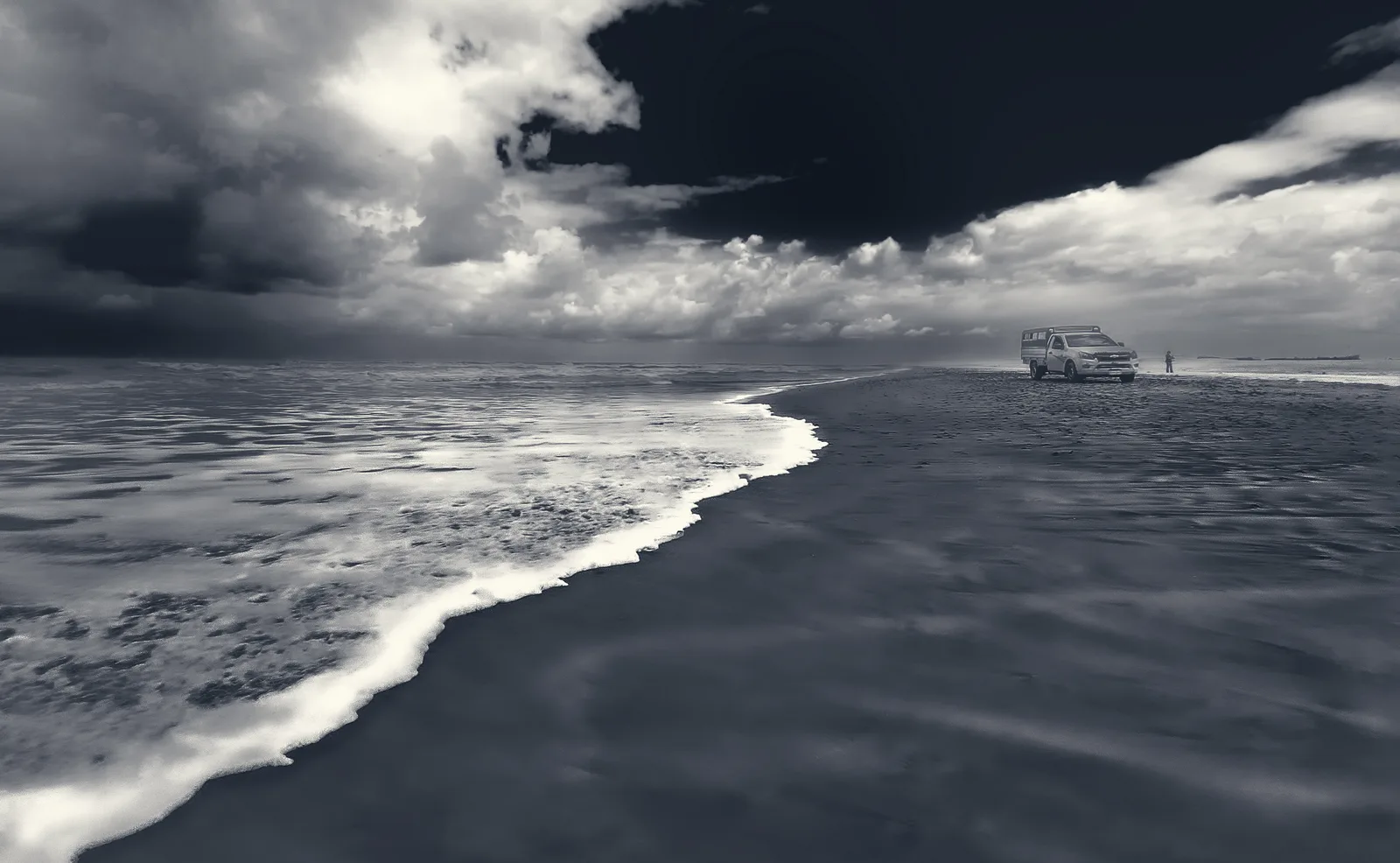
On the coastal road that runs alongside Lake Burullus in Kafr El-Sheikh, a line of sand dunes stands in the early morning, looking nothing like the dunes of the desert. Their sand is held in place by low fences of woven reed, and between one fence and the next grow coarse coastal plants whose roots cling to the sand as if gripping the land by its edges. A few kilometres behind these dunes, a farmer walks down to his field before the heat sets in, cups a handful of water from his well and tastes it, then spits it out and shakes his head. The water his father once used to irrigate rice has turned salty, and land that used to yield two crops now struggles to give one.
This is a crisis that makes no noise and never leads the evening news, because it unfolds too slowly for the eye to catch in a day or a season. The shoreline retreats by centimetres, seawater seeps beneath the fields drop by drop, and a sweet well turns brackish over the course of years. Yet it is among the gravest issues the country faces, because the land the sea is creeping over is the Nile Delta: the most fertile ground Egypt has, and the most densely settled.
According to United Nations Development Programme (UNDP) data, roughly 25 per cent of Egypt's population lives in the Delta, one Egyptian in four, on low-lying, densely populated land that holds the country's most fertile farmland. This is where the rice, cotton, wheat and table vegetables come from, along with a large share of the catch from the northern lakes. If flooding or salinity strikes this land, the impact will not stop at Kafr El-Sheikh and Damietta; it will reach the dinner table of every household in Egypt.
The science is simple to explain and hard to confront. The Mediterranean is rising, the ground the Delta stands on is sinking, and the two forces work in the same direction. The documents of the project discussed below record that sea level off the Delta coast is rising at between 3.2 and 6.6 millimetres a year, and that land subsidence ranges from about 0.4 millimetres a year at Alexandria in the west to nearly three millimetres at Port Said in the east; the site descriptions in the same document go further, putting subsidence in the Port Said area at three to five millimetres a year. A few millimetres sound trivial, but they accumulate over decades, and on a flat shore they translate into metres of retreat.
Some care with words is needed here. No one can say with certainty that a particular city "will drown" on a particular date, and anyone who does is selling fear, not knowledge. What the Green Climate Fund document offers is a conditional scenario: if sea level rises by one metre, roughly 20 per cent of the Delta's land area is expected to be under water by the end of the twenty-first century. It is a possibility hanging on a condition, and its value lies not in any certainty that it will happen, but in the way it sets the scale of what must be prepared for, starting today.
Inundation, however, is not the only danger, nor even the nearest. The nearest is what the farmer confronts each morning when he tastes his well: saltwater intrusion. As the sea rises, it pushes its salt water into the aquifers and spoils the fresh water, and salts build up in the soil until the roots can no longer drink. The project documents warn that sea level rise will have a direct and decisive effect on infrastructure and development in the low-lying coastal lands, that the salinisation of land and water will hit agriculture, fisheries and freshwater sources, and that the damage from coastal flooding, should it occur, would extend to the whole economy; because what stands to be lost here is not a holiday beach but prime agricultural land.
Against this silent threat came a practical response that was no less quiet. On 2 October 2017, the board of the Green Climate Fund approved project FP053, titled "Enhancing Climate Change Adaptation in the North Coast and Nile Delta Regions in Egypt". Total financing is about $105 million, of which $31.384 million is a grant from the Fund and about $73.807 million is co-financing. The project runs for seven years, is implemented by the Ministry of Water Resources and Irrigation with UNDP support, and, after an extension, is expected to be completed at the end of November 2026, according to the Fund's project page.
The heart of the project is those dunes we began with on the Burullus road. Instead of massive concrete walls, the project has built 69 kilometres of soft sand barriers, designed to resemble the natural dunes that protected the coast before they eroded away. They are built from sand, reusing the material dredged from navigation channels rather than dumping it at sea, then fixed in place with reed fences that trap wind-blown sand and with native plants whose roots spread through the dune and hold it, with rock in some spots. According to the approved funding proposal, they are spread over five highly exposed sites: west of the Burullus boughaz, the inlet linking the lake to the sea, in Kafr El-Sheikh (27 kilometres); west of the new Ashtoum El-Gamil inlet in Port Said (12 kilometres); east of New Damietta city (12 kilometres); west of New Gamasa city in Dakahlia (12 kilometres); and west of the Rosetta mouth of the Nile in Beheira (6 kilometres). The Burullus dunes where we started are the longest of the five.
Why sand and reed rather than concrete? Because a hard wall repels a wave, which then returns with its full force somewhere else, and it often simply shifts the erosion to the neighbouring stretch of shore; these are the negative outcomes the project document attributes to conventional hard protection. A sand dune, by contrast, absorbs the energy of the waves and rebuilds itself with the wind if its plants and reed fences are left in place, and it usually costs less than a stone wall running for tens of kilometres. A soft barrier, if it works, is not merely a dam; it is a shore recovering.
The project documents put the number of direct beneficiaries at about 768,000 people and indirect beneficiaries at about 16.9 million, close to 17.7 million Egyptians whose resilience is expected to improve. A story published by the United Nations office in Egypt in June 2021 describes accompanying works, among them an agricultural drainage network north of the coastal road serving roughly a thousand feddans (the Egyptian land unit, slightly over an acre) and at least five hundred families, and a drainage scheme in the village of El-Aqoula that protects roads from rainwater; at that time, it noted, about ten per cent of the barriers had been completed. According to the most recent UNDP update, in August 2026, the 69 kilometres across the five sites were completed by 2025, a further six kilometres were added in Beheira and Kafr El-Sheikh to bring the total to 75 kilometres, and the government has committed to maintaining them for forty years. The Fund's page, as of this writing, still lists the project as under implementation.
But the project does not stop at sand. Its second strand is the drafting of an integrated coastal zone management plan for the entire North Coast, training staff in the coastal governorates to apply it, and setting up local coastal committees to carry it out over the long term. According to UNDP, the governing framework for this plan was referred to the Cabinet for ratification in February 2026, and coastal management committees have been formed in eight governorates on the Mediterranean. The shore is not the responsibility of any single body; it is a space contested by irrigation, agriculture, fisheries, tourism and housing, and without a plan that brings them to one table the sand will start eroding again the moment the grant runs out.
And here comes the part played by someone the documents never name: the citizen who lives on this coast or heads there in summer. A sand dune is a fragile thing. A four-wheel drive crossing it snaps the roots of its plants; a lorry hauling away its sand "for building" opens a breach the sea will pour through; a kiosk or a holiday chalet built on top of it cancels out its whole purpose. Stripping sand from the beaches and building illegally on the dunes are not merely harmful habits but outright breaches of the law. Environment Law No. 4 of 1994, as amended, prohibits in Article 73 the erection of any structures within two hundred metres of the shoreline, and in Article 74 any work that interferes with the natural course of the shore, except with the approval of the competent authority in coordination with the Egyptian Environmental Affairs Agency; offenders face imprisonment of up to six months and a fine of up to fifty thousand Egyptian pounds, or one of the two. Water Resources and Irrigation Law No. 147 of 2021 permits no removal of sand from dunes within the restricted shoreline zone without a licence from the Ministry, and empowers the responsible engineer to halt offending works and remove them immediately by administrative order at the offender's expense. When we see a broken reed in the fence, or someone cutting the plants to feed a fire, reporting it to the Environmental Affairs Agency or the Egyptian General Authority for Shore Protection is not informing on a neighbour; it is protecting the land.
Then there is a quieter, deeper kind of support: understanding the integrated management plan when it reaches our village or town, rather than rejecting it because it bars building near the water. The ban here is not a deprivation; it is insurance for the fields and homes behind the shore. A coast left to its dunes and its plants protects us, and a coast we gnaw away at year after year will give ground to the sea no matter how much is spent on it.
We return to the farmer on the outskirts of Burullus, wiping the salty well water from his palm. The sand barrier will not bring the sweetness back to his water tomorrow, nor in a year, because salt that has entered the land leaves it far more slowly than it came in. But every metre of dune that holds its ground, every reed fence that keeps its sand, every coastal plant left to grow, means that his son may one day taste the well water and not spit it out. The sea creeps forward by the millimetre, and the defence against it is built by the millimetre too: with sand, with reed, and with hands that do not tamper with what was planted to protect them.
Related Stories
Adult Literacy in Egypt: The Scale of the Challenge and the Classes Changing Lives
Recent censuses have put illiteracy at roughly a quarter of Egyptians aged ten and over — millions of adults who never learned to read. From the General Authority for Literacy and Adult Education to NGO classrooms and volunteering university students, a look at the programmes teaching them, and what actually works.
August 18, 2026 · 6 min read

Before the Katb el-Kitab: The Medical Certificate the Law Demands, What It Reveals, and Why It Cannot Stop a Marriage
A compulsory medical test before Egypt's marriage-contract registration, the katb el-kitab, ends in a certificate with a QR code that the ma'zoun or church authority requires. What does it detect, what does it cost, where is it done, and why does it matter so much in Egypt? Above all: why can its result never prevent a marriage? A calm guide for every engaged couple worried about "what if they find something in me?"
September 12, 2026 · 9 min read

Know Your Rights: Withholding Your Inheritance Is a Crime. What Article 49 Says, and How to Recover Your Share
Since the end of 2017, refusing to hand over an inheritance is no longer a family quarrel buried in silence but a misdemeanour punishable by imprisonment and a fine, a provision that has survived two constitutional challenges. We explain who the law reaches, civil suit versus criminal complaint, why a final division of the estate is not required, and the door to settlement that stays open even after a verdict.
September 11, 2026 · 8 min read