‘The Flu Shot Is What Gives You Flu’ — What’s Actually Inside the Seasonal Vaccine?
With the first chill of autumn and the return to school, the same line comes back: ‘I got the shot and fell ill with flu a week later.’ We examine this one claim: does the seasonal flu vaccine spread the disease? Verdict: false. The reason lies in how the vaccine itself is made, in the two weeks the body needs to build immunity, and in other winter viruses wrongly blamed for it.
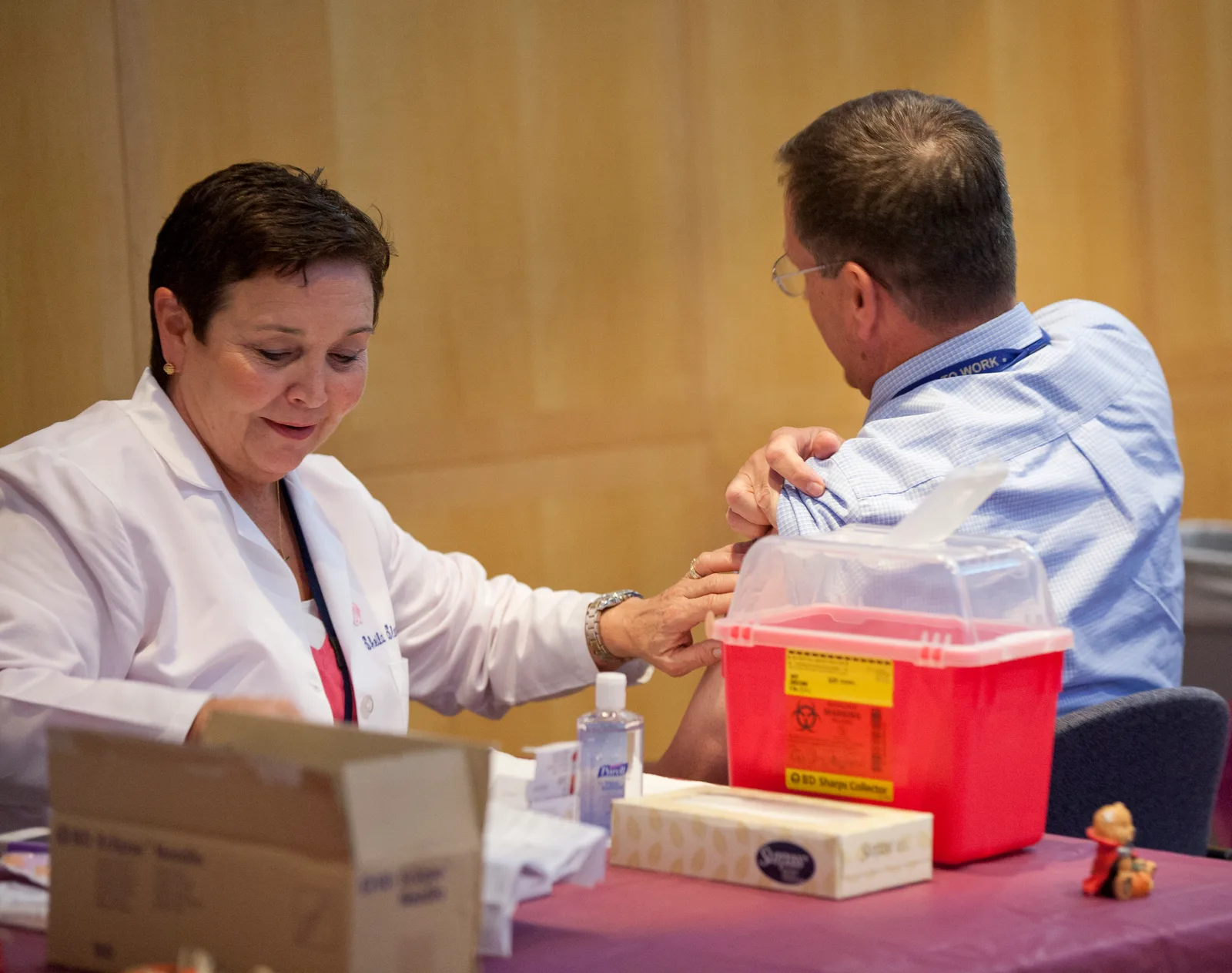
On the first cold morning of this autumn, a short queue forms outside the health office window: a mother holding the hand of her son, freshly back at school after the long break; a neighbour in his sixties asking about the appointment and the paperwork he needs; and, somewhere between them, someone who has already made up his mind not to take anything at all. In almost every queue like this, one line comes up in slightly different words: ‘I got the shot last year and came down with flu a week later — I’m not taking it again.’ The same sentence resurfaces every year, in living rooms, on social media, on bus seats, until for many people it has become an assumption that needs no proof: the vaccine is what gives you the flu.
The claim we are examining today is one specific claim, with no hedging: that the seasonal flu shot passes the disease on to whoever takes it. We put the verdict at the top of the piece, not the bottom: this claim is false. By its very composition, the injected vaccine cannot give anyone the flu. What people actually experience in the days after vaccination has well-documented explanations, which we go through one by one below — and all of them have far more to do with coincidence and bad timing than with the shot that gets blamed.
Start with the simplest question: what is actually in the injection? The US Centers for Disease Control and Prevention (CDC), on the page it dedicates to correcting flu-vaccine misconceptions, says that shots given by needle are made either from inactivated — that is, killed — viruses, or from a single protein taken from the virus. Either way, the injected fluid contains nothing capable of reproducing inside the body. The immune system sees a ‘picture’ of the enemy and trains on it, without ever meeting a living pathogen.
The World Health Organization places the same claim among what it calls ‘five myths about the flu vaccine’: the myth that the vaccine can give you the disease. WHO’s answer is that the injected vaccine contains an inactivated virus that cannot give you flu, and that the body aches or mild fever some people feel afterward are a normal immune response, which usually clears up within a day or two.
This is exactly where the distinction matters. A mild immune reaction is one thing; a real infection is another. The first is generally light, localised and short-lived: a sore arm when pressed, some fatigue, perhaps a slight fever, gone within a day or two. A genuine bout of flu, by contrast, is usually described as a sudden attack: fever, aches through the whole body, and exhaustion that can keep someone down for days — though the fever may be absent in some patients, particularly the elderly. This is a general description, not a substitute for a doctor; diagnosis is ultimately their job, not an article’s and not the queue’s.
The most important explanation — the one that accounts for most of the stories we hear — is timing. The CDC explains that the body needs about two weeks after vaccination to build the antibodies that protect it. Anyone exposed to the virus a few days before the shot, or during those two weeks before immunity is complete, can genuinely fall ill with no connection whatsoever to the vaccine. The shot did not bring on the illness; it simply arrived a little later than it needed to.
The second explanation is that winter is not caused by a single virus. The CDC itself notes that a person can fall ill with another respiratory virus that isn’t flu — rhinoviruses, say, or the coronavirus behind COVID-19 — with symptoms that look similar and circulate in the same season, while the flu vaccine protects against flu alone. A cold a week after vaccination is not proof that the shot failed. We have previously covered two related questions on this platform — the claim that antibiotics treat the common cold, and the role of vitamin C in preventing it — and readers wanting more detail can go back to those pieces.
And even where it does apply, protection is not an absolute promise. WHO points out that several flu viruses circulate at the same time, and the vaccine targets specific strains chosen for that season — so a vaccinated person falling ill does not mean the vaccine ‘doesn’t work’; it improves someone’s odds against the disease without eliminating the possibility of infection. Anyone selling you total protection is overselling it, and anyone telling you the vaccine is useless because it isn’t perfect is overselling the opposite case.
One exception should not be glossed over, so that simplification doesn’t turn into distortion: there is a version of the vaccine given as a nasal spray rather than an injection, and it does contain live viruses — but weakened ones. The CDC’s page on this vaccine explains that the viruses in it are ‘cold-adapted’, meaning engineered to reproduce only at the cooler temperature inside the nose rather than in the lungs, which is why they do not cause illness. According to the CDC, it is approved for people aged two to forty-nine, is not given during pregnancy or to people with weakened immunity, among a broader list of contraindications the same page sets out in detail. As of this writing, we found no official announcement that the nasal-spray vaccine is available at Egyptian outlets; asking your local health office is the only way to know which type is actually on offer to you.
And what about the serious side effects people fear? WHO describes them as extremely rare, and cites a specific figure: one in a million people may develop Guillain-Barré syndrome. Against that, the organisation sets a figure that puts this rarity in perspective: flu-related respiratory deaths worldwide are estimated at up to 650,000 a year, and WHO notes that this figure covers respiratory deaths alone, meaning the true toll is likely higher; possible complications it lists include pneumonia and inflammation of the heart or brain. The comparison here is not between a risk and absolute safety, but between two probabilities of very different scale.
Pregnant women deserve a line of their own, since this rumour affects them more than most. WHO states that the inactivated vaccine is safe at any stage of pregnancy, and that pregnant women are among the priority groups who should receive it, because their immunity tends to be weaker than usual. The nasal-spray vaccine, as noted, is not given during pregnancy. In every case, the decision should be made with the doctor managing the pregnancy — not on a relative’s advice or a passing post.
In Egypt, the press reported on 27 August that the Ministry of Health and Population said flu is not just a ‘cold’ and can lead to complications, that the vaccine is a safe and effective preventive measure even though it doesn’t offer 100 percent protection, that priority groups are the elderly, children, people with chronic illness and those with weakened immunity, that it is best taken before the season peaks and school returns, and that inquiries can be made through the 105 hotline. We are not citing prices or available quantities here, since these change quickly and could well be out of date by the time you read this.
As for the person telling that same story every year, they are not lying when they say they fell ill after the shot; what happened to them genuinely happened. But the order in which two events occur in time is not proof that one caused the other. The answer to them is not an accusation or condescension, but an explanation of what is in the injection, of the time the body needs, and of the number of viruses that share the winter with us. Anyone hesitant has every right to ask, and anyone who asks deserves an answer, not a scolding.
As of this writing, this is what the recognised health authorities are saying. But the decision in your own case — yours, your children’s, your mother’s who takes three medications a day — belongs at your local health office or your treating doctor’s clinic, not in this article or the family group chat; this piece explains a widely circulated claim and is not a substitute for medical advice. And when you get home, remember that the vaccine is just one layer of protection: after it, there is still washing your hands, covering a sneeze, and staying home for a day when the fever runs high — out of consideration for whoever sits next to you on the bus tomorrow morning.
Related Stories
“A Cold Shot Cures a Cold”: A False Claim, and What Trials Say About the “Power” of the Vein
“Forget the pills, take a shot and you'll be back on your feet” is advice that returns with the first chill of every year. We test two claims: that a “cold shot” cures a cold, and that an injection is inherently stronger than tablets. Verdict: false. The evidence lies in the mixture itself, in randomized trials comparing vein with mouth, and in an official Egyptian guide. The route of a medicine is the doctor's decision alone.
November 22, 2026 · 9 min read

“The nawwat have fixed dates the calendar knows in advance”: misleading. The season is real; the date is not science
Every November the same table returns to our phones: al-Miknasa on 16 November, Qasim on 4 December, as if rain kept an appointment in the calendar. Egypt’s meteorological authority says there is no fixed scientific start date for the nawwat and the names are popular, not official. The table’s attribution also shifts between two bodies, and we could not find it on either site. We debunk the claim, honour the heritage and show how to check.
November 16, 2026 · 8 min read

“Parcel on hold: update your details via the link”: a text that doesn’t update your account but opens it to others
A text says your parcel is stuck or your details need updating; one link will fix it. The claim: a message asking you to update your details through a link is an official message from the post office or bank. Verdict: false. Egypt Post denies asking for confidential data or updates through unofficial links; the Central Bank warns against links and sharing codes. How to read the message, and what to do at once if you entered your details.
November 11, 2026 · 8 min read