Beneath the Blue Ceiling: How the United Nations Works, and Who Holds the Veto at the Security Council
Every time a crisis flares, you hear that the Security Council has met and that some state has raised its veto. But what actually happens beneath the blue ceiling? A journey from the General Assembly hall to the horseshoe table: how a UN resolution is born, when it binds, how a single word kills it, and where Egypt sits in the picture.
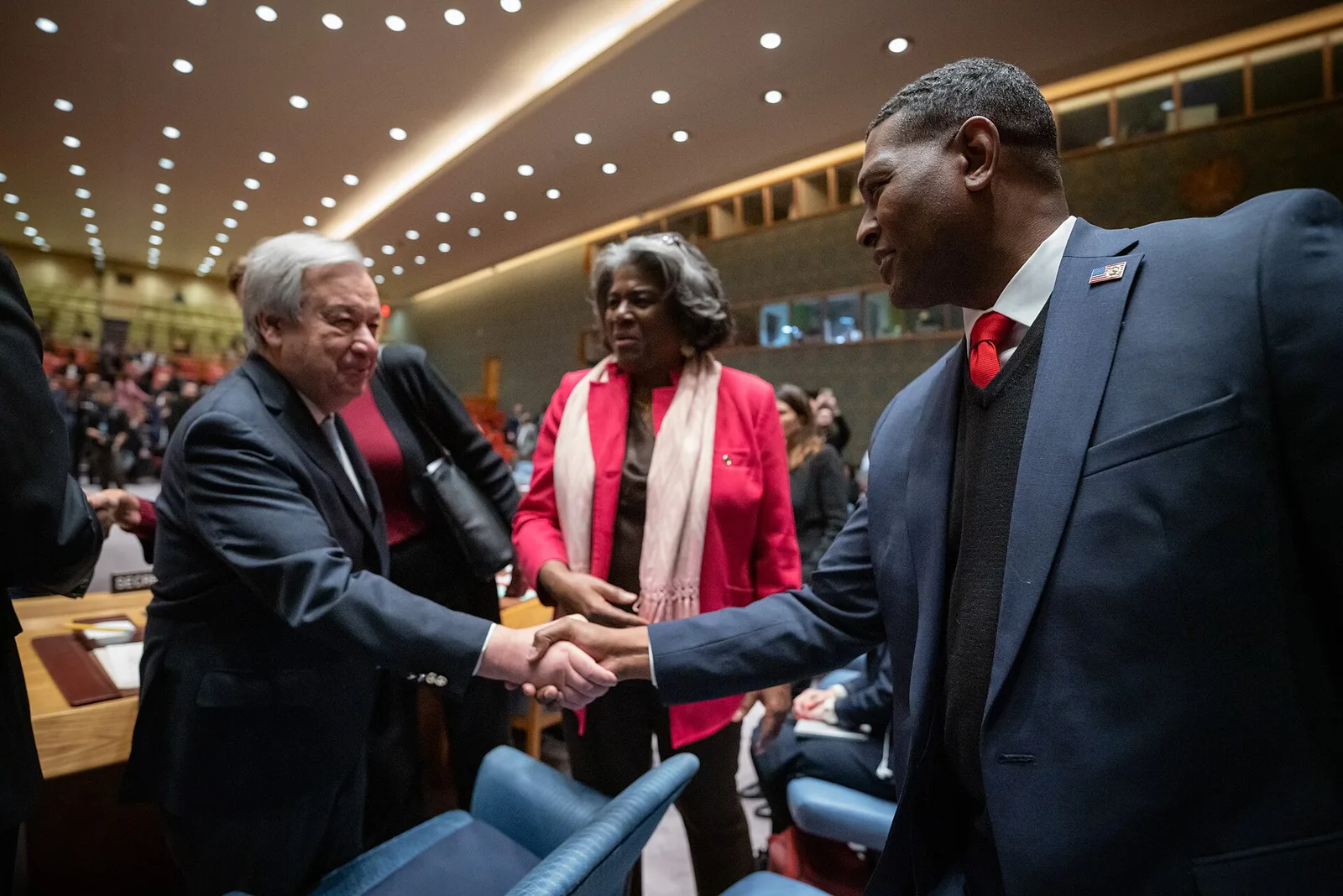
Turn on any evening news bulletin on the night of a major crisis and you will hear the same sentence we have all learned by heart through sheer repetition: "The Security Council is holding an emergency session." A few hours later comes the second familiar line: "A veto has killed the draft resolution." But ask yourself honestly: do you know what really happens inside that chamber with its famous horseshoe-shaped table? And who has the power to say a single "no" that stops the will of the entire world in its tracks? In the lines that follow we go up together into the glass building overlooking the East River in New York and take the machinery apart piece by piece, so that from today you read the news out of the United Nations with a different eye.
The story begins in the rubble of the Second World War. On 26 June 1945, after weeks of deliberation in the city of San Francisco, the delegates of dozens of states signed a document called the Charter of the United Nations, and Egypt was among them, a founding member whose signature appears on the original copy. The Charter entered into force on 24 October 1945, the date the world marks every year as United Nations Day. The organization began with fifty-one founding states; today its blue flag shelters 193, which is to say very nearly every recognized country on earth. The founding idea was at once simple and immensely heavy: never again to let humanity slide into a third world war.
When you hear "the United Nations," you are not hearing the name of a single body but of an entire family of them. There is the General Assembly, where every state has a seat; the Security Council, responsible for war and peace; the International Court of Justice in The Hague, which settles disputes between states; the Economic and Social Council; and the Secretariat, headed by the Secretary-General, with staff spread across the globe. A sixth organ, the Trusteeship Council, effectively completed its historic mission once the territories placed under trusteeship became independent. But the spotlight, and with it the real power, falls on two bodies: the General Assembly and the Security Council. The difference between them is the difference between a pulpit and a courtroom.
The General Assembly is as close as the world comes to a global parliament: one vote for every state, whether it is a superpower with a nuclear arsenal or a small island in the middle of an ocean. Every September you see the familiar scene: presidents and monarchs taking their turn at the green marble rostrum in New York, each with a message for the world. But note a crucial point that many people miss: on political questions, General Assembly resolutions are recommendations. They carry great moral and political weight, yet they do not legally bind states, apart from the organization's internal affairs such as the budget. The Assembly's voice is a mirror of the world's conscience; the hand that holds the instruments of compulsion sits in another room.
That hand is the Security Council: fifteen seats, and from them the most dangerous files on the planet are managed. Five permanent members never leave: the United States, Russia, China, Britain and France, the powers that emerged victorious from the Second World War. Ten elected members are distributed by the General Assembly across the world's regions; each sits for two years, then leaves, and may not stand for immediate re-election. The Council began in 1945 with eleven members and was enlarged in 1965 to fifteen, raising the elected seats from six to ten, after the organization's membership had doubled with the wave of independence across Asia and Africa. Even the presidency rotates: the fifteen states take it in turn, month by month, in the English alphabetical order of their names.
Now to the heart of the machine: the vote. Any decision on a substantive matter requires nine votes out of fifteen, subject to one lethal condition: that no permanent member votes against. That condition is the veto, a Latin word meaning, literally, "I forbid." Picture a draft resolution that has won fourteen votes out of fifteen; a single permanent member raising its hand against it is enough to sink the text as though it had never existed. An abstention by a permanent member, under long-settled practice, does not block a decision, and purely procedural matters such as setting the agenda are not subject to the veto at all.
And why did the world accept so glaring a privilege in the first place? The answer lies in a painful lesson called the League of Nations, the earlier experiment that collapsed between the two world wars because the great powers abandoned it, or never joined it at all. The founders of 1945 understood that the big powers would not walk into a house whose keys they did not hold, and so the veto became the price of their seat at the table: a safety valve meant to keep them inside the system, which has repeatedly turned into the lock that freezes it. The veto was used in the Council's very first years, and became a weapon traded back and forth throughout the Cold War. And the permanent seat belongs to the state, not to the government of the day: the Soviet Union's seat passed to Russia after the union broke apart in 1991, and China's seat passed in 1971 to the People's Republic of China.
Here we reach the distinction missing from so many headlines: not everything the Security Council issues carries the same force. Decisions taken under Chapter VI of the Charter, on the pacific settlement of disputes, are closer to recommendation and mediation. Chapter VII is the Council's real sword: once it determines that there is a threat to the peace or an act of aggression, it can impose economic sanctions and arms embargoes, and even authorize the use of military force, and the Charter itself obliges all member states to accept and carry out the Council's decisions. There is a lighter register than any of this, the "presidential statement": a text read out by the Council's president once all fifteen members have agreed on it. It is an important political message, but it is not a numbered resolution entering the record of binding acts. So when you read "presidential statement," understand that the Council wanted to speak without drawing its sword.
Let us follow the journey of a UN resolution step by step. It begins with one state taking charge of the file, known in the Council's corridors as the "penholder," which writes a first draft and circulates it to the members. Then come closed-door consultations in which the wording is trimmed and polished, because a single term, "condemns" instead of "expresses concern," can flip the position of a great power, until the text settles into its final, vote-ready form. In the chamber the hands go up: nine votes or more with no objection from a permanent member means the birth of a numbered resolution that enters the record, while a single objection from a permanent member is a formal death notice for the draft, however many supporters it had. And the veto is no longer free of moral cost: since 2022 the General Assembly convenes automatically to debate every veto cast, so that the state which used it must stand and explain itself before the world; decades earlier, in 1950, the Assembly devised the "Uniting for Peace" mechanism so that it could act whenever the Council is paralysed.
And where does Egypt stand in all this? At the centre of the picture from the very first moment: it signed the Charter in San Francisco in 1945 as a founding member, long years before most of Africa and Asia joined the organization. It has since held a non-permanent seat on the Security Council several times across the organization's history, from its earliest years to its term in 2016 and 2017 as a representative of the African continent. And an elected member is not a mere spectator, as some imagine: it presides over the Council in turn, it takes part in drafting and negotiating texts, and its vote is one of the nine without which no resolution is born. The veto is not in its hand, true, but the pen, the podium and the vote are.
Egyptians also have a story with the organization that rises above the seats themselves: the Egyptian diplomat Boutros Boutros-Ghali served as Secretary-General of the United Nations from 1992 to 1996, the first from Africa and from the Arab world. His story carries a telling lesson at the very core of our subject: the Secretary-General is appointed by the General Assembly on the recommendation of the Security Council, and in 1996 the recommendation for a second term ran into a veto inside the Council, so he left after a single term. That is how far the shadow of the veto reaches, as far as choosing the man who stands at the summit of the organization itself. A single episode like that explains the system better than dozens of pages could.
Because the veto stands at the heart of every debate, the argument over reforming the Security Council has been renewed for decades: demands for permanent seats for Africa, Latin America and rising powers, and calls to regulate or restrict the use of the veto. But here is the paradox that explains the long wait: amending the Charter requires the approval of two-thirds of the General Assembly and then ratification by two-thirds of the member states, and those must include all five permanent members. Put plainly: any reform that touches the veto needs the signatures of the veto holders themselves. And so the door stays open to discussion and closed to change until further notice.
The practical conclusion I want you to leave with is four small questions to ask whenever a piece of UN news crosses your path. Who issued the text: the General Assembly, with its moral weight, or the Security Council, with its teeth? Is it a numbered resolution or merely a consensual presidential statement? If it is a resolution, was it adopted under the binding Chapter VII, or did it stay within the realm of recommendation? And finally: did it pass by consensus, did it fall to a veto, or did it narrowly escape one? Answer those four questions and you will find that you have begun to read what happens beneath the blue ceiling the way diplomats read it: as a text whose weight is calculated to the word, not a passing headline in a crowded bulletin.
Related Stories
A Hole in the Sky, Mended by a Treaty: The Montreal Protocol and Egypt’s Part in Saving the Ozone Layer
On 16 September the world marks the International Day for the Preservation of the Ozone Layer, the anniversary of a treaty ratified by every country on Earth that actually worked. From a 1974 scientific paper to the 1987 Montreal signing, Egypt's 1988 ratification and the 2023 Kigali Amendment: the story of a refrigerant cylinder in a technician's hand, and why scientists expect the sky to heal around 2040.
September 16, 2026 · 7 min read
The Arab League: The House of the Arabs, Whose Windows Look Out on Tahrir Square
A few steps from Tahrir Square stands "the House of the Arabs": one of the oldest regional organisations in the world, born in Cairo before the United Nations Charter itself. How do its summits and its secretariat actually work? Why do its resolutions bind only those who accept them? And what lies behind the departure to Tunis and the return home? A tour inside an old neighbour we walk past every day and barely know.
September 2, 2026 · 7 min read
'That's Wrong': Harassment Isn't 'Flirting' — Two Years or a 100,000-Pound Fine for Words, Five for Coercion
A word thrown on the street that the man who says it calls a 'joke,' and a longer route a mother makes her daughter take because it feels 'safer.' In 'That's Wrong,' we hold the behavior up against Law 141 of 2021, without exaggeration or minimization: two to four years in prison or a 100,000-pound fine for words and gestures, five years or more for sexual coercion. And we ask about the third party — the one who hears and does nothing.
October 10, 2026 · 8 min read