“The Americans never landed on the Moon”: an annual claim, answered by flags and footprints seen from orbit
As World Space Week opens, the short clips swearing that the Apollo landing was filmed in a studio are back. We examine the claim not through the astronauts’ testimony but through what any scientist in the world can check today: photographs from orbit, lunar rocks in laboratories, and the reflectors used every night to measure the distance to the Moon.
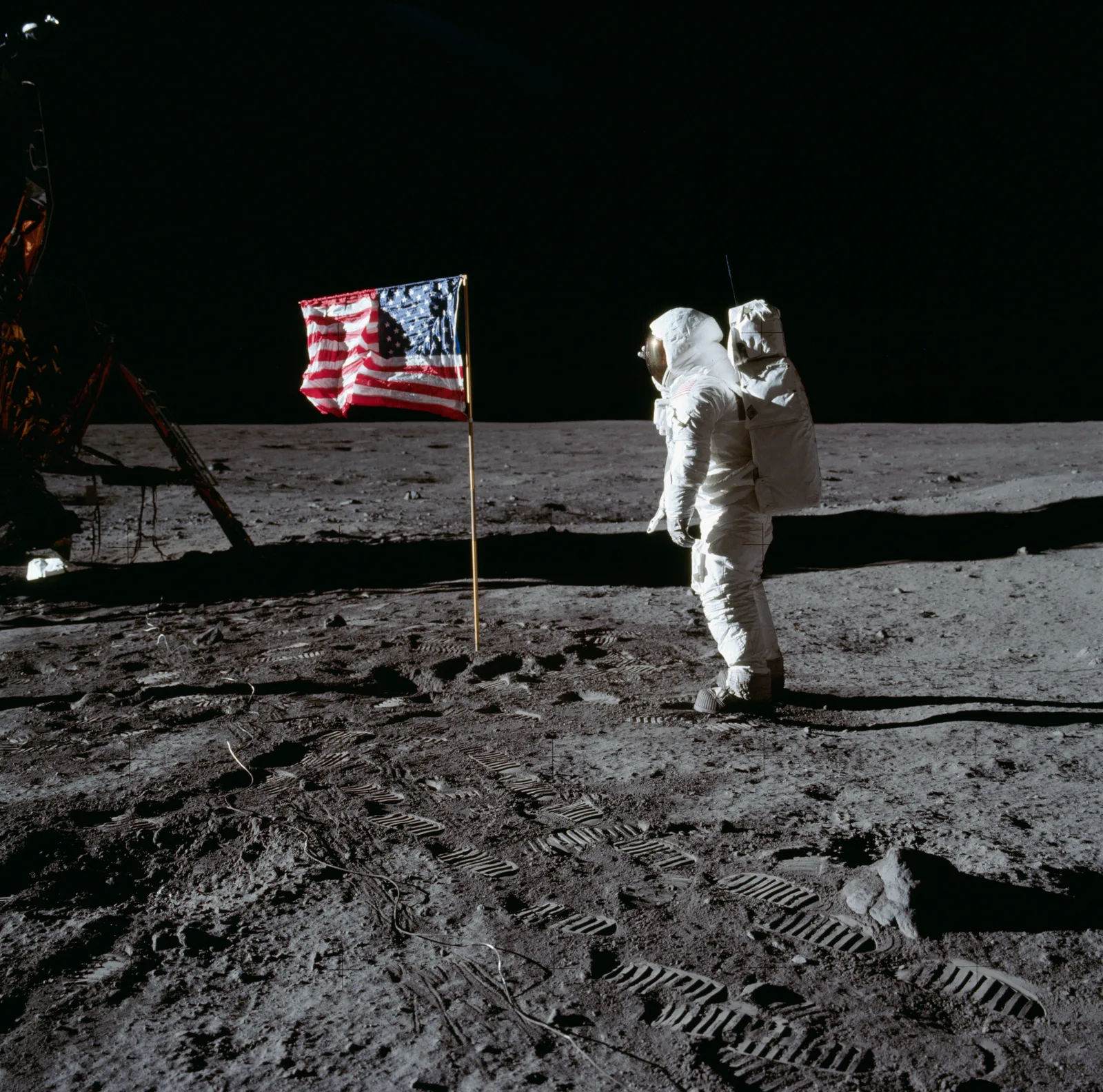
At a café on a side street in Shubra, the crowded old district of northern Cairo, after the evening prayer, a young man holds his phone up to his friends and plays a clip barely a minute long: an American flag moving on the surface of the Moon, and a confident voice-over asking, “How can the flag be flapping when there’s no air?” Everyone laughs, and one of them swears he has “known for ages that the whole thing was filmed in a studio”. Above their heads at that very moment passes the Moon, which to this day carries on its surface small mirrors at which scientists aim laser beams from observatories on different continents, measuring the distance between us and it to a precision approaching a millimetre.
The claim we examine today holds that the Apollo missions that landed on the Moon between 1969 and 1972 never took place at all, and that the scenes the world watched were filmed in a studio on Earth. Our verdict, which we set out at the beginning rather than the end, is that the claim is false. We will not rest that verdict on the testimony of the astronauts, which our earlier piece on the myth that the Great Wall of China can be seen from the Moon relied upon, because anyone who believes the conspiracy theory will not be persuaded by the word of people he regards as part of it. We will rely instead on what can be checked today with instruments that no single agency and no single country owns.
Let us begin with the scene the clip opens its story with: the flag that “flutters”. The Apollo flag was not hung from an ordinary flagpole; it was fixed along its top edge to a horizontal rod that kept it spread out in a place where there is no wind. When the astronauts drove the pole into the soil and twisted it to seat it firmly, the cloth shook, and in a vacuum there is no air to damp that shaking quickly as there is on Earth, so it keeps rippling for a few moments longer than we would expect. In other words, the movement the young man takes as proof that there is air is exactly what happens when there is none. And in the original footage, once the astronauts step away from the pole, the flag falls completely still.
The first piece of evidence requires no one’s word, only a look. Since 2009 NASA’s Lunar Reconnaissance Orbiter has been circling the Moon, and its camera has photographed all six landing sites. The agency says the American flags are still standing and casting shadows at every site except that of Apollo 11, where the astronaut Buzz Aldrin had said as far back as 1969 that the exhaust of the ascent engine knocked the flag down at lift-off; the orbital images matched what the man had said forty years earlier. Better still, the agency published a sequence of images of a single site taken at different hours of the lunar day, and anyone with a browser can watch the flagpole’s shadow swing around it just as the shadow of the lamp post on your street does. No studio produces a shadow that turns with a real sun across a lunar day lasting about two Earth weeks.
The second piece of evidence is finer and clearer. In September 2011 NASA lowered the orbiter from about 50 kilometres to roughly 21 kilometres above the surface and took the sharpest images to date of the Apollo 12, 14 and 17 sites. At the Apollo 17 site the tracks of the lunar rover show up as sharp parallel lines in the soil, and distinct from them are the trails the astronauts’ feet wore between the lander and the scientific instruments, the last human footsteps on the Moon as of this writing. Footprint trails still visible from orbit forty years on, because the Moon has no wind to wipe them away; and that is also why the flags are still standing.
Someone may object: these are NASA’s pictures of NASA’s sites. That would be a fair objection if the Moon belonged to a single country. But probes from other countries, India and Japan among them as far as we know, have orbited the Moon and photographed its surface, and no space agency anywhere in the world, East or West, has produced anything that contradicts the existence of those sites. More important still, other lines of evidence need no probe at all.
The third piece of evidence you can touch with your own hand, or a researcher you know can. The six Apollo landings brought back to Earth 382 kilograms of lunar rock, core samples, soil and dust, in some 2,200 separate samples from six different sites, held today at the Johnson Space Center, from which around four hundred samples are distributed every year to researchers and teachers around the world. For half a century these rocks have been analysed in laboratories in countries with no part in the American–Soviet rivalry, and they were found to contain what cannot be faked: an age greater than that of most rocks on Earth; an almost total absence of water, and of the water-bearing minerals, such as clays, that form on Earth in the presence of water; and the marks of a constant bombardment by particles from the Sun that occurs only on a surface with no atmosphere.
The fourth piece of evidence is the one that passed over the heads of our friends at the café without their noticing. The astronauts of Apollo 11, and then of Apollo 14 and 15, left on the lunar surface panels of corner-cube retroreflectors, mirrors that send any beam that reaches them straight back along the direction it came from. From 1969 to this day, observatories on Earth have aimed laser pulses at those panels and timed the beam’s journey out and back, about two and a half seconds, to calculate the distance between the Earth and the Moon. The Grasse observatory near Nice in France, the Apache Point observatory in the United States, the Matera observatory in Italy and the Wettzell observatory in Germany are all capable of this measurement; some of them still carry it out regularly today, and at Apache Point its precision has reached the millimetre.
Consider what that means: scientists in at least four countries depend on instruments that work only if they are really there, at the announced locations on the Moon. It is from these measurements that we know the Moon is drifting away from us by about four centimetres a year, and that its core is partly molten. If the reflectors did not exist, France, Italy and Germany would have had to collude with the Americans for half a century, and the Soviet Union, which was tracking the Apollo flights with its own equipment at the height of the rivalry, would have had to keep silent about the greatest scandal it could ever have won.
And here we arrive at the question we always like to ask in this section: why does a claim like this spread in spite of all that? The answer, as far as we can tell, lies not in ignorance but in the way short clips are made. A single minute puts a decisive-sounding question to you and leaves you feeling you have discovered what the scientists missed, without giving you time to ask: has the person talking to me examined the original images? Does he know how cloth behaves in a vacuum? Has he looked up the reflectors? The most dangerous thing about these clips is not what they say about the Moon, but what they teach us about how we handle any piece of news.
Nor is Egypt far removed from any of this. We have a national space agency and Egyptian satellites orbiting the Earth, as we described in an earlier piece on Egypt’s place in the space race. The boy who learns today that the Moon is a real place that human beings have reached, and that this is established by measurement rather than by belief, is the one who may be working in an Egyptian control centre twenty years from now. Whoever learns instead that everything is a conspiracy will find no reason to learn anything at all.
And if you own a home telescope, know that all six landing sites lie on the near side of the Moon, and that well-known guides to amateur astronomy, as far as we know, explain how to find the Sea of Tranquillity, where Apollo 11 landed, and the regions around it. You will not see the spacecraft themselves; they are smaller than any lens on Earth can resolve. But you will see the place with your own eyes, and you will know that what we are talking about is not a studio in a desert but a spot in the sky you can point out to your children.
The next evening the same young man may sit at the same café and hold up his phone once again. We only hope that this time the clip is about the shadow of a flagpole turning with the Sun on the surface of the Moon, or about a laser beam leaving an observatory in the south of France and coming back two and a half seconds later. World Space Week begins today, and the Moon will rise over Shubra as it rises every night, bearing standing flags, footprints no wind will erase, and small mirrors that still return the light to whoever asks.
Related Stories

"Cough Hard to Survive a Heart Attack Alone": A WhatsApp Message Egyptian Homes Pass Around, and Medicine Says Otherwise
A chain message reaches nearly every phone in Egypt: if you have a heart attack alone, cough hard and in rhythm until your heart steadies. The American Heart Association flatly rejects "cough CPR," the message confuses a heart attack with cardiac arrest, and every minute spent coughing instead of calling the free 123 ambulance line is taken from the patient's life. This is what medicine says.
September 28, 2026 · 7 min read

"Reading in Dim Light Ruins Your Eyes": What Ophthalmologists Confirm, and the Risk Parents Really Overlook
With evening study sessions back under a single bulb, the old warning returns: "You'll go blind." We checked the claim word for word and found ophthalmologists of one mind: dim light and sitting close to the screen tire the eyes; they do not damage them. But behind that reassurance stands a real danger most households overlook, and regional estimates put Egypt's children at the top of it.
September 19, 2026 · 7 min read

“Tea After Meals Blocks Iron”: The Mothers’ Warning Science Confirmed, and a Simple Fix
It is rare for a warning from the Egyptian kitchen to be backed so clearly by the laboratory. Black tea taken with a meal cuts the absorption of iron from bread, lentils and vegetables by startling margins, and milk does not rescue it. But the answer is not to banish the tea tray; it is to hold it back by a single hour, and to put a wedge of lemon on the table. We lay out the evidence, and why it matters for Egypt in particular.
September 10, 2026 · 7 min read