"Reading in Dim Light Ruins Your Eyes": What Ophthalmologists Confirm, and the Risk Parents Really Overlook
With evening study sessions back under a single bulb, the old warning returns: "You'll go blind." We checked the claim word for word and found ophthalmologists of one mind: dim light and sitting close to the screen tire the eyes; they do not damage them. But behind that reassurance stands a real danger most households overlook, and regional estimates put Egypt's children at the top of it.
In the first week of the school year, the small room returns to its evening ritual: a wooden desk, a mathematics textbook lying open, and a single bulb throwing its yellow light across half the page while leaving the other half in shadow. The boy edges the book closer and closer to his face, until his nose almost touches the paper, and then his mother walks in carrying a glass of tea and delivers the line generations know by heart: "Get that book away from your eyes, boy. You'll go blind." The boy pulls back a little, then returns to his old position the moment she leaves. And the argument ends there, without anyone asking the question that matters most.
The claim we are checking today, word for word, is one Egyptian households have repeated for decades: that reading in dim light damages the eyes, and that sitting close to the television or a screen damages them too. The verdict, according to the consensus of ophthalmologists in their largest professional bodies: false. Weak light does not damage the eye, and sitting close to a screen does not damage it either. Both may tire it, and that is a fundamental distinction we will explain in the lines that follow.
The clearest reference here is the American Academy of Ophthalmology, the largest association of eye doctors in the world, which devotes an entire page on its website to correcting common myths about eyesight. The page states, in words that leave no room for interpretation, that reading in dim light does not harm the eyes, though good lighting does make reading easier. It adds that sitting very close to the television may cause eyestrain or a headache, but it does not damage vision, in children or in adults. And on computer and phone screens, it says that looking at them does not harm the eyes, though carrying on without a break contributes to strain and dryness.
What is the difference between strain and damage? Strain is a temporary state: small muscles inside and around the eye work harder to hold the image steady under difficult conditions, and the reader feels heaviness in the eyelids, a mild headache, burning and dryness, or blurring that clears after a few minutes of rest. Damage means a permanent change in the structure or function of the eye. And science, as of the time of writing, knows of no mechanism by which the light of a weak bulb or the nearness of a screen turns an evening's fatigue into harm that is still there in the morning.
In fact, the Academy itself draws attention to an important observation about the scene we opened with: a child who habitually sits very close to the screen, or holds the book close to the eyes, may be showing a sign of nearsightedness that has not yet been detected, not the prelude to nearsightedness that the closeness will cause. In other words, the mother may be reading the scene backwards: she sees the closeness as the cause of an illness to come, when it is very often the symptom of a problem that is already there. The question that should have been asked, instead of the warning, is this: does this boy need glasses?
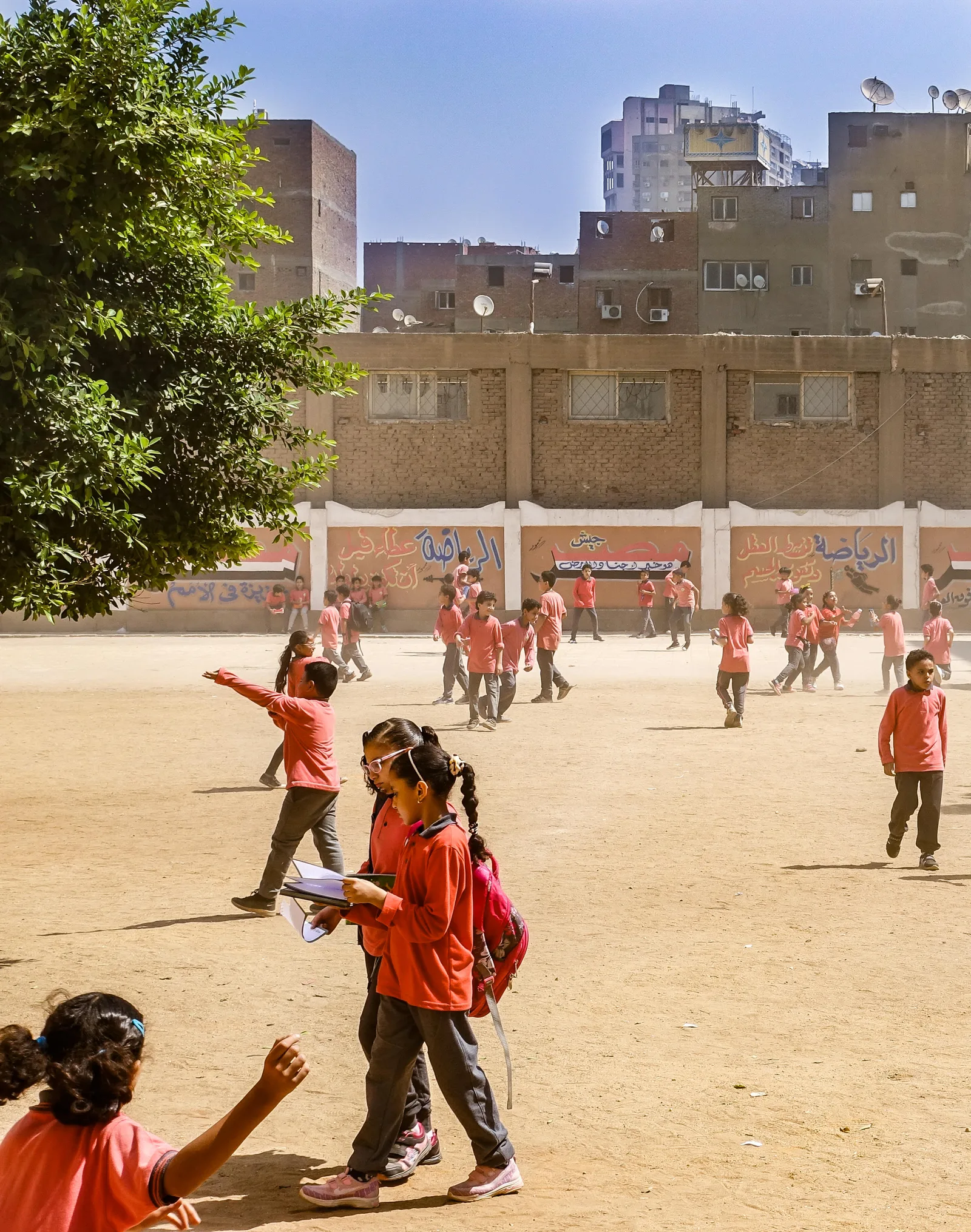
But the real danger is different, and it is too serious to be left hiding behind a comforting myth. What research actually links to nearsightedness in children is not the brightness of the bulb but two other things: long hours of near work, meaning reading, writing and screens held a short distance from the eye for stretches at a time, and too little time spent in natural daylight. And those are precisely what multiply during the weeks of homework and revision, when the child goes from a closed classroom to a closed room, from the book to the phone, seeing the sun only through the window of the microbus, the shared minibus that carries much of Egypt's daily commute.
A small Chinese study published in 2020 in the British Journal of Ophthalmology fitted the glasses of eighty-six fifth-graders from a single primary school in Hunan province with a small device that measured working distance and light intensity moment by moment throughout the day. The finding was that the nearsighted children spent about forty minutes a day on average in bright light, above three thousand lux, a level found practically only outdoors, compared with nearly a full hour for their non-nearsighted classmates, and by contrast spent more time on activities at less than twenty centimeters from the eye. The sample is small and cannot settle the matter on its own, but it agrees with what larger studies find: distance, duration and daylight matter far more than the strength of the bulb.
Other studies point the same way. A German cross-sectional study published in 2022, on around one thousand four hundred children and adolescents from the LIFE Child project in the city of Leipzig, found that children who went outdoors only once a week were clearly more likely to be nearsighted than those who went out twice or more, and that how often a child went out into daylight mattered more than how long they stayed, while the risk also rose with longer uninterrupted sessions of near work. The researchers concluded that daily exposure to sunlight and cutting down on uninterrupted near work may protect against the abnormal growth of the eye. As far as we know, this is the explanation most researchers lean toward today: daylight sends the growing eye a signal that restrains its excessive elongation, the elongation that ultimately means nearsightedness.
And here the matter becomes Egyptian par excellence. A systematic review and meta-analysis published in 2024 pooled thirty-eight population-based studies conducted between 2008 and 2023 on more than one hundred and three thousand children in Middle Eastern countries, and arrived at an overall estimate of the prevalence of nearsightedness among schoolchildren of no more than roughly six percent. But when the countries were looked at one by one, the estimate for Egypt was the highest in the region and far above the overall figure: about fifty-five percent of the children covered by the Egyptian studies, along with the highest regional estimate for astigmatism as well.
A necessary journalistic caution is due here. This figure is not a national statistic, and it does not mean that half of Egypt's children wear glasses or ought to. It is an estimate pooled from a limited number of Egyptian studies, varied in their locations and methods, carried out on schoolchildren in particular governorates, from Upper Egypt to South Sinai, that do not represent the whole country. But even after all those reservations, it is a signal that cannot be ignored: the eyesight problem among our children is far larger than imagined by households that still confine the danger to the eye to a weak bulb.
So what should parents do? First, do not let the argument over lighting hide the real question. A child who brings the book closer, or squints to see the blackboard, or complains of headaches after school, or whose grades slip for no obvious reason, needs an eye examination by an ophthalmologist, not a warning. Better still, eye tests should be routine on entering school and at the start of each stage of schooling, because a child who has never once seen the world clearly does not know there is anything to complain about.
Second, rely on the rest rule the professional bodies recommend, known as the 20-20-20 rule: for every twenty minutes of reading or screen time, lift your eyes to something about six meters away, out of the window or at the far end of the room, for twenty seconds. Keep the book and the phone at a comfortable distance, roughly the length of a forearm, and light the room well, not because darkness damages the eye, but because good light rests it and reduces fatigue and headaches.
Third, and most important: get the children out into the daylight. At least an hour in the street, at the club (the members' sporting and social clubs where many Egyptian families spend their free hours), on the rooftop or in the school yard, daily or nearly so, is, as far as we know, the cheapest preventive measure that nearsightedness research knows today, and it requires neither a prescription nor a device. All that is needed is for the child's eyes to see the light of the open sky regularly, and for the long stretches of near work to be broken up by intervals of distance.
Let us return to the small room. The mother comes in with the glass of tea and sees the boy all but glued to the book. This time she does not say "You'll go blind," because she now knows that a weak bulb will not do that. Instead she asks him when he last saw the blackboard clearly, puts an appointment with the eye doctor for next week into her phone, reminds him to lift his eyes from the page every twenty minutes, and decides that the late-afternoon hour in the street outside the house is not a waste of time but part of the studying. The difference between the two homes is not in the bulb, but in the question asked beneath it.
Related Stories

“Tea After Meals Blocks Iron”: The Mothers’ Warning Science Confirmed, and a Simple Fix
It is rare for a warning from the Egyptian kitchen to be backed so clearly by the laboratory. Black tea taken with a meal cuts the absorption of iron from bread, lentils and vegetables by startling margins, and milk does not rescue it. But the answer is not to banish the tea tray; it is to hold it back by a single hour, and to put a wedge of lemon on the table. We lay out the evidence, and why it matters for Egypt in particular.
September 10, 2026 · 7 min read
Horoscopes and Palm Reading Under the Microscope: Why Do We Believe Predictions That Fit Everyone?
One personality profile handed to an entire class — and most students judged it "remarkably accurate." Astrologers who failed a test they themselves had helped design, in the pages of Nature. We take apart the secret of predictions that fit everybody, and hand you a practical test for any "reading" before you pay a penny for it or build a decision on it.
September 5, 2026 · 7 min read
"Fizzy Drinks Dissolve Your Bones": The Truth Behind Egypt's Most Famous Household Warning
A tooth left in a glass of cola corrodes within days — but does your skeleton melt with every sip? We follow the trail from the kitchen-shelf experiment to the Framingham study and find a truth calmer than the panic and more serious than the shrug: the danger lies in sugar and excess, not in "melting bones".
August 29, 2026 · 6 min read