Before Sunrise on the Field: A Full Workday No Payroll Ever Records
Every October 15, the world marks a workday that begins before sunrise in Egypt's villages and never appears on a payroll. A 2007 UN resolution, the latest official statistics on rural households and their workforce, 1.6 million women counted in agriculture, and a social-insurance law waiting for someone to register under it: a sober look at labor everyone lives off yet no ledger counts.
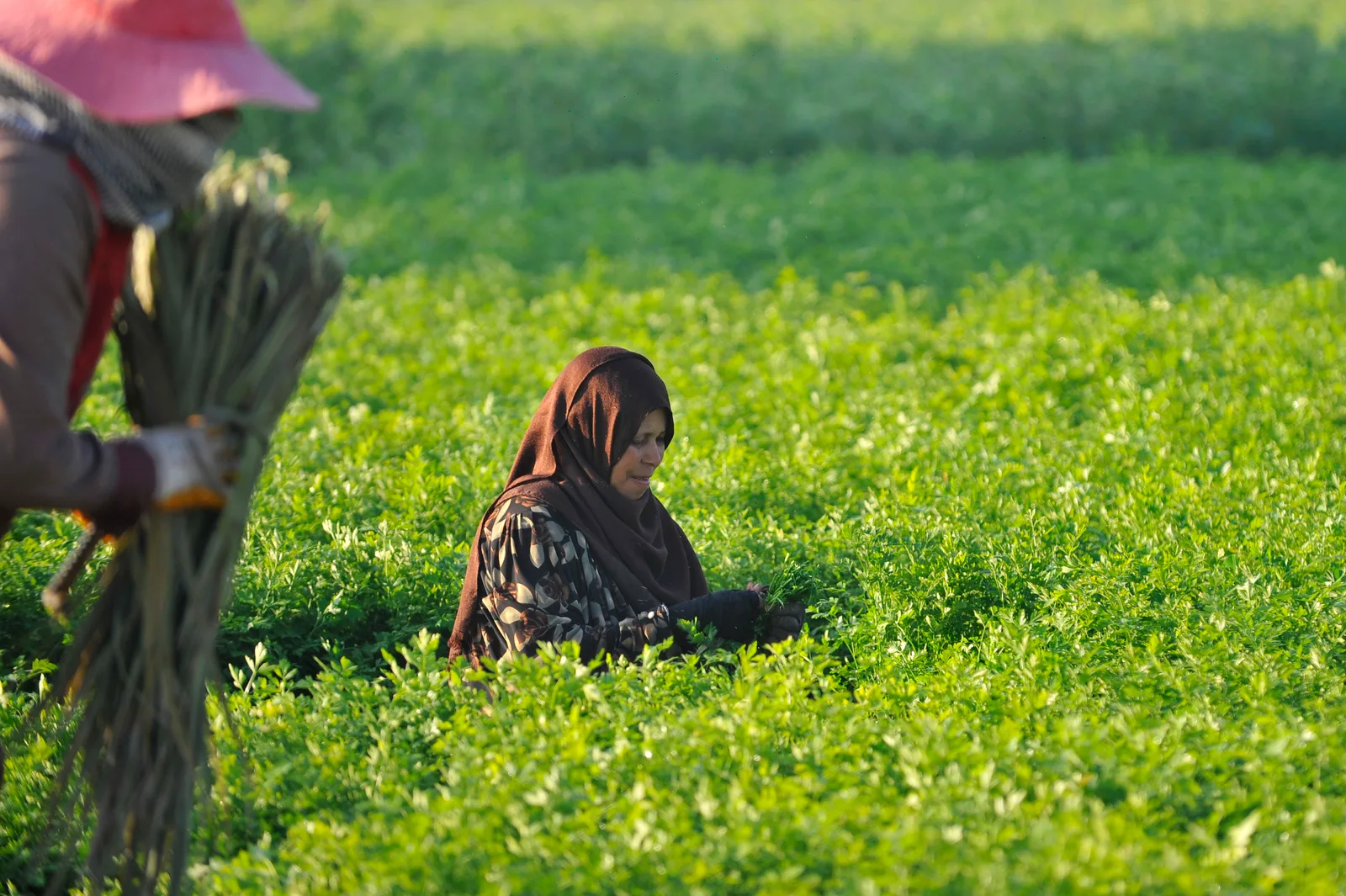
Before the sun rises over the field, a full day has already begun in thousands of Egyptian villages. In the Delta as in Upper Egypt, the first thread looks the same: movement in the courtyard, water heating, dough going into the oven, poultry being fed, milk being drawn, strained and packed before the collector arrives to carry it to the gathering point. None of this is written in any ledger, and no one signs an attendance sheet. Yet what leaves this house before seven in the morning is the first link in a food chain that ends on tables in the cities.
With first light, the day's second stretch begins: land is irrigated, weeds are cleared, fruit is picked and sorted into crates before the truck carries it off to market. In certain seasons — cotton picking, tomato sorting, or rose cutting — the day stretches until nothing is left of it. Then comes the walk back home: lunch, a child's homework, a trip to the health unit for a vaccination or blood-pressure medicine for a grandfather. The day does not end at sunset, but at the last task that can still be finished by lamplight.
Every October 15, the world pauses before this long day and gives it a name. The UN General Assembly, under Resolution 62/136 adopted on 18 December 2007, designated 15 October as the International Day of Rural Women, in recognition — in the resolution's own words — of their critical role in enhancing agricultural and rural development, improving food security, and eradicating rural poverty. The occasion, at its root, is not a bouquet of flowers but an attempt to make uncounted work visible — first in the statistics, then in policy.
In Egypt, the village is no side note. According to a statement issued by the Central Agency for Public Mobilization and Statistics (CAPMAS) on 15 May 2025, the country had 26.5 million households as of 1 January 2025, of which 14.7 million — 55.6 percent — live in rural areas, against 11.8 million in urban areas. More than half of Egyptian households, in other words, are rural, and in a great many of them an essential slice of daily economic life rests on women's work that carries no contract and no job title.
In the formal labor market, the balance tilts toward the countryside. CAPMAS's Labor Force Survey bulletin for the second quarter of 2026, published on 6 August 2026 and the latest available as of this writing, put the labor force at roughly 35.6 million people — 20.2 million in rural areas against 15.4 million in urban ones — with about 7.8 million women against 27.8 million men, and female unemployment at 14.4 percent against 3.4 percent for men. The same bulletin showed agriculture, forestry, logging and fishing leading all economic activities with about 6.25 million workers, or 18.6 percent of the total, of whom roughly 1.62 million were women.
Yet for all their rigor, these figures do not capture the day that began before sunrise. They are designed to measure those who work for pay or are seeking work under a specific technical definition, and even the 1.6 million women counted in agriculture are simply those who met that definition. The hours spent at the clay oven, milking, or weeding the family's own plot fall into a gray zone: real work that is unpaid and unrecorded. This is an interpretive point, not a statistic — where there is no wage, no contract and no record, there is nothing to count in the first place, and the absence of a number becomes part of the problem rather than evidence that the work does not exist.
Time-use research pushes this observation closer to certainty. A UN Women report, "The Role of the Care Economy in Promoting Gender Equality — Progress of Women in the Arab States," published in December 2020, found that married women in Egypt spend roughly seven times as many hours on unpaid care work as married men, that unmarried women spend about six and a half times as many hours as their male counterparts, and that a working woman does not shed this burden but carries it on top of her paid job. The estimate is national rather than specifically rural, but it illuminates a gap that shows up most starkly in the village.
At the global level, the United Nations' page for this day cites three figures: women make up nearly 40 percent of the agricultural labor force by a 2023 estimate, own only about 15 percent of agricultural land, and earn 82 cents for every dollar a man earns in paid agricultural work. These are global figures, not Egyptian ones, and cannot be treated as a local percentage. As for women's share of Egyptian landholdings, the most recent figure underpinning the international databases is an old one: data from the Food and Agriculture Organization (FAO) still trace back to the 1999/2000 agricultural census, when the share of female landholders did not exceed roughly 5 percent. As of this writing, no more recent official figure is available, to our knowledge, to replace it.
This is where the practical side of the story begins — a matter of paperwork before it is a matter of fields. The national ID card is the first document proving a woman's existence before the state; without it, she cannot open a bank account, register an agricultural landholding, or enroll in social insurance. For years, the National Council for Women has run its "Egyptian Citizenship Initiative — Your Card, Your Rights" in cooperation with the Civil Status Authority, sending mobile units to issue ID cards free of charge to women who cannot afford them in the most underserved areas. According to figures the Council publishes on its website, about 2.8 million cards have been issued since the initiative began, though no more recent figure had been announced as of this writing. Waivers of late-registration fines have accompanied these campaigns during time-limited decisions rather than as a standing rule, so the safest course is to ask the civil registry office what is in effect at the time of application.
The second document concerns insurance. Social Insurance and Pensions Law No. 148 of 2019 extended coverage to irregular labor, including temporary agricultural workers in fields, orchards, and livestock and poultry operations, as well as holders and owners of agricultural land whose holding or ownership is less than one feddan (roughly 0.42 hectares, or about an acre). Under the law's definition and its executive regulations, issued under Prime Ministerial Decree No. 2437 of 2021, this category covers anyone employed by an employer for less than six consecutive months, or whose work does not by its nature fall within the employer's usual activity, provided the person is not already covered by the law as an employee or an employer, and is not under eighteen years of age. The meaning in the village is simple: an unregistered harvest season is effort with no trace, while a registered contribution turns, years later, into a pension or disability compensation — and the practical reference point is the nearest social insurance office.
Then comes a third layer that has nothing to do with paperwork and everything to do with distance: how far the health unit is, the state of the road between home and school, and whether clean drinking water and sanitation reach inside the house rather than stopping at the edge of the village. Each of these services, when it moves one step closer, gives the rural woman back hours she used to spend on the road, hauling water, or waiting in line. This is the premise behind the national rural development project "Decent Life" (Haya Karima), and its real payoff is measured in the hours saved each day, not in ribbon-cuttings.
None of this is meant as pity, nor as a bleak portrait. The Egyptian village is behind no one, and it holds practical knowledge the city does not: irrigation schedules, crop cycles, poultry diseases, and how to reckon a season before it starts. What is needed is not softer language but three concrete steps: that the work be registered so it can be counted, that the worker be enrolled in social insurance so she is protected, and that services be brought closer so hours are saved. Anything less is just occasion-talk: it lasts a single day and ends with the sunset, while this same work had already begun long before that day's sunrise.
In the city, when a loaf of bread is set on the table, a glass of milk beside it, a plate of tomatoes in the middle, and a bunch of roses in the corner of the room, every one of those items has passed through hands that began their day before sunrise and were never entered on any payroll. October 15 does not change this day or shorten it, but it gives it a name and a place in the accounting. Perhaps the most useful way to mark it is not a greeting sent out, but two practical questions: do the women in your family's village home hold valid national ID cards? And does any of them know that a social-insurance contribution can be registered in her name?
Related Stories

After the Final Bell, a Second School Day Begins: Evenings at the 'Sanater' on an Egyptian Street
At seven in the evening a side street is lit more by the signboards of the 'sanater', Egypt's private tutoring centres, than by its lampposts: taxis pull up and pull away, bags carry the 'sheet' instead of the textbook, and children queue on the stairs. A report from the pavement, on World Teachers' Day, on a scene every Egyptian home knows and the policies that have tried to change it since 2022.
October 5, 2026 · 7 min read
Two Wheels in the Gridlock: Where Does the Bicycle Stand on Egypt's Streets on Car-Free Day?
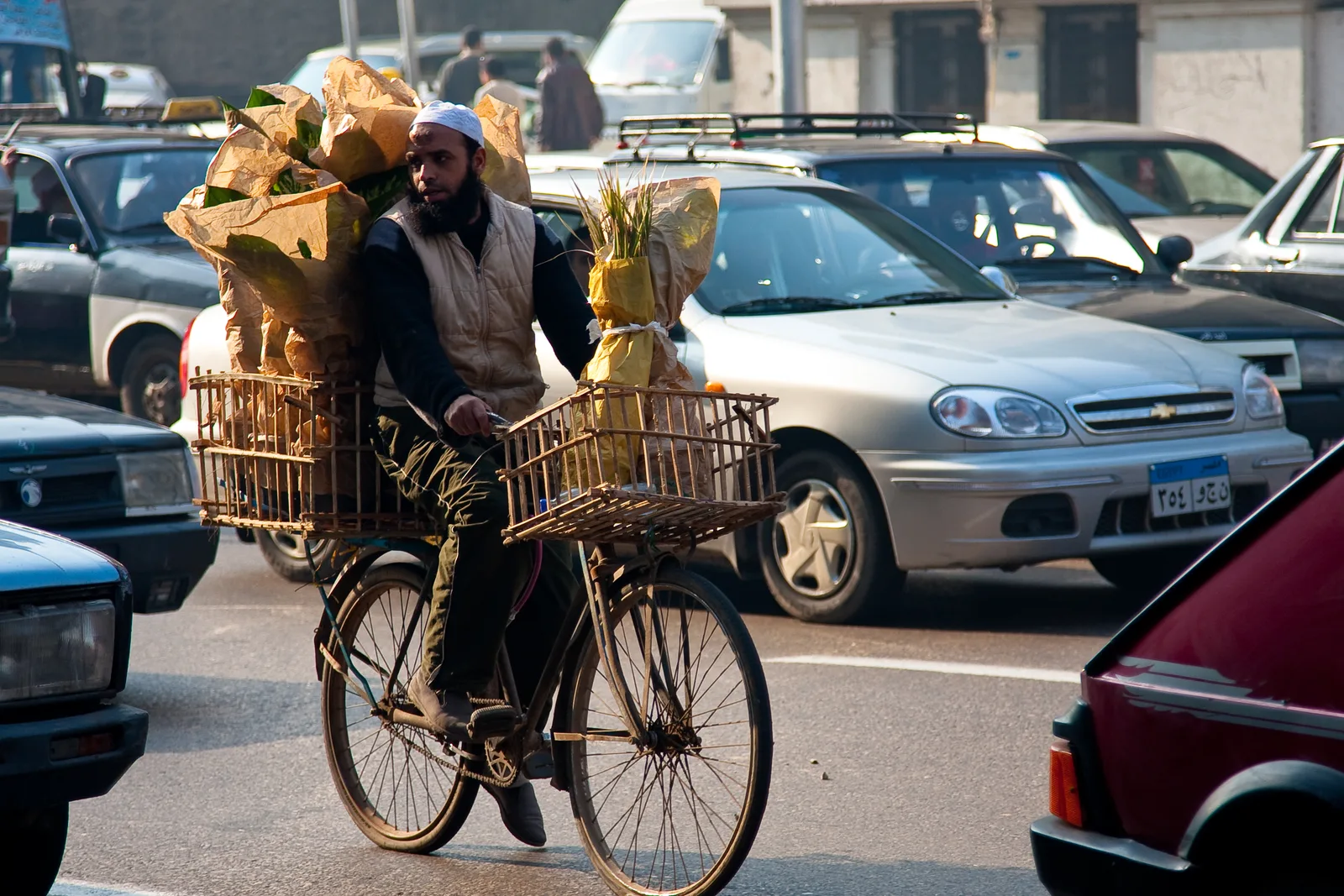
On 22 September the world marks Car-Free Day, while on our streets the bicycle threads its way between microbuses and along a painted lane with a car parked on it. From Cairo Bike to the "Your Bike, Your Health" scheme to a boy carrying a tray of bread on his head down a side street: a report on what any passer-by can see, and a single question: whom is the bicycle for in Egypt, and why does a safe lane remain a dream?
September 22, 2026 · 8 min read

Egypt's New Criminal Procedure Code 174/2025 Takes Effect: What Has Actually Changed for Citizens?
After roughly seventy-six years, Egypt's old Criminal Procedure Code has been retired, and Law No. 174 of 2025 took effect with the start of the new judicial year. A measured look at what has actually changed: alternatives to pretrial detention, expanded from three to seven; detention periods and their ceilings; the presence of a lawyer; notification by modern means; and new safeguards for victims and witnesses.
October 18, 2026 · 8 min read