No, Egypt's Watermelons Are Not Being Injected With Dye
Viral videos claim Egypt's watermelons are injected with dye. We checked official statements and scientific fact-checks: no documented case exists, and injection would visibly ruin the fruit within hours. Verdict: false — plus how to pick a good watermelon.
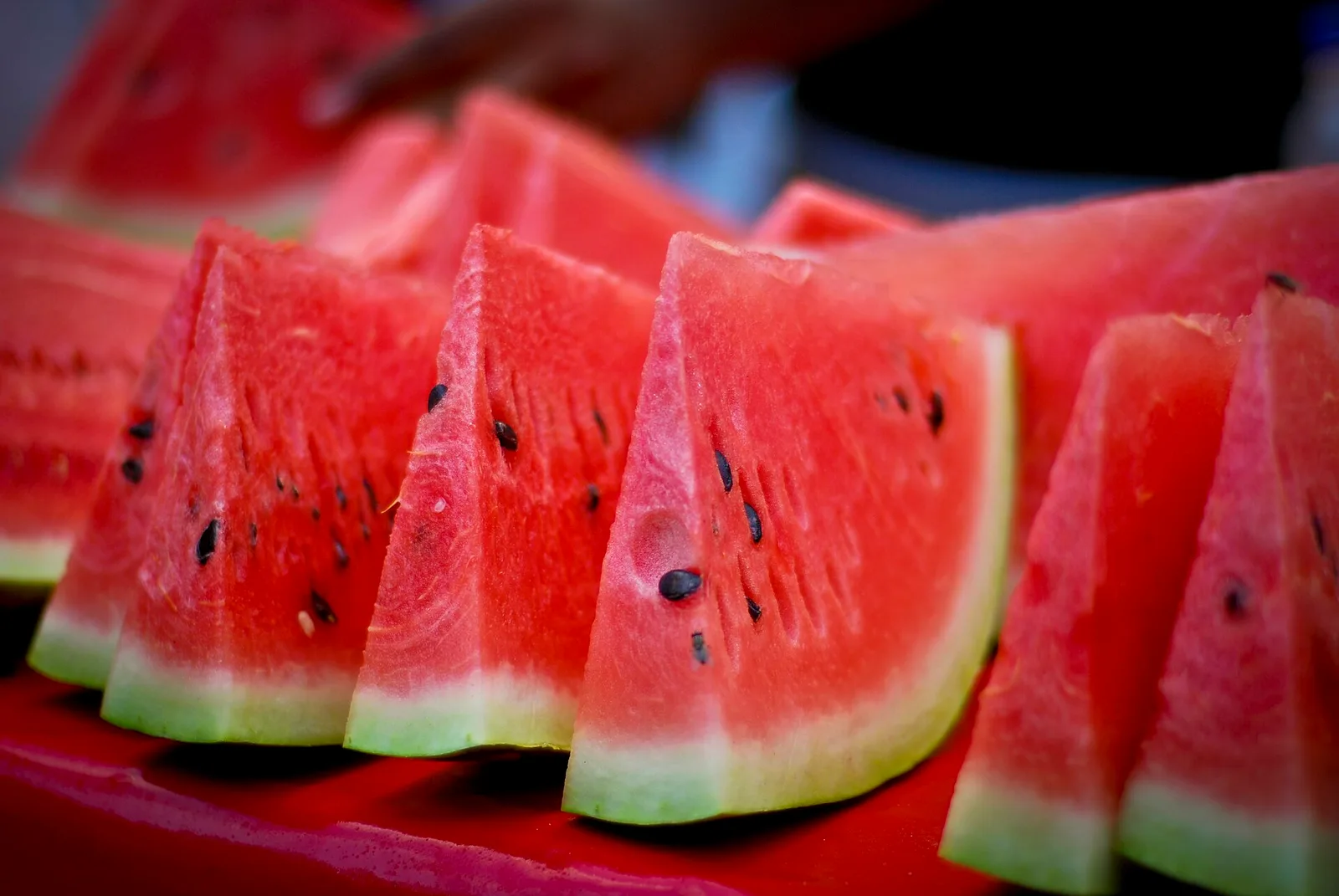
Every summer, the same warning resurfaces on Egyptian social media: the watermelons in the market have supposedly been "injected" with red dye or chemical solutions to boost their color and sweetness. The story made the rounds again during the 2026 season, often paired with clips of people plunging syringes into fruit, or with the "tissue test," in which a red stain on a napkin is presented as proof of tampering.
Voice of the Citizen traced the claim from both ends: statements by Egypt's official bodies, and scientific fact-checks published by international verification platforms. The bottom line is that the claim rests on no documented case, and that injection itself is self-defeating — it ruins the fruit and leaves visible traces. Verdict: false.
In late July, the cabinet's Information and Decision Support Center published a rebuttal of circulating fruit-safety rumors in which Dr. Mohamed Mahmoud, head of the Agriculture Ministry's growth-regulators committee, said there is "no such thing as fruit injection": approved compounds are applied by spraying, under internationally recognized standards, as reported by Ahram Gate.
Earlier, in mid-June, Dr. Hind Abdallah, director of the ministry's Central Laboratory for Pesticide Residue Analysis, dismissed reports of unsafe watermelon as "rumors entirely devoid of truth" that recur every summer and harm farmers, consumers and exports alike. In remarks carried by Youm7, she noted that the watermelon's thick rind acts as a natural shield against pesticide penetration, and that Egypt exported some five million tons of agricultural produce in the first half of 2026 without a single rejection.
Nor is the rumor new to this season. In late April, the Agriculture Ministry described the "carcinogenic watermelon" claims as seasonal fabrications, according to matching reports by Masrawy and Al Arabiya. And in the 2024 season, Dr. Soliman Omran, head of the national watermelon seed program, told Sada El-Balad that watermelon on the Egyptian market is "completely safe," explaining that the white streaks seen inside some fruit are a sign of early harvesting, not of a carcinogen.
Scientifically, the claim collides with the nature of the fruit itself. A review by the health fact-checking platform THIP Media explains that injecting liquid into a watermelon raises the internal pressure of its cells until their walls rupture, leaving the flesh soft and leaking juice, while the puncture opens the rind to bacteria and fungi. Agricultural specialists cited by Editorji estimate that a punctured watermelon ferments and rots within hours to about two days at most, with the needle mark remaining visible on the rind — meaning an "injected" watermelon would betray itself before ever reaching the consumer intact, making this form of fraud commercially pointless in the first place.
As for the most widely shared clip of a man injecting a watermelon with red liquid, the Indian fact-checking outlets The Quint and BOOM examined it and concluded it was a staged scene produced by a YouTube channel called The Social Junction, originally carrying a disclaimer that it was fictional and made "for awareness" — before it was clipped and recirculated in several countries as a real incident.
Even the "tissue test," in which a napkin turns red when rubbed against a slice, proves nothing. Lycopene — the natural pigment responsible for the fruit's red color — stains tissue on its own. THIP Media's review also notes that a 2015 government analysis of watermelon samples in India's Karnataka state found no trace of the erythrosine dye the rumors invoke.
The 2026 season also shows how a limited local incident can balloon into a national rumor. In May, a video spread of farmers in Baltim, Kafr El-Sheikh governorate, complaining that their crop had failed. The Agriculture Ministry dispatched a scientific committee which concluded — according to Sada El-Balad — that the problem was confined to just 7.5 feddans out of 3,500 planted in the area, and was caused by poor farming practices by some growers, not by contamination or tampering with fruit on sale.
Taking all of this together — the absence of any documented case, repeated denials by the competent authorities, the practical impossibility of injection at market scale, and the proven fabrication of the most-shared videos — Voice of the Citizen rates the claim that market watermelons are injected with dyes or solutions as: false.
That leaves the practical question: how do you pick a good watermelon? Per guidance published by Youm7: look for the yellow field spot on the rind, a sign the fruit ripened on the ground; tap it lightly — a deep, hollow sound signals ripeness; choose one that feels heavy for its size, with a dry, brownish stem, a symmetrical shape and distinct dark-green stripes; and avoid overly shiny fruit.
And when should an odd color or appearance genuinely worry you? Not internal cracks, "hollow heart" or white streaks in the flesh — those are natural growth phenomena or signs of early picking. Concern is justified when you find punctures or soft spots on the rind, a fermented or sour smell, foamy or slimy juice, or an off taste — in which case do not eat the fruit and report it to the Consumer Protection Agency. The most useful lesson from the agricultural experts' statements stands: the real contamination risk comes from handling — an unclean knife, or cut fruit left unrefrigerated for hours in the heat — not from an alleged needle in the market.
Related Stories

“The Americans never landed on the Moon”: an annual claim, answered by flags and footprints seen from orbit
As World Space Week opens, the short clips swearing that the Apollo landing was filmed in a studio are back. We examine the claim not through the astronauts’ testimony but through what any scientist in the world can check today: photographs from orbit, lunar rocks in laboratories, and the reflectors used every night to measure the distance to the Moon.
October 4, 2026 · 7 min read

"Cough Hard to Survive a Heart Attack Alone": A WhatsApp Message Egyptian Homes Pass Around, and Medicine Says Otherwise
A chain message reaches nearly every phone in Egypt: if you have a heart attack alone, cough hard and in rhythm until your heart steadies. The American Heart Association flatly rejects "cough CPR," the message confuses a heart attack with cardiac arrest, and every minute spent coughing instead of calling the free 123 ambulance line is taken from the patient's life. This is what medicine says.
September 28, 2026 · 7 min read

"Reading in Dim Light Ruins Your Eyes": What Ophthalmologists Confirm, and the Risk Parents Really Overlook
With evening study sessions back under a single bulb, the old warning returns: "You'll go blind." We checked the claim word for word and found ophthalmologists of one mind: dim light and sitting close to the screen tire the eyes; they do not damage them. But behind that reassurance stands a real danger most households overlook, and regional estimates put Egypt's children at the top of it.
September 19, 2026 · 7 min read