Half the Crate Never Arrives: A Night at the Wholesale Market and the Story of Food Lost Between Field and Plate
Hours before the city wakes, crates are unloaded under floodlights, and some produce is set aside because it didn't survive the journey. Estimates published by the Food and Agriculture Organization in 2022 put annual loss and waste at nearly half of Egypt's vegetables and fruit. A night inside the wholesale market shows where the cold chain breaks down — and why it matters to you when you pick out tomatoes in the morning.
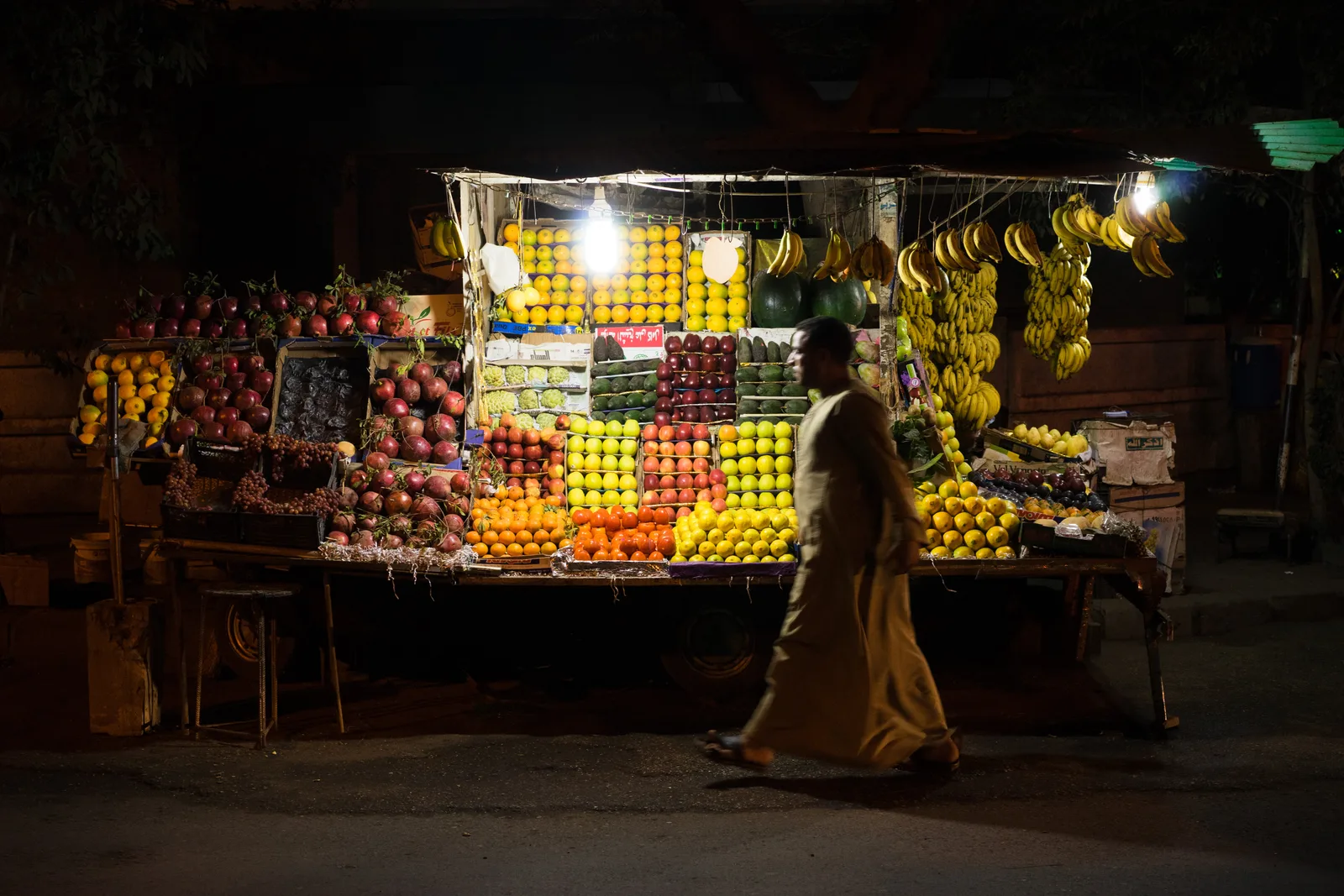
The scene repeats every night at any major wholesale market. It's just before three in the morning, and the city is asleep except for a truck rolling in through the gate, white floodlights hanging from tall poles casting light on wet crates. The air smells of cabbage, wash water and diesel. A driver climbs down from his cab, rubs his eyes, and points to an empty spot; another climbs onto the truck bed and unloads the cargo crate by crate. Time here is measured in trucks, not clock hands. Hours later, a shopper will stand in front of a box of tomatoes at ten in the morning and turn one over in his fingers, never imagining that this fruit had been awake seven hours before he was.
A wholesale market, in any governorate, is not just a place to sell — it is the hinge through which every vegetable entering your home must pass. Cairo governorate's official website describes Obour Market as the governorate's main market for vegetables, fruit and fish, operating around the clock in shifts, with daily prices set according to supply, demand and volume, and providing, together with its adjoining industrial zone, around one hundred thousand jobs. The governorate adds that trucks arrive daily from other governorates to the market's warehouses, where retailers from Greater Cairo and the surrounding areas buy their stock. Similar markets exist in other governorates, so what we describe here is the rule, not the exception.
But our story today is not about the crates that make it — it's about the ones that don't. Every night, with every load unloaded, a side corner fills up with what's been set aside: fruit crushed under the weight of what was stacked on top, others that changed color along the way, and still others that look fine on the outside but have gone soft to the touch and won't survive another day on a shelf. This is not an exceptional sight; it is an everyday occurrence in markets the world over. What differs from one country to another is the size of that corner — how small it stays, or how much it swells until it swallows the effort of an entire season.
In Egypt, the available figures on that corner are not comforting. A statement issued by the Food and Agriculture Organization of the United Nations (FAO) in Egypt, published in April 2022, cited an FAO study estimating that around fifty percent of vegetables and fruit, forty percent of fish, and thirty percent of milk and wheat are lost or wasted annually in Egypt. The same statement cited another figure attributed to a different source: average per capita food waste in Egypt of about ninety-one kilograms a year, according to estimates by the National Center for Social and Criminological Research, as relayed by the FAO. As far as we know at the time of writing, these figures have not been updated; they are estimates, not numbers carved in stone, but they are enough to say the problem deserves attention.
The same statement goes into finer detail: the FAO representative in Egypt, presenting baseline data from one of the organization's projects, says quantitative loss in grapes is estimated at more than forty-five percent, and that the figure rises to more than fifty percent for tomatoes — in the production, wholesale and retail stages alone. This is data from a specific project, not a final institutional figure, and estimates vary among the FAO's own sources depending on the crop and the measurement method. Another important distinction remains: quantitative loss is what is actually discarded because it is no longer fit for consumption, whereas quality loss is when the fruit arrives intact but has lost its firmness, color or flavor, so it sells for less than it's worth — a loss borne by both grower and buyer that no one ever records in a ledger.
Where does all this happen? The short answer: in the gap between the moment of picking and the moment of cooling. Vegetables and fruit are living things that keep respiring after they're picked, and the hotter they are, the faster they respire and burn through their water and sugar. If a fruit is picked on a hot day and sits for hours in the shade of a tree or at the edge of a field before loading, it has already begun to age before the truck even moves. That is why most loads arrive before dawn, racing the fruit away from the sun's hours; a truck leaving after sunset from Minya, Beni Suef or Beheira buys its cargo extra hours of life with no refrigeration at all.
Then comes the packing stage, which many underestimate. A crate overfilled beyond its capacity, and rows stacked all the way to the truck's roof, mean that the fruit at the bottom carries the weight of everything above it for hours over uneven roads. The bruise doesn't show up at the moment of loading — it appears a day or two later, as a dark spot or a soft patch. The load is then unloaded, re-sorted and moved on to the retail shop, and every handling takes its share of loss. Food isn't lost all at once; it's lost in small installments at every link in the chain.
At the heart of the night comes a moment familiar to anyone who has visited a wholesale market before dawn: the moment of the scale and the call. The load is sorted and weighed, the price moves with the quantities that arrived that night and the demand traders expect, and the deal is struck within minutes. Because the price changes daily, there is no point fixing a particular figure for a kilo of tomatoes in an article read months later; what matters is the rule: the fresher the load arrives, the higher its owner's share of the price, and the more tired it arrives, the further it slides down to second grade — and perhaps into that side corner.
It must be said clearly: this is a breakdown in a chain, not a charge against any one party. Seeing crates discarded, it is tempting to blame the wholesale trader or talk of "monopoly" — but that is talk with no evidence behind it. The wholesale trader himself loses when a load arrives damaged; the farmer loses; the transporter loses; and the consumer pays the cost of the loss on top of the price of whatever arrives intact. The fault is distributed: no cooling at the field, packing that doesn't protect, exposed transport, repeated handling, and storage at the wrong temperature. Fixing it is a matter of engineering and organization, not morality.
In recent years, publicly announced efforts have moved in this direction. According to the State Information Service, the Ministry of Supply and Internal Trade, through the Internal Trade Development Authority, is working on a plan to develop wholesale markets to modern specifications, with the stated goal of reducing the number of trading links products pass through and curbing losses; as far as we know at the time of writing, the plan is still in the implementation and rollout phase, governorate by governorate, so we cannot present its final results as an accomplished fact. Separately, the FAO and the Egyptian Food Bank announced, in April 2022, a partnership to raise awareness on combating food waste, launched with a Ramadan campaign under the slogan "Thirty Tips in Thirty Days," which then extended into governorate-level initiatives, coordinated with the Food Loss and Waste Monitoring Unit at the Agricultural Economics Research Institute, and in support of a draft anti-loss-and-waste law that was under discussion at the time. The measure of such efforts lies in their results years later, not in their announcement.
The market's night also has a human face that percentages cannot capture. Shift work means families living on an inverted calendar: sleeping by day, working in the cold and damp, a hot meal eaten standing at four in the morning. With late October, as the days grow shorter with the season and the clocks fall back sixty minutes at the start of winter time, darkness comes earlier and the working night grows longer — coinciding with the winter vegetable season and its large volumes: a longer night, kinder cold for the crop, and harsher for those who work through it.
The home has its own share in this story — and it is the one share we can change today, not years from now. The ninety-one-kilogram-per-person figure does not happen in the field or on the road; it is an estimate of what is wasted at the consumption end: in our kitchens, on our tables, and in retail shops. We see it in buying more than we need because the price looked tempting, in vegetables sealed inside closed bags that sweat and then rot, and in cooking made in excess for occasions and then thrown out. The remedy is simple, and well known to the older generation: a written shopping list, taking vegetables out of the bag so they can breathe, separating spoiled produce immediately because one damaged fruit hastens the spoilage of its neighbors, cooking what is close to wilting, and an old rule: eat the old before the new.
Next time you stand at the vegetable stall at ten in the morning and turn over a box of tomatoes with your fingers, remember that what you're holding was, hours earlier, on the back of a truck cutting through the agricultural road in the dark, and that a fruit next to it didn't make it and was left in a side corner, far from your eyes. This awareness won't change tomorrow's price per kilo, but it will change how you look at what you buy and what you throw away: every crate that arrives intact is a small gain for an entire country, and every fruit you save in your kitchen is the last link in a long chain that began in a distant field and ended with you.
Related Stories
Before Sunrise on the Field: A Full Workday No Payroll Ever Records
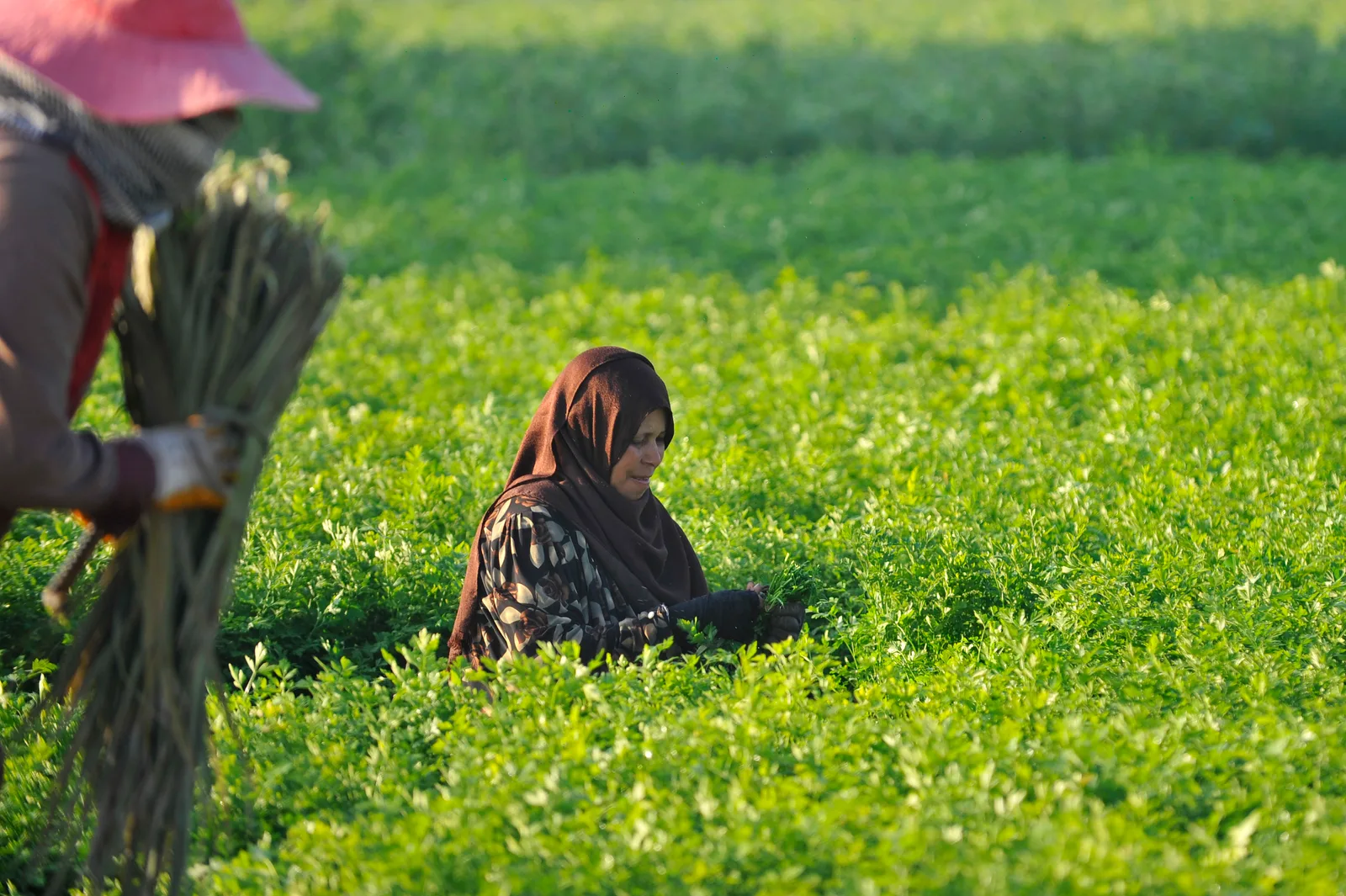
Every October 15, the world marks a workday that begins before sunrise in Egypt's villages and never appears on a payroll. A 2007 UN resolution, the latest official statistics on rural households and their workforce, 1.6 million women counted in agriculture, and a social-insurance law waiting for someone to register under it: a sober look at labor everyone lives off yet no ledger counts.
October 14, 2026 · 7 min read

After the Final Bell, a Second School Day Begins: Evenings at the 'Sanater' on an Egyptian Street
At seven in the evening a side street is lit more by the signboards of the 'sanater', Egypt's private tutoring centres, than by its lampposts: taxis pull up and pull away, bags carry the 'sheet' instead of the textbook, and children queue on the stairs. A report from the pavement, on World Teachers' Day, on a scene every Egyptian home knows and the policies that have tried to change it since 2022.
October 5, 2026 · 7 min read

“A Cold Shot Cures a Cold”: A False Claim, and What Trials Say About the “Power” of the Vein
“Forget the pills, take a shot and you'll be back on your feet” is advice that returns with the first chill of every year. We test two claims: that a “cold shot” cures a cold, and that an injection is inherently stronger than tablets. Verdict: false. The evidence lies in the mixture itself, in randomized trials comparing vein with mouth, and in an official Egyptian guide. The route of a medicine is the doctor's decision alone.
November 22, 2026 · 9 min read