Keda Ghalat (That's Just Wrong): Harming an Animal Has Been a Crime Under Egypt's Penal Code Since 1937
A neighbour sets out poisoned bowls beside the school wall; a cart driver beats his donkey across the face to make it haul a load beyond its strength. Many assume that "just an animal" means no law protects it. In fact, Articles 355, 356 and 357 of the Penal Code punish killing, poisoning and harming animals with penalties that go as far as prison. On the eve of World Animal Day, we explain what the law says and what the right thing to do is.
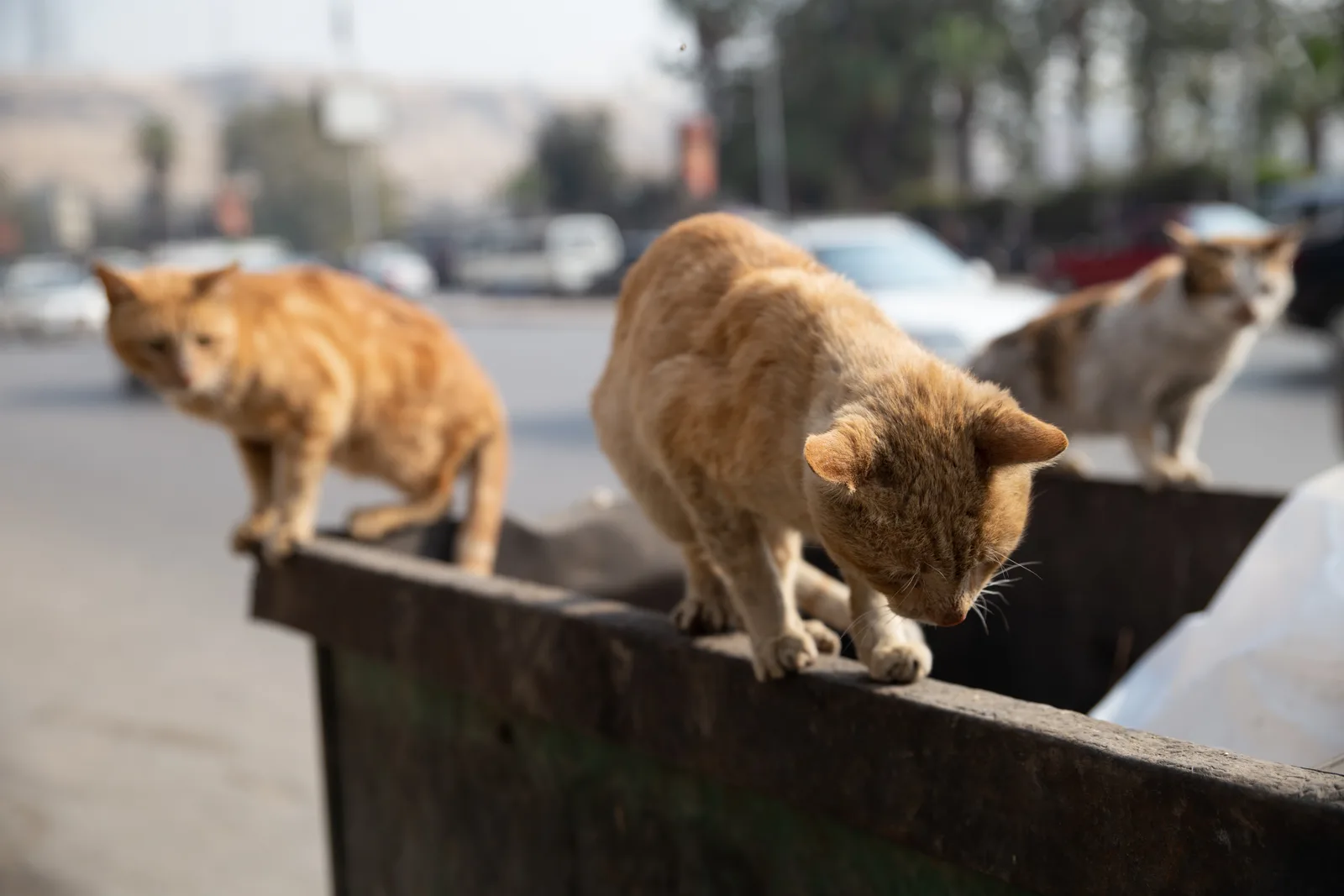
At seven in the morning, as parents walk their children past the school wall on a quiet residential street, one of them notices a small cat lying motionless beside a plastic bowl holding scraps of food. A few metres on, a second cat, then a third. The children stop, and one reaches a hand towards the bowl before his mother snatches him back. The neighbours whisper: so-and-so was fed up with the cats yowling at night and decided to "get rid" of them his own way. On the parallel street, a man stands behind a karro — a flatbed donkey cart — loaded with several times what a scrawny donkey can bear, and brings his stick down on the animal's face every time it stumbles. Nobody intervenes, because the same ready-made line is in everyone's head: "It's just an animal."
That line is what we pause on today. Because the actor in both scenes is neither an authority nor an institution but a particular neighbour and a particular cart owner, each of whom chose to treat a living creature as though it were a stone in the road. And the fact many people do not know is that Egyptian law has not left this act unpunished: it is spelled out explicitly in the Penal Code, issued as Law No. 58 of 1937 — almost ninety years ago. Legal protection for animals is neither a modern fad nor an imported luxury; it is standing law with clear article numbers.
Let us start with Article 355 of the Penal Code. It punishes with imprisonment with hard labour anyone who intentionally and without necessity kills a riding, draught or pack animal, or any kind of livestock, or causes it serious harm. The same article covers anyone who poisons one of these animals, or poisons fish in a river, canal, stream, marsh or pond, as the article lists them. It adds that the offender may be placed under police supervision for no less than one year and no more than two. The donkey beaten across the face until it is injured, the horse deliberately wounded, the cow poisoned to spite its owner — all of these fall within the scope of this article.
Article 356 then stiffens the penalty when the offences set out in the preceding article are committed at night: the punishment becomes aggravated imprisonment, or imprisonment of three to seven years. The common explanation for this escalation is that someone who slips out under cover of darkness to lay poison or kill a beast of burden is acting with premeditation and with the intent to conceal the act — which the legislator evidently regarded as more dangerous than an act carried out in broad daylight.
Article 357 is the one closest to the scene of the cats by the school wall. It punishes with imprisonment of no more than six months, or a fine, anyone who intentionally and without necessity kills or poisons a domestic animal not mentioned in Article 355, or causes it serious harm. Cats and dogs are domestic animals according to the standard legal commentaries, so deliberately putting down poison for them is a criminal act. We should note here that the fine amounts set in these articles are very old and no longer reflect our times, which is why the custodial sentence is the essential point that anyone tempted to do this should keep in mind.
A reader may ask: what does "without necessity" mean? On the settled reading of the text, the law does not criminalise slaughtering livestock for food, nor warding off a genuine danger; it criminalises killing and harm that have no justification beyond irritation, revenge or contempt. The difference between a butcher who slaughters according to the rules and a neighbour who slips poison into a bowl of food is precisely the difference between a lawful act and a crime. To our knowledge, there have been discussions in recent years about a standalone animal welfare bill, but as of the time of writing, the articles of the Penal Code remain the law in force criminalising the killing and abuse of animals.
The harm does not stop with the animal. A bowl of poison beside a school wall is a direct danger to children, who touch everything and put their hands in their mouths. It is a danger to a dog or cat owned by one of the neighbours that goes out into the street for a few minutes. It is a danger to any bird or other creature passing through. Whoever laid the poison did not just kill cats; he planted a lethal substance in a public space shared by everyone, and he may find himself facing far greater liability than he imagined if a child is harmed.
Beating a working animal is harm of another kind. A donkey loaded with twice what it can carry and beaten across the face will not work better; it will work worse and die sooner, and it may collapse in the road, block traffic and expose its owner to loss. Kindness here is not just sentiment but practical arithmetic: an animal that is fed, watered and loaded within its capacity lives longer and produces more. The Egyptian farmer knew this wisdom long before it was written into any law.
And there is a third, more hidden harm: what children learn when they see that cruelty carries no consequences. A child who watches his neighbour poison the cats, or sees the cart owner beat the donkey with no one to stop him, learns that power is exercised over the weakest, and that pain whose screams go unheard does not count. That is a lesson we do not want for our children, and it is what makes "keda ghalat" — that's just wrong — not merely a moral observation here but a matter of upbringing and safety.
So what is the right thing to do? First, if street cats or dogs are a genuine nuisance, the route is to report it to the competent authorities, not to take justice into one's own hands or scatter poison in the road. Second, anyone who keeps an animal or works with a draught or pack animal must feed and water it, load it within its capacity and treat it when it falls ill, and must understand that severe beating and deliberate injury are a punishable offence, not merely cruelty. Third, pesticides and household poisons, where they are needed, must be kept out of reach of children and animals and never left in a public place.
And if you see someone doing this, you are not obliged to get into a fight with him in the street. You can speak to him calmly, remind him that this is an act punishable by law, and if he persists you can file a mahdar — a formal police report — at the police station, as with any other incident. Witnesses who saw the bowl being put down, and photographs of the bowl or the injured animal, not of people, all help. What matters is that everyone knows silence is not the only option.
We publish this article on the eve of World Animal Day, which falls on 4 October. The day has a story of its own: it was started by the German Heinrich Zimmermann in Berlin in 1925, and in May 1931 the International Animal Protection Congress in Florence, Italy, unanimously adopted 4 October as World Animal Day. In other words, the world was agreeing on this idea in roughly the same years that the Egyptian legislator was setting these articles down in the Penal Code that remains in force today. We are behind no one on the text; the lag, if there is one, is in enforcement and in awareness.
Now return to the same street on another morning. The children walk past the school wall and find no poisoned bowl and no dead cat, because the neighbour, when the yowling got to him, called the competent authority instead of buying poison. And the cart owner on the parallel street unloaded half the cargo and walked alongside his donkey instead of beating it across the face. The law did not change between the two mornings, and no superhuman force descended on the neighbourhood. What changed is that someone learned that "just an animal" is not a legal phrase, that kindness is not weakness, and that the street we share with the weakest creatures is the same street our children grow up in.
Related Stories
Four on a Motorcycle and No Helmet: A Bare Head Is the Dearest Thing a Family Can Lose on the Road
In the second week of school the same scene repeats: a father driving, one child in front, another behind, the mother clutching the bags, and not a single helmet among them. Press reports citing CAPMAS show deaths jumping from 190 to 897 between 2020 and 2024, while a Cochrane review finds a helmet alone cuts the risk of death by 42%. The law has punished the bare head since 1999, fine raised in 2008. So why do we not comply?
September 23, 2026 · 8 min read

"A Hook-Up on the Cable" Is No Clever Trick: Electricity Theft Is a Crime the Whole Neighbourhood Pays For
A bare wire dangling from a lamp post to a balcony, an air conditioner on a meter that never moves, and a fuse blowing for the third time, plunging a bill-paying neighbour into darkness. Article 71 of the Electricity Law calls this unlawful appropriation of current, punished by prison and a fine, while a tougher amendment awaits the House of Representatives. What does a whole street lose from one hook-up? And what is the right alternative?
September 14, 2026 · 7 min read
A Camera Over the Wounded: Filming and Sharing Accident Victims Is Not “Documentation” but a Violation Punishable by Law
Raised phones ring the injured man before paramedics do, and the video reaches family group chats before the news reaches his relatives. Kedda Ghalat (“that’s wrong” in Egyptian Arabic) names the behaviour, explains why it obstructs rescue and strips dignity, what the Constitution, Law 175 of 2018 and the Telecommunications and Intellectual Property Laws say, why Article 309 bis does not apply on a public road, and what to do instead.
September 7, 2026 · 8 min read