A Camera Over the Wounded: Filming and Sharing Accident Victims Is Not “Documentation” but a Violation Punishable by Law
Raised phones ring the injured man before paramedics do, and the video reaches family group chats before the news reaches his relatives. Kedda Ghalat (“that’s wrong” in Egyptian Arabic) names the behaviour, explains why it obstructs rescue and strips dignity, what the Constitution, Law 175 of 2018 and the Telecommunications and Intellectual Property Laws say, why Article 309 bis does not apply on a public road, and what to do instead.
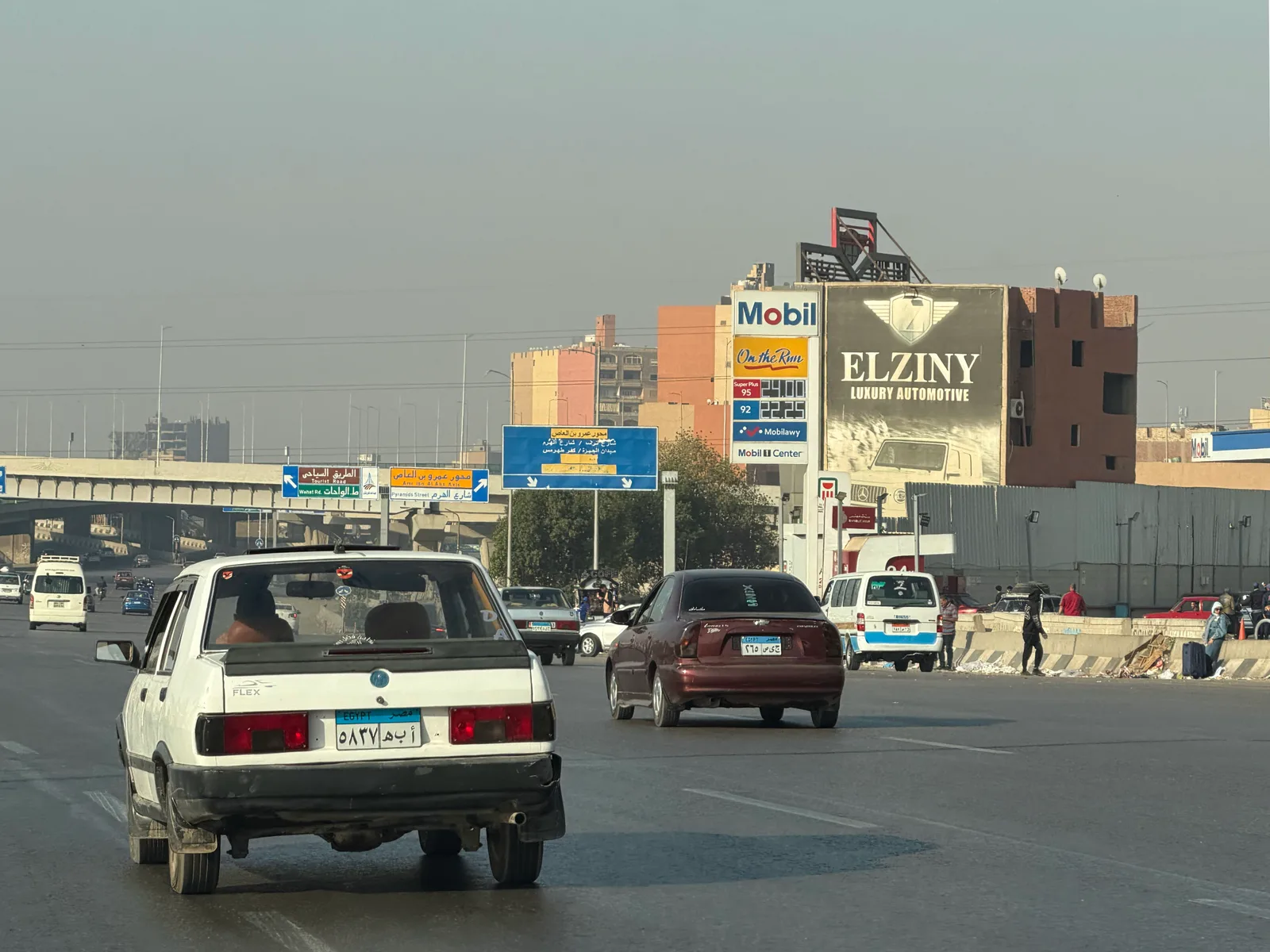
It is nearly eight in the evening on Cairo’s Ring Road, and the traffic slows abruptly, then stops. A small pickup truck has flipped onto its side, and behind it a microbus — the minibus share taxi that carries much of Egypt’s daily traffic — has come to a halt across the lanes. Within a single minute a complete ring of people forms around the injured man stretched out on the asphalt, but most of the hands in it are not extended to help; they are raised high, each holding a glowing screen, recording. One man edges closer to get a clear shot of the face; another calls out, “Film it, film it — millions are going to watch this.” Before the ambulance arrives, and before the injured man’s family knows anything at all, the video has already landed in family WhatsApp groups, captioned “God protect us — does anyone know who this is?”
This is not one particular accident but a generic scene familiar to anyone who travels Egypt’s roads. And it is what this column calls by its plain name: kedda ghalat — Egyptian Arabic for “that’s wrong”. Raising a phone over an injured person does not make you a witness or a documenter; it makes you part of the harm, however good your intentions. And the harm here is twofold: harm to a body waiting for someone to save it, and harm to the dignity being stripped from a human being at the weakest moment of his life.
Start with the body. The first minutes after any accident are the ones by which the chances of survival are measured — a self-evident truth that needs no statistics. A human ring wrapped around the injured means the ambulance will struggle to get close, and that a wounded person who needs air and space finds instead a ceiling of arms and faces above him. To our knowledge there are no documented Egyptian figures measuring how many minutes a victim loses to onlookers, but logic is enough: every body between the injured man and the ambulance door is an obstacle, and every raised phone that is not dialling 123, the ambulance line, is a lost chance.
Then dignity. The man lying on the asphalt did not choose this position, and gave no one permission to turn him into material to be passed around. His face may be smeared, his clothes torn; he may be crying out for help; he may already be dead. In every case there is a mother who will open her phone in a few minutes to find her son in a clip circulating among strangers, and an injured man who will recover weeks later only to discover that the moment of his helplessness has become a permanent archive on other people’s phones. The news that should have reached the family in the calm voice of a hospital or a police officer reaches them instead as a clip trailing comments that know no mercy.
Here it is worth stating clearly what Egyptian law says, because many people raise their phones believing that whatever happens in the street is fair game for everyone. The first foundation is the Constitution itself. Article 57 of the 2014 Constitution provides that “private life is inviolable, safeguarded and may not be infringed upon.” This is the highest rule in the Egyptian legal order, and every law beneath it is read in its light. In this column’s assessment, private life does not end at the front door, and a person’s state of health and moment of pain are at the very core of his privacy wherever he may be; though the Court of Cassation, as we shall see, reads “private place” more narrowly, so applying the principle to a public road remains less clear-cut than applying it to publication.
The second foundation, and the most directly relevant to our case, is Article 25 of the Anti-Cyber and Information Technology Crimes Law No. 175 of 2018. That article punishes with imprisonment of not less than six months and a fine of fifty thousand to one hundred thousand Egyptian pounds, or either penalty, anyone who violates the sanctity of private life, or who publishes through the information network any information, news, images or the like that violate any person’s privacy without his consent, whether true or false; and video clips, in our view, count as images. Note that last phrase: truth is no defence here. What matters is that you published, over the internet, something that violates a person’s privacy without his permission.
Because precision is a duty, let us put the other provisions in their proper place. Article 309 bis of the Penal Code No. 58 of 1937 punishes with imprisonment not exceeding one year anyone who, by any device, captures or transmits an image of a person in a private place without his consent, and Article 309 bis (a) increases the penalty for anyone who publishes what was obtained by those means. The text speaks explicitly of a “private place”, and a public road is not a private place. The Court of Cassation settled this point in Appeal No. 17841 of Judicial Year 92, the reasoning of which was published in December 2025: filming people on a public road, in full view of passers-by, falls neither under the concept of private life nor under Article 25 of Law 175 of 2018, since a private place is an enclosed one that eyes from outside cannot reach. But the court did not sanction the act; it classified it instead as the crime of deliberately causing annoyance through misuse of telecommunications equipment under Article 76 of the Telecommunications Regulation Law No. 10 of 2003, punishable by imprisonment and a fine of five hundred to twenty thousand pounds, or either.
What does this mean for the clip taken over the injured man? That capturing it in the street is not a violation of the sanctity of private life in the narrow criminal sense, but it may be punished as misuse of a communications device. As for publishing it, Article 25 is the provision closest to criminalising it, although the Court of Cassation’s narrow reading of privacy makes its application to street footage a matter for each court to decide. And there is a civil-law basis that concerns publication specifically: Article 178 of the Intellectual Property Protection Law No. 82 of 2002, under which whoever takes a photograph of another person has no right to publish it without that person’s permission. It is true that the article allows publication of a picture “in connection with events that occurred in public”, but it requires that its circulation not harm the person’s honour, reputation or standing — and a bloodied face crying for help on the asphalt is, in our view, about as close to such harm as one can get. The Court of Cassation confirmed in Appeal No. 9542 of Judicial Year 91 that permission to photograph does not include permission to publish. These lines explain; they do not rule. In any specific case the word belongs to the prosecution and the court.
And this is not our own invention. In December 2025 a legal article in Youm7, on the filming of celebrity funerals, linked the obsession with filming to Article 309 bis of the Penal Code and Article 25 of Law 175 of 2018, stressing that publication is punishable whether the content is true or false. That same month the reasoning of the Cassation ruling mentioned above was published. And in June 2026 a report in Masrawy warned that your phone camera could land you in prison if you film citizens in the street without their permission. The subject’s return with such frequency means the behaviour is still widespread, that the legal press comes back to it every time the scene repeats, and that the public debate around it keeps being renewed.
Someone may say: “I filmed to protect the victim’s rights, in case the driver fled.” An understandable intention, but the difference between documentation and violation is where the clip goes. Documentation goes to the police report, the prosecution or the victim’s lawyer; violation goes to the friends’ group chat and to the accident pages that feed on tragedy. The same clip can be evidence that protects a right in one place and a crime that tramples dignity in another — and you are the one who decides. Nor should you forget who is watching: a child who opens his mother’s phone and finds a body on the road, a heart patient who receives the bloody clip over breakfast. When you press “send”, you are not sending to a person; you are sending to an entire household.
So what is the right thing to do? It is simple, and the order matters. First: clear the way. If you are not trained in first aid, the best thing you can offer the injured is air and space. Do not move the casualty from where he lies unless staying there is an immediate danger to him — a fire, say, or an oncoming car — and secure the scene so that whoever comes after you does not hit him. Second: call 123, Egypt’s ambulance number, and say calmly where you are and how many injured you can see; that call is worth more than a thousand clips. Third: if you must film, film what serves the case, not the views — the car’s number plate and the position of the accident, not the injured man’s face or body. And fourth, the most important: keep the clip for the competent authorities, hand it to those with the power to investigate, and do not post it.
And to anyone who receives the clip from someone else: do not forward it. Whoever shot the clip took the first step, but everyone who presses “forward” takes part in the second — publication without consent, which Article 25 punishes — and may find himself answerable for it before the law; and even if the courts differ over the legal classification, the moral argument needs no ruling. Do not comment “does anyone know who this is”, and do not go looking for his identity so that you can be the first to break the news to the family in a way that wounds them. If you know the person who shot the clip, tell him calmly to delete it. The family, if they are to know, should know from a source that preserves their dignity.
A word about consent. The man moaning on the asphalt cannot tell you “don’t film me”, nor raise a hand in front of the lens. His inability to object is not agreement. The law calls this “without his consent”; conscience calls it something simpler: if you were in his place, would you want this scene captured of you?
Now go back to the Ring Road, to the ring closing around the injured man. Imagine the raised hands coming down, the circle stepping two paces back, and a single voice saying, “I’ve called 123, the ambulance is on its way — make room.” Imagine that the only clip taken went to the police report, not to WhatsApp, and that the injured man’s family heard the news from the hospital in a human voice, not from a mocking comment under a video. None of this needs a new law; it needs only that you lower your hand a moment before you raise it. Because next time, the person lying on the asphalt might be someone you know — and might, God forbid, be you.
Related Stories

The Accessible Bay Is No Luxury: Taking an Accessible Parking Space Is Theft of the Right to Move
"Just one minute and I'm gone" — with a single sentence, a whole person's freedom is stolen. The accessible bay and the ramp are not privileges; they are a lifeline of movement protected by law and by accessibility codes. This article calls the behaviour by its name, shows you how to stand firm but courteous when someone takes the space, and explains why one minute of your time can cost somebody else an entire day.
September 1, 2026 · 7 min read

The Horn Is Not a Vent for Your Temper: One Hand on the Horn Assaults a Whole Street's Nerves
A hand slams down on the horn and the noise bursts through your window without asking permission. Why is random honking not "letting off steam" but an act of acoustic aggression against an entire street? On the line between a warning that averts danger and a din that makes people ill — and on the medicine, the law and the common decency that all stand on the side of your ear.
August 25, 2026 · 7 min read
Smoking Indoors: Your Freedom Ends at Someone Else's Lungs
Episode two of 'Kda Ghalat' dismantles the 'I'm free' defence: WHO counts over 1.6 million non-smokers killed by second-hand smoke every year, and a 45-year-old Egyptian law bans indoor smoking. So why is the café still full of smoke?
August 22, 2026 · 6 min read