Smoking Indoors: Your Freedom Ends at Someone Else's Lungs
Episode two of 'Kda Ghalat' dismantles the 'I'm free' defence: WHO counts over 1.6 million non-smokers killed by second-hand smoke every year, and a 45-year-old Egyptian law bans indoor smoking. So why is the café still full of smoke?
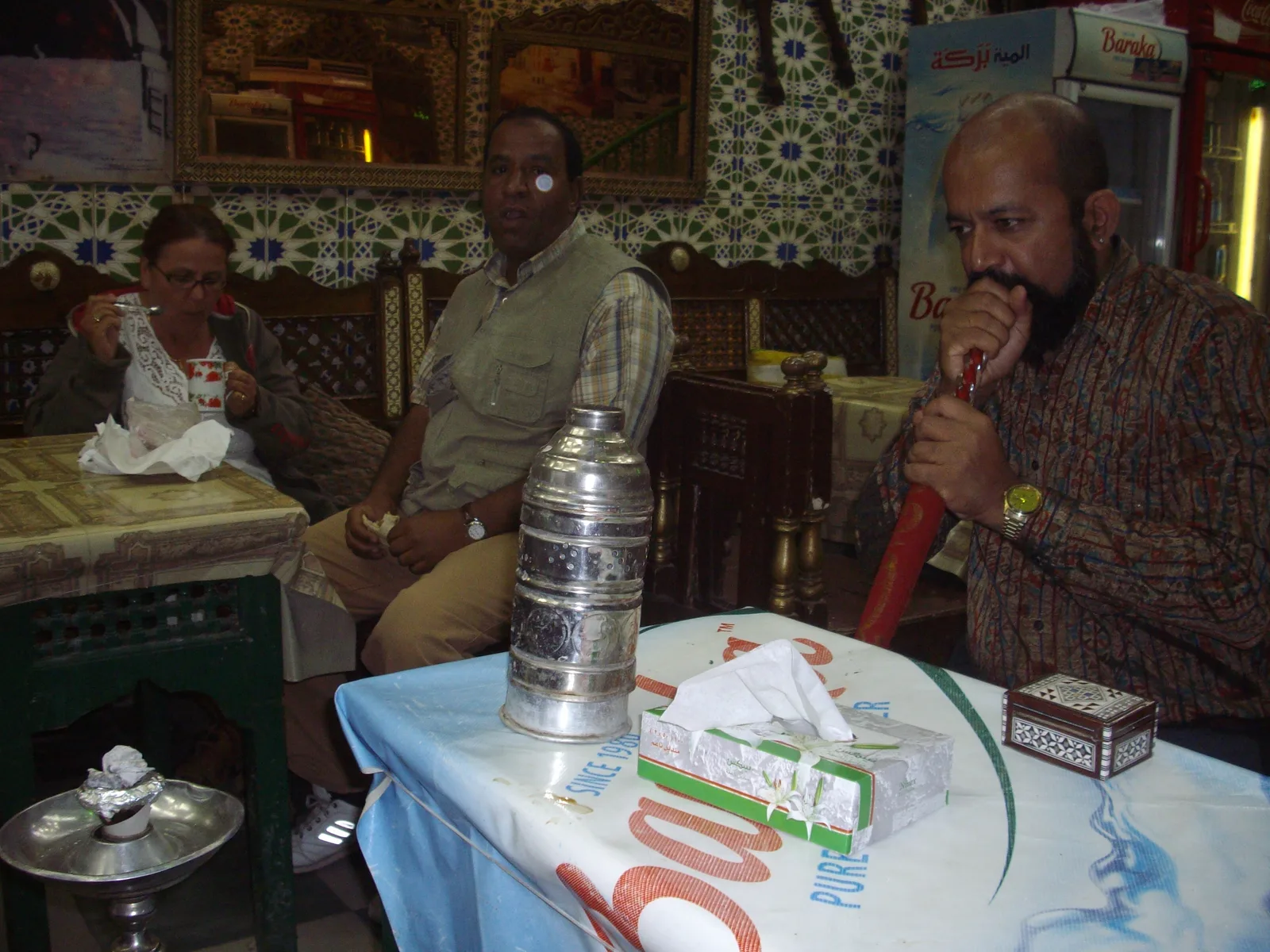
The scene repeats every night in thousands of Egyptian cafes: a closed hall, air conditioning recycling the same air over everyone, and a man lighting his third cigarette, oblivious to the child at the next table hunched over a glass of juice, coughing. Nobody objects; objecting might look like 'making a scene', the waiter stays out of it, and the owner sees no reason to upset a regular customer.
And if someone does object, the ready answer comes back: 'I'm free.' It sounds like a strong argument because it leans on a value nobody disputes. But in this particular setting it is broken at the root: freedom applies to what is yours, and the air inside a closed room belongs to no one person — it belongs to everyone breathing it.
Smoke does not respect table borders and does not ask permission before it travels. Someone smoking outdoors, away from others, is making a choice that concerns only themselves. Someone smoking in an enclosed space imposes that choice on every pair of lungs present: the waiter working a full shift in the haze, the pregnant woman with no other cafe nearby, the child who was never asked. That is where freedom ends and harm begins.
Second-hand smoking is not an opinion open to debate; it is documented harm. According to the World Health Organization's updated fact sheet published in June 2026, tobacco kills more than 7 million people every year — over 1.6 million of them non-smokers who died from exposure to other people's smoke. The WHO is unequivocal: there is no safe level of exposure to tobacco smoke, which damages nearly every organ in the body.
Egypt is no bystander to these numbers. The Global Adult Tobacco Survey, in its Egyptian round published in 2009, found that around 61% of adults were exposed to second-hand smoke inside their own homes, and around 62% of people working indoors were exposed at their workplaces — among the highest rates recorded across surveyed countries. The figures are old, certainly, but they remain the most comprehensive published data on Egyptian adults.
The irony is that the law has existed for 45 years. Law No. 52 of 1981 on the prevention of the harms of smoking prohibited, in its Article 6, smoking on public transport and in enclosed public places designated by decree of the health minister. Then the amendment by Law No. 154 of 2007 added a provision banning smoking 'entirely, in all its forms' in health and educational facilities, government offices, sports and social clubs, and youth centres.
The law has teeth — on paper. The original 1981 text set a fine of no more than twenty pounds; the 2007 amendment raised it to between EGP 50 and 100 for a smoker violating the ban. The manager responsible for an establishment that allows smoking, however, faces a fine of EGP 1,000 to 20,000. Note the hierarchy: the legislator burdened the establishment with many times what it asked of the smoker, recognising that behaviour is policed by the owner of the place, not by chasing every cigarette.
But the law has a loophole wide enough to fit an entire cafe: private cafes and restaurants are not on the list of comprehensively banned places, and their inclusion still hangs on decrees defining 'enclosed public places'. The specialist legal platform Tobacco Control Laws concludes that Egypt's legislation falls short of Article 8 of the Framework Convention on Tobacco Control — which Egypt ratified in 2005 — requiring indoor workplaces and enclosed public places to be entirely smoke-free.
Even where the ban does apply, enforcement runs into three walls: a smoker's fine set in 2007 whose deterrent value has eroded with time; a social climate in which objecting to a smoker feels heavier than the smoking itself; and establishments that fear losing a customer and look away — despite being the law's primary addressee and the bearer of its largest fine.
Comparative experience says prohibition works. On 29 March 2004, Ireland became the first country in the world to ban smoking in all enclosed workplaces, pubs and cafes included, over fierce opposition from the hospitality sector at the time. The Irish Heart Foundation, citing published scientific research, estimates the ban saved more than 3,700 lives in its first three and a half years, with an immediate 26% drop in ischaemic heart disease deaths and a 32% drop in stroke deaths.
And for anyone convinced our cafe culture is beyond change: Turkey — heir to centuries of coffee-house and shisha tradition — began a national ban in 2008, then extended it in July 2009 to cafes, restaurants and even shisha lounges. A country that mirrors our cafe rituals found a path between the smoker's freedom and everyone else's air: smoking outside, clean air inside.
This series judges behaviour, not people. The smoker is not the enemy; many of us smoke or love someone who does. The ask is not to stub out the cigarette but to take it into the open air, where your freedom is whole and untouched. Inside a closed room whose air everyone shares, a cigarette is not an exercise of liberty but harm imposed on people who never chose it — and that is just wrong.
Responsibility is a ladder, and it starts at the top: the owner of the place, armed by the law and its fines, must be the one to say 'no smoking here' before we ask the smoker to say it to himself. Share with us through Citizen Lens: photograph the 'No Smoking' signs drowning in smoke, or the places that genuinely enforce the rule without losing their customers — and we will publish both pictures side by side.
Related Stories
Keda Ghalat (That's Just Wrong): Harming an Animal Has Been a Crime Under Egypt's Penal Code Since 1937
A neighbour sets out poisoned bowls beside the school wall; a cart driver beats his donkey across the face to make it haul a load beyond its strength. Many assume that "just an animal" means no law protects it. In fact, Articles 355, 356 and 357 of the Penal Code punish killing, poisoning and harming animals with penalties that go as far as prison. On the eve of World Animal Day, we explain what the law says and what the right thing to do is.
October 3, 2026 · 6 min read
Four on a Motorcycle and No Helmet: A Bare Head Is the Dearest Thing a Family Can Lose on the Road
In the second week of school the same scene repeats: a father driving, one child in front, another behind, the mother clutching the bags, and not a single helmet among them. Press reports citing CAPMAS show deaths jumping from 190 to 897 between 2020 and 2024, while a Cochrane review finds a helmet alone cuts the risk of death by 42%. The law has punished the bare head since 1999, fine raised in 2008. So why do we not comply?
September 23, 2026 · 8 min read
"A Hook-Up on the Cable" Is No Clever Trick: Electricity Theft Is a Crime the Whole Neighbourhood Pays For
A bare wire dangling from a lamp post to a balcony, an air conditioner on a meter that never moves, and a fuse blowing for the third time, plunging a bill-paying neighbour into darkness. Article 71 of the Electricity Law calls this unlawful appropriation of current, punished by prison and a fine, while a tougher amendment awaits the House of Representatives. What does a whole street lose from one hook-up? And what is the right alternative?
September 14, 2026 · 7 min read