“Kida Ghalat”: Loudspeakers on a Residential Street After Midnight. Your Joy Is a Right, and So Is Your Neighbour’s Rest
A wedding marquee, a band and a loudspeaker beneath balconies where a student is revising, a sick woman is resting and a two-month-old baby is sleeping: when does a legitimate celebration become noise the law asks about? We separate a licensed hall, bound by the sound limits of the environment law, from a private street party, and propose an announced finishing time and sound aimed inward, so the joy and the neighbours’ night can both be kept.
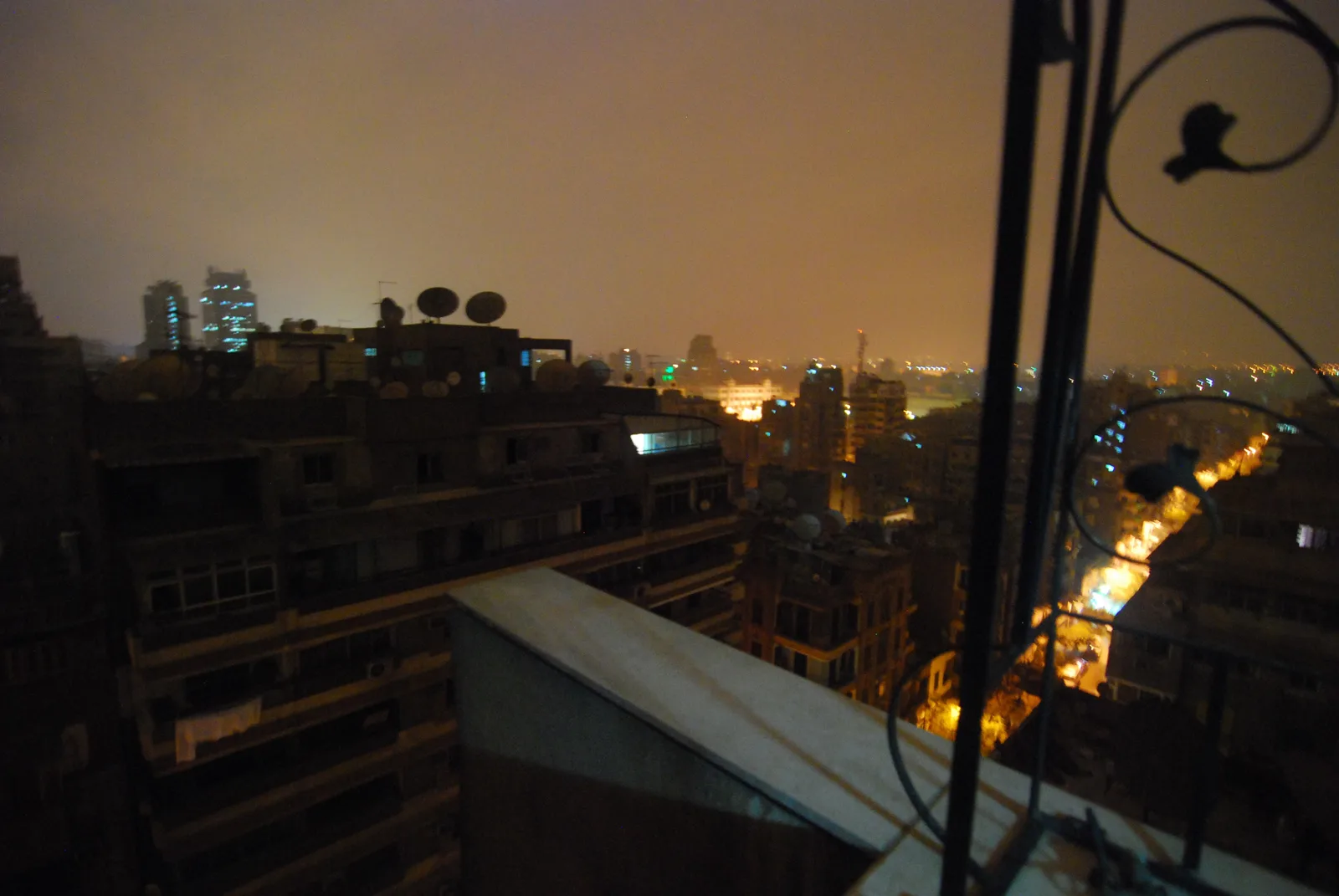
At this time every year, as the winter wedding season begins, a residential street in any Egyptian city wakes up to the remains of a long night: chairs stacked on the pavement, cables strung across the asphalt, and a row of loudspeakers still standing beneath the balconies, waiting for someone to carry them away. The scene is so familiar that it needs no witness. Many people know it from the districts of Cairo, just as they know it from Asyut, Aswan and the towns of the Delta. There is not a word in these lines against the celebration itself. A wedding is the joy of a lifetime, people celebrate with what they have and in the place where they have it, and putting up a sarādiq, the large wedding marquee pitched in the street, is an old tradition nobody is ashamed of. The objection here is to two things only: the hour, and the volume.
Let us define the subject at the outset, so that the discussion does not drift beyond what we mean. This article concerns the loudspeakers of weddings, marquees and commercial sound systems that are set up on a residential street and run after midnight, and the sound limits in Egypt’s environment law. It is not about the car horn in traffic, to which we devoted an earlier article in this series, nor about cafes on ground floors. Its subject is narrower and clearer: a large speaker cabinet aimed at the front of a building with dozens of windows, at an hour its residents assume is for sleep.
In a building like this, in any neighbourhood, there are people behind the windows whom the hosts of the party know nothing about, and who would turn the volume down of their own accord if they did. There is a student revising for a morning exam he has been preparing for over several weeks. There is a nurse who has just finished a night shift and has another in a few hours. There is a woman discharged from hospital on a doctor’s orders to rest. There is a two-month-old baby who sleeps for half an hour, then startles awake and sets the whole household crying. And there is a grandfather who counts his heartbeats with every wave of heavy rhythm. On winter nights the windows are shut and the curtains drawn, yet low frequencies pass through glass and walls far more easily than sharp sounds. No shutter or curtain holds them back, and a wall softens them only a little.
What makes such a night different is not the loudness alone but the hour at which it arrives. Sleep broken during its deep hours is not made up by sleeping longer, and someone who wakes repeatedly before dawn starts the day tired even if he believes he slept enough. Low frequencies are the hardest part of the problem, because they reach the bed after losing their sharpness, so the sleeper wakes without knowing what woke him. A fact sheet on noise from the World Health Organization’s Regional Office for Europe, which is regional material and contains no Egyptian figures, describes noise as an underestimated threat that can cause short-term and long-term health problems, including sleep disturbance, and notes that night-time disturbance can lead to more doctor visits and more spending on sleeping pills. We cite no percentage or figure here, and anyone suffering long-term insomnia should, as a rule, see a doctor.
Winter time adds a dimension to the matter that many people overlook. Since late October 2026, Egypt has returned to winter time by turning the clock back 60 minutes, under Law 24 of 2023 on the daylight saving time system, which makes summer time run from the last Friday of April to the end of the last Thursday of October each year. Darkness now arrives earlier, and the household of the employee and the schoolchild also goes to bed earlier, while the night of a celebration starts late and runs long. The gap between the building’s clock and the marquee’s clock therefore widens: one household counts its night from eight o’clock, while at a party the night begins at eleven and nothing about one in the morning seems late.
It is therefore worth separating two cases that should not be put in the same basket. The first is an establishment carrying on a business: a wedding hall, a shop, or a sound contractor who hires out speakers and operates them. Here the environment law applies, issued as Law 4 of 1994. Article 42, as replaced by Law 9 of 2009, obliges all bodies and individuals, when carrying out productive, service or other activities, and especially when running machinery and equipment and using horns and loudspeakers, not to exceed the permitted sound-level limits. It also obliges licensing authorities to ensure that the total of the sounds emitted in a single area stays within the permitted limits. The limits themselves, and the duration of exposure to them, do not appear in the article: they are set by the law’s executive regulations and their annexes, according to the type of area. A licensed venue is further bound by the conditions of its licence and by the rules governing public premises, and the administrative authority has its own measures if the venue breaches them.
The second case is a private celebration: a family that sets up a marquee in front of its home for a single night and hires a band and a loudspeaker. This is not a business activity on the family’s part, and the closest provision is one in the Penal Code that punishes anyone who makes a commotion or an unusual noise that disturbs the residents of the area. We give neither its article number nor the amount of its fine here, because we have not read its operative wording in the text of the law itself. Setting the legal classification aside, the safer course in practice is to ask the district or local unit about the procedures for occupying the road before booking the marquee, not after. That is the body that regulates road occupancy, and the details of its procedures differ from one district to another. Otherwise the host may find himself in trouble on the night of his own wedding.
As for the penalty, it most likely applies to the first case rather than the second. Article 87 of the environment law, in its wording as replaced by Law 9 of 2009, punishes anyone who violates the first paragraph of Article 42 with a fine of not less than 500 Egyptian pounds and not more than 2,000 Egyptian pounds, together with confiscation of the devices and equipment used in committing the offence, and the fine is doubled for a repeat offence. This is what we read in the text of the amending law as published in the Official Gazette, issue 9 (bis), dated 1 March 2009, which is the latest amendment to this article that we have found. Press reports circulate limits many times higher; we found no basis for them in the text, so we have not repeated them. Nor will you find a single decibel figure in these lines, because those limits belong in the executive regulations and their annexes, not the body of the law.
So what should the neighbour do? The first step is not a complaint but a knock on the door, in broad daylight before the night of the party rather than in the middle of it: a calm word to the host or the sound contractor asking for an announced finishing time. Many parties turn their volume down as soon as their hosts learn there is a sick person, an examinee or a newborn in the building. If that fails, a complaint goes to the district or local unit, as the body responsible for licences and road occupancy; to the governorate’s environmental department or the Egyptian Environmental Affairs Agency, as the body charged with enforcing the environment law; and to the police station for the disturbance itself. We do not publish a hotline number here that we have not read on the responsible body’s own website. The complaint channel is something to ask the authority about at its offices or on its official site.
And what should the host do, whose joy is a right nobody denies? Five steps take nothing away from his night. First, announce a finishing time and write it into the agreement with the sound contractor, rather than keeping it in his memory. Second, aim the speakers into the marquee and at the ground, not at the fronts of buildings or up the street. Third, turn down the low frequencies after a late hour, since those are what cross walls and wake sleepers, instead of raising the whole sound in search of enthusiasm. Fourth, tell the neighbours days in advance and invite those who can come, because a guest does not complain. Fifth, choose a hall or a club when circumstances allow, and leave a lane open in the street through which an ambulance can pass if anyone needs one.
The owner of the marquee is no villain in this story, and he must not be portrayed as one. He is a man who has borrowed the street for one night in his life and paid for it out of long toil to bring joy to his daughter or his son, and in good faith he sees that one night harms no one. And indeed, a single night really does no harm if it ends at a known time and at a measured volume. But if every night on the street is a single night in the eyes of whoever is hosting it, the neighbourhood does not sleep for a whole month. The street is an unwritten contract among its residents: whoever borrows it tonight for his celebration must expect his neighbour to borrow it tomorrow, perhaps for an occasion that is not a happy one.
Besides, a wedding does not need all this volume to be a wedding. The zaffa (the wedding procession), the drum, the song and the zaghareed (ululations of joy) are all loud by nature. But what has changed is not people’s generosity, nor their happiness, nor their love of celebrating. It is the size and power of the speakers, which can now reach the top floor of the next building at two in the morning. Whoever measures the worth of his night by how far his sound carried does his wedding an injustice. The celebration people remember kindly is the one where they laughed, ate, danced and prayed for the family, not the one that kept a neighbouring building awake and left its talk the next morning full of complaint and bitterness.
The next morning, the host will pass among his neighbours to collect the chairs, and a single glance will be enough to tell him what happened in the night. The point is not that the street should fall silent or its lights go out, but that it should know its hour: joy until an announced time, then night for those who need it. If you are the host, announce the finishing time and write it into the agreement, aim the sound inward, and knock on your neighbours’ doors before the speakers go up, not after they come down. If you are the neighbour, begin with a knock on the door before any complaint. Your joy is a right, and your neighbour’s night is a right just like it, and the price of one must not be paid out of the other.
Related Stories

“That’s Wrong”: One Glance at the Screen — WHO Says Drivers Who Use Phones Are About Four Times as Likely to Crash
On the World Day of Remembrance for Road Traffic Victims, marked today on the third Sunday of November, we look at a habit seen on every street that seems harmless: the phone in hand behind the wheel. The World Health Organization says drivers who use a phone are about four times as likely to crash, and that hands-free kits are not much safer, because the problem is attention, not the hand.
November 15, 2026 · 8 min read

"That's Just Wrong": Digging Under the House for Treasure Finds No Gold — Only a Collapsing Roof and Years in Prison
The summer of 2026 alone brought a string of illegal digs that collapsed on people searching for buried treasure: five dead in Al-Qusiya, Assiut, in June; ten deaths in Assiut alone within less than a month, according to Masrawy; then three in Fayoum and one under an old house in Bilbeis in August. We tell what happened, explain what Egypt's Antiquities Protection Law says, and show how legitimate archaeological excavation actually works.
November 3, 2026 · 8 min read

"That's Just Wrong": Demolition and Renovation Debris Dumped on the Corner — Owner and Contractor Liable, Not Passers-By
A mound of dirt and broken brick appears overnight at the corner, narrowing the pavement and clogging the storm drain before the first rain. This is not just another litter story: demolition and renovation debris has its own law, beginning with the building permit and a contract with a licensed hauler — and liability falls first on whoever ordered the work and paid for it. Here is the practical path, and the penalty.
October 27, 2026 · 7 min read