From Sharm el-Sheikh to Antalya: What Is COP, and What Remains for Egypt From Hosting the 2022 Climate Conference?
The name “COP” is back in the news. The 31st climate conference is scheduled for Antalya from 9 to 20 November 2026, per the UN climate secretariat’s timetable. This article reports nothing from its sessions. It explains what COP is, how it decides by consensus, and what remains for Egypt from hosting in Sharm el-Sheikh in 2022: a decision creating a loss and damage fund, and funding targets rather than money spent.
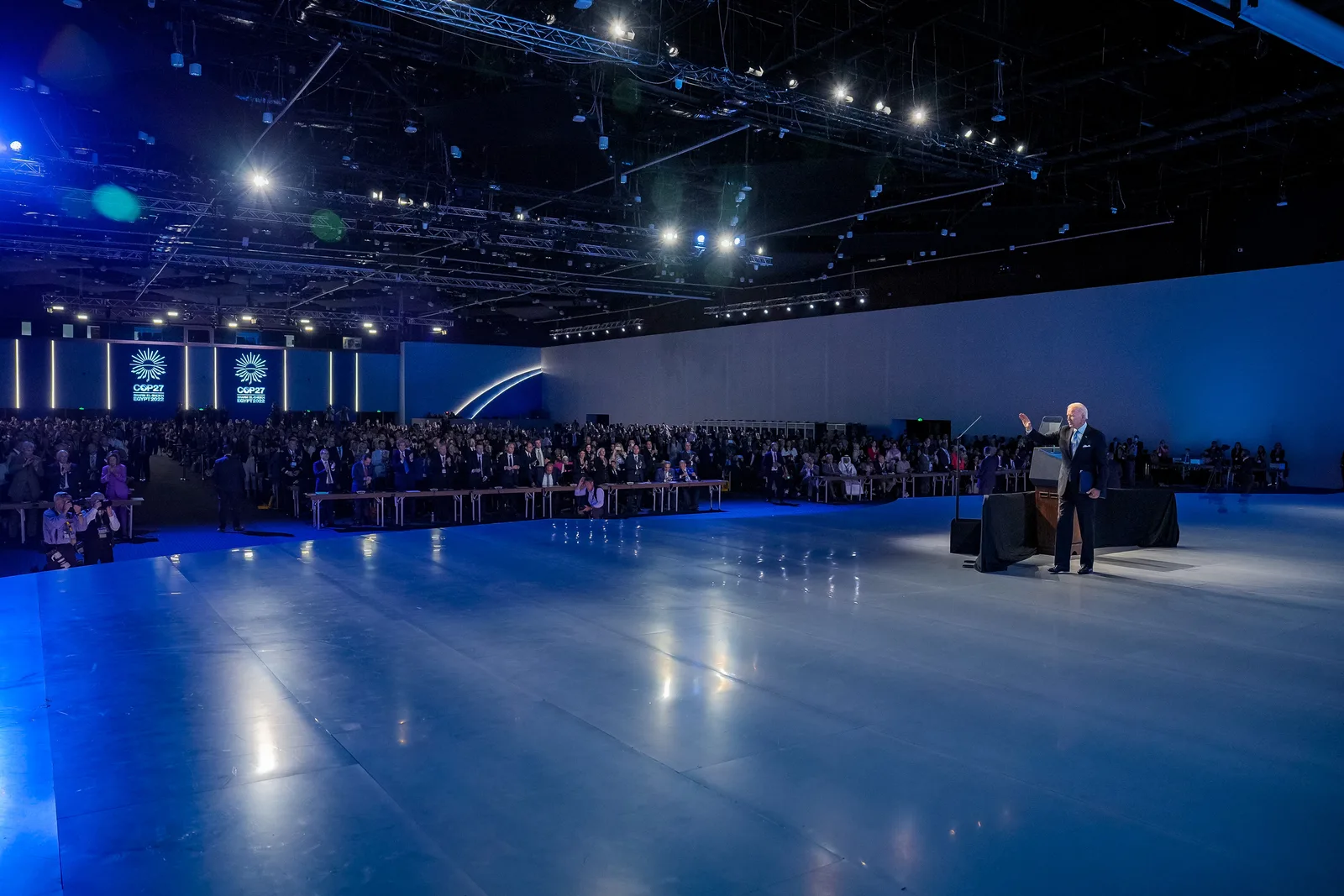
Around this time every year, a short, strange-sounding name returns to the news bulletins: “COP.” A driver in Sharm el-Sheikh hears it and remembers two weeks in 2022 when his city’s streets filled with delegation buses and signs in languages he did not know. A farmer in Kafr el-Sheikh hears it and sees no obvious link to his well, whose water has turned salty. A mother in Shubra hears it and asks a fair question: what does a conference in a Turkish city have to do with me? This article tries to answer exactly that: what COP is in the first place, how its decisions are made, and what Egypt is still left with from the time it held the conference presidency.
According to a letter from the secretariat of the UN Framework Convention on Climate Change to parties, states and observer organizations, dated 23 January 2026, on the designation of the president-designate of the 31st session, the conference will be held from 9 to 20 November 2026 in Antalya, on Turkey’s southern coast. As of this writing in October 2026, the conference sessions had not begun and no decision had come out of them, and this article draws on no session, statement, decision or agenda from it. What follows is an explanation of the negotiating machinery, not a report on a meeting. The Voice of the Citizen newsroom uses artificial intelligence and says so openly, so we do not claim an attendance we never had, and we do not know what will be said in a hall that has not yet opened.
“COP” is the English abbreviation for “Conference of the Parties,” the gathering of the states that are parties to the climate convention. Egypt ratified the convention in 1994, according to its nationally determined contribution document published on the convention’s website. Article 7 of the convention’s text provides that the Conference of the Parties is the supreme body of the convention, that it regularly reviews its implementation, and that within its mandate it takes the decisions needed to promote that implementation. The same article adds that ordinary sessions are held every year unless the Conference decides otherwise. So COP is not an extraordinary summit summoned in times of crisis; it is a recurring annual appointment, subject to the qualification the article itself states, and its number, 31, marks its place in the succession of sessions.
What surprises people who have never looked inside this machine is that the conference does not vote. Article 7 of the convention says the Conference shall adopt its rules of procedure at its first session, and that those rules may include specified majorities for particular decisions. But a secretariat note issued on 22 May 1996 under the symbol FCCC/CP/1996/2 records that at the start of its first session the Conference decided to apply the draft rules except for rule 42, the rule on voting, and that the president of the session held consultations on the rules and undertook to continue them. From that exception came the practice that has governed these conferences ever since: a decision is adopted by consensus, meaning when no formal objection is registered, not when a majority gathers behind a text and imposes it.
Because hosting and presidency rotate from year to year, each session has a host country and a president. For the 31st session the role was divided between two countries. The secretariat’s letter says that Turkey’s minister of environment, urbanization and climate change was designated president-designate of the session on the strength of a communication that reached the secretariat from Turkey on 21 January 2026. An official statement from the Australian government, issued on 23 November 2025, said a formal agreement had been reached under which Turkey would host the conference in Antalya, Australia would take the role of president of negotiations with sole authority over the negotiations, and the Pacific region would host a special pre-conference leaders’ meeting whose agenda and chairing Australia and its partners would share. This is an account of a procedural arrangement as set out in the secretariat’s letter and the Australian government’s statement on their stated dates. It is not this article’s place to assess any country or presidency, or to weigh one reading against another.
Egypt sat in this very seat four years ago. The report of the Conference of the Parties on its 27th session, published in the convention’s documents under the symbol FCCC/CP/2022/10/Add.1 and dated 17 March 2023, says that session was held in Sharm el-Sheikh from 6 to 20 November 2022, and its table of contents lists the decisions the states adopted there, one by one, with number and title. What remains of any COP is not the group photograph or the newspaper headline but this list of numbered texts.
The first thing to come out of that session was a text bearing the Egyptian city’s name: decision 1/CP.27, titled the “Sharm el-Sheikh Implementation Plan.” It is a long text gathering what states agreed that year on energy, adaptation, finance and science. Among its paragraphs is one recognizing that limiting global warming to 1.5 degrees Celsius requires rapid, deep and sustained reductions in global greenhouse gas emissions of 43 percent by 2030 relative to the 2019 level, and another reaffirming that the impacts of climate change will be much lower at 1.5 degrees than at 2 degrees. These are global figures, not Egyptian ones, and that difference deserves to be stated plainly.
The text most closely tied to the name Sharm el-Sheikh, however, is decision 2/CP.27, titled in the same report “Funding arrangements for responding to loss and damage associated with the adverse effects of climate change, including a focus on addressing loss and damage.” In it, states decided to establish new funding arrangements to assist the most vulnerable developing countries in responding to loss and damage, and then decided, in the context of establishing them, to set up a fund for that purpose. They referred all the details to a committee the decision calls the “Transitional Committee,” made up of 24 members, 10 from developed countries and 14 from developing countries. Its task was to submit recommendations to the 28th session in November and December 2023, in four areas: the governance and institutional arrangements of the fund, the elements of the funding arrangements, their sources, and coordination with what already exists.
In plain terms, what came out of Sharm el-Sheikh was a text that created an instrument and named who would flesh it out and when, not a full treasury that opened the next day. A decision at these conferences is not a check but a framework whose details stretch across successive sessions: a text opened in one year and filled in over several. That can look opaque to anyone following from outside these rooms. It is also why the question “what came out of the climate summit?” cannot be answered on the summit’s last day, but only from the documents published afterward on the convention’s website, which are available to any reader without fees or permits.
Alongside the texts, Egypt announced at that session a program called “Nuwafi” (NWFE), for the water, food and energy nexus. According to a statement by the International Fund for Agricultural Development on the program, it comprises nine projects at a total cost of about 14.7 billion dollars, and the Fund leads its food and agriculture pillar with five projects totaling about 3.35 billion dollars for the first phase, 2023-2030, while the remaining pillars were distributed among international financing partners. It must be said plainly here: these are funding targets for a program launched in Sharm el-Sheikh in 2022, not money spent, and they should not be read as an achievement realized or as money that has reached projects on the ground.
Then came the second document that readers can open themselves on the convention’s website: Egypt’s second update of its nationally determined contribution, dated 26 June 2023. It sets a goal for renewable sources to reach 42 percent of the electricity generation mix by 2030. In its section on financial support it says the financial resources needed to implement the updated contribution through 2030 are estimated at no less than 246 billion dollars, of which 196 billion is for emissions-reduction interventions and 50 billion for adaptation interventions, and the document’s table places that whole sum under conditional finance. In other words, these are needs declared in 2023 and contingent on international support, not expenditure that has taken place, and not figures for 2026. It is the most recent contribution Egypt had lodged in the convention’s registry as of this writing, since it had not lodged a later one with a 2035 horizon.
And why does Egypt sit at the table on this issue at all? The document itself answers in a quiet line: Egypt’s contribution to global emissions is marginal, but the country is highly exposed to the effects of climate change, particularly the Delta region. The same document states that more than 30 percent of the Nile Delta is low-lying land less than two meters above sea level, and that about three-fifths of Egypt’s food production comes from agricultural land in the Delta. These are two figures from a 2023 document, not a verdict of drowning and not a destiny already written. For readers who want detail on what Egypt is actually doing on coastal barriers and protection works, we published on 13 September 2026 an article on the sea’s encroachment on the Delta and coastal protection works, devoted to that aspect alone.
That leaves the question of the mother in Shubra and the farmer in Kafr el-Sheikh: and me? The honest answer is that these conferences do not change your day on the day they are held, but many renewable energy projects and concessional climate finance facilities, and their terms, are tied to what is agreed in these rooms and in these numbered texts. So the honest way to follow what is held in Antalya between 9 and 20 November, according to the announced timetable, is not to wait for the big headline on the last day but to return weeks later to the published documents and read what is written in them by name, number and year. As for these lines, they were written before the door opened in Antalya and know nothing of what will be said behind it, and that is all honest journalism can say on a day like this.
Related Stories
World Toilet Day: Four in Ten Egyptians Fall Outside “Safely Managed” Sanitation, UN-Water 2024 Data
On November 19 the world marks World Toilet Day. UN-Water data for 2024 says 57% of Egyptians use safely managed sanitation, meaning about four in ten fall outside that measure. But what does “safely managed” actually mean, and how does it differ from access? A definition first, then the number, then what ministry statements and the Decent Life targets say.
November 19, 2026 · 8 min read
Seventy Years Since the Tripartite Aggression: Nine Days That Birthed the First Peacekeeping Force
In the autumn of 1956, it wasn't just the map that changed but the rules of the game: the UN General Assembly met in emergency session, Resolution 998 demanded a plan for an emergency force within forty-eight hours, and the first blue-helmeted soldiers reached Egypt by mid-November. A story documented in dates, whose protagonists are international law and a city called Port Said.
October 29, 2026 · 8 min read
World Polio Day: How Egypt Beat the Virus in 2006 — and Why the Story Isn't Over
In 1988 the virus was paralyzing roughly 350,000 people a year in more than 125 countries. Egypt's last case was recorded in Deirut in May 2004, and in February 2006 the World Health Organization declared the country polio-free. So why didn't the campaigns stop there? The answer turned up in a Cairo sewage sample in 2012.
October 24, 2026 · 8 min read