World Polio Day: How Egypt Beat the Virus in 2006 — and Why the Story Isn't Over
In 1988 the virus was paralyzing roughly 350,000 people a year in more than 125 countries. Egypt's last case was recorded in Deirut in May 2004, and in February 2006 the World Health Organization declared the country polio-free. So why didn't the campaigns stop there? The answer turned up in a Cairo sewage sample in 2012.
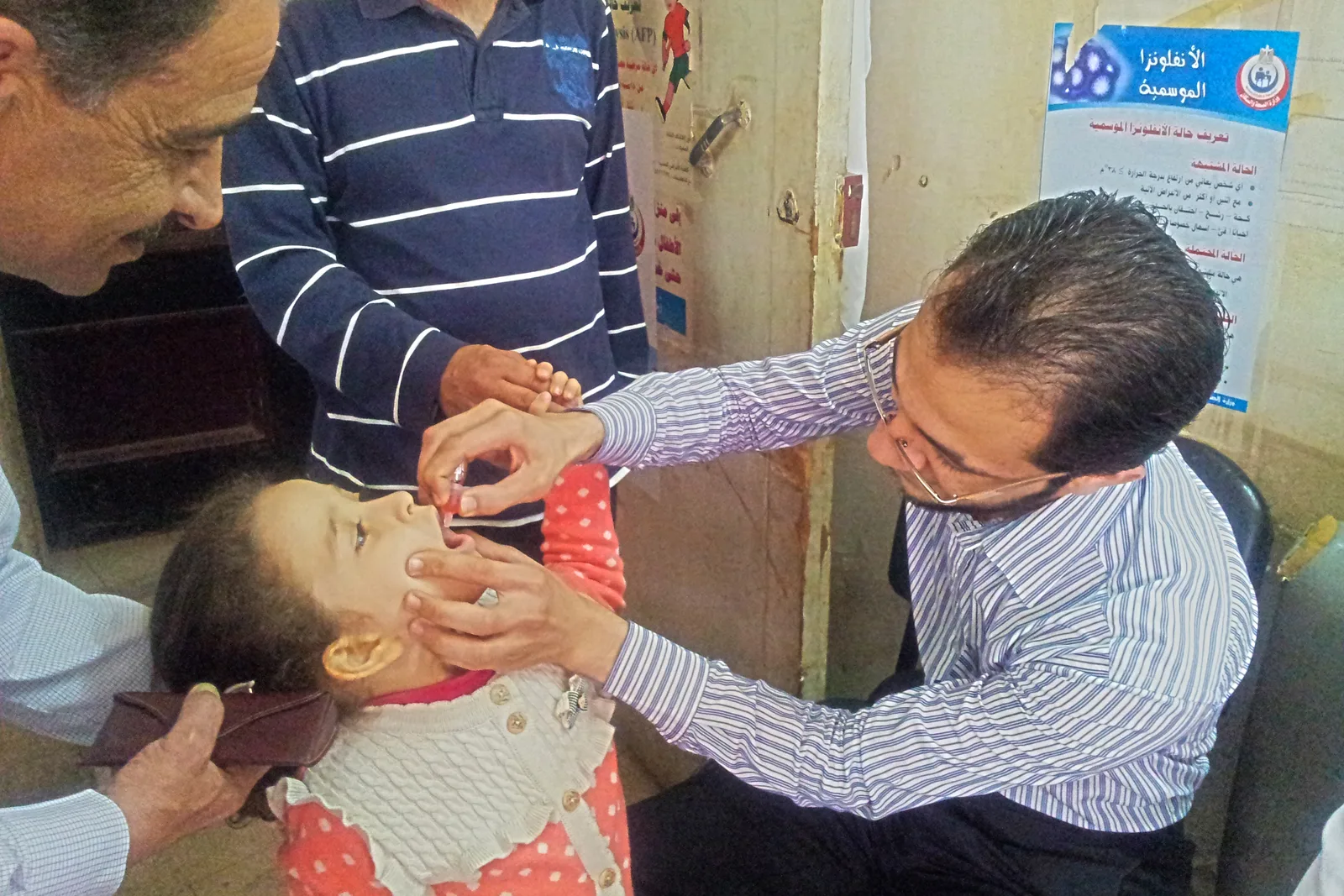
At a small health clinic in a working-class neighborhood, a line of mothers has been standing on the stairs since morning. A baby in his mother's arms tugs at the edge of her headscarf and wails; a nurse repeats, in a voice worn smooth by years of saying it, that the mother should open her little one's mouth: two drops and it's done. Five seconds, no more — two drops on the tongue, a smudge of purple ink on a small finger, and the line shuffles forward. It is a composite scene, not a single recorded moment, one that has played out across Egypt millions of times over the decades. And that very ordinariness — the fact that nothing worth mentioning happens — is the whole story we are telling today.
Every year on October 24, the world marks World Polio Day. Rotary International, the organization behind the observance, says it chose the date to honor the birth of Jonas Salk, the American scientist who led the team that developed the first polio vaccine — an injectable, inactivated shot — before Albert Sabin followed with a cheaper, easier-to-administer oral vaccine, the one behind the familiar "two drops." Published sources, however, date Salk's birth to October 28, 1914, not the 24th, so that detail is attributed to those who tell it, not verified on our end. As for the year the observance itself began, we have not been able to confirm it from a reliable source as of this writing, so we stick to what is established: the date and what it stands for.
Polio, or poliomyelitis, is a virus transmitted mainly through the fecal-oral route — meaning contaminated hands, water, and food — and it strikes mostly children under five, though anyone unvaccinated is at risk regardless of age, according to a World Health Organization fact sheet. One in every 200 infections ends in irreversible paralysis, usually in the legs; among those paralyzed, 5 to 10 percent die when the muscles that control breathing stop working. There is no cure — only prevention.
About four decades ago, the world lived with this virus the way it lives with the weather. The World Health Organization estimates that 1988 alone saw roughly 350,000 paralysis cases across more than 125 endemic countries. Since that year, with the launch of the Global Polio Eradication Initiative, wild poliovirus cases have fallen by more than 99 percent, and as of this writing endemic transmission persists in only two countries: Afghanistan and Pakistan. The organization says more than 20 million people are walking today who would otherwise have been paralyzed, thanks to that effort.
Egypt's share of that number is substantial. On the day Egypt's polio-free status was announced, then-Health Minister Hatem Mostafa El-Gabaly — as quoted by news agencies on the day of the announcement, February 2, 2006 — said something worth remembering: that polio "had been endemic in our country throughout recorded history," and that "the tools of our age have finally defeated this enemy that has accompanied us since pharaonic times." That was not just rhetorical flourish. Many researchers believe a votive stela of a man named Roma — described as a temple gatekeeper, though sometimes referred to as a priest — from the Eighteenth Dynasty, now held at the Ny Carlsberg Glyptotek in Copenhagen, shows him making an offering to the goddess Astarte while leaning on a staff, his right leg withered — the earliest known depiction of the disease. That remains a scholarly inference, not a certainty, as far as we know.
The road from endemic to polio-free was not a single leap but slow, painstaking work. In September 2000, Egypt launched what is known as environmental surveillance: collecting samples from sewage systems and testing them for the virus, alongside the traditional surveillance that tracks acute flaccid paralysis cases among children. By 2001 the network covered eleven sites in eight governorates, expanding to thirty-three sites in eighteen governorates by June 2004, according to a report by the US Centers for Disease Control and Prevention. The logic behind it was simple: the virus is shed in feces, so finding it in the sewage system tells you it is still circulating even before a single child is paralyzed.
Then the end came quickly. The last two wild poliovirus type 1 cases were recorded in Upper Egypt: one in June 2003 in Abu Qurqas, Minya governorate, and another in May 2004 in Deirut, in neighboring Assiut governorate. A National Immunization Days round in April 2004 — a scheduled round under the program, not a reaction to any specific case — reached 11.3 million children, up roughly 15 percent from the 9.8 million reached in the December 2002 round, according to administrative data cited in the CDC report. The direct response to the May case was two "mop-up" rounds in June and July of that same year, as the report explicitly states. After that, the wild virus never turned up in an Egyptian child again.
On February 2, 2006, the World Health Organization declared Egypt — along with Niger — polio-free, stating that the virus had infected no one in either country for a full twelve months. It is worth noting that those twelve months were not counted from the last paralysis case — Egypt's last case was in May 2004, roughly twenty-one months earlier — but from the last time any trace of the virus had actually been found: the last wild poliovirus in Egypt was picked up from a sewage sample in mid-January 2005, according to a published study on the country's environmental surveillance. At the time, only four countries remained on the endemic list: Afghanistan, India, Nigeria, and Pakistan. India came off the list years later, then Nigeria, until only two remained. Egypt, in other words, had not been a bystander to a battle fought elsewhere in the world — it was one of the fronts closed through its own people's efforts, while two fronts stayed open further east.
But the word "free" is often misread. It does not mean the virus has become impossible here — only that it is no longer transmitted locally and continuously between people. The Global Polio Eradication Initiative states this plainly on its own page for polio-free countries: until polio is fully eradicated from the planet, every country remains at risk of importing the wild virus, as has in fact happened in a number of them. Certification, then, is not a wall around a border, nor a document filed away in a drawer; it is a recognition of a present condition, renewed through work, not paperwork.
The proof came from Egypt itself just six years later. A World Health Organization statement published on February 11, 2013, reported that wild poliovirus type 1 had been isolated from two sewage samples collected on December 2 and 6, 2012, from two areas of Greater Cairo, and that genetic analysis showed it was closely related to a virus circulating in northern Sindh province, Pakistan. It matters to state clearly here, without exaggeration or understatement, exactly what that statement itself said: the virus was found only in sewage, and no paralysis case was recorded. In other words, the network built since 2000 caught the virus before it paralyzed a single child.
What followed explains why national campaigns keep recurring in a country that is already "free." Between February 2 and 6, 2013, more than 155,000 children in the two affected areas received the trivalent oral vaccine, and — according to the same statement — a campaign was planned for early March targeting three million children across all of Cairo with the monovalent type 1 oral vaccine, followed by a nationwide campaign in April targeting twelve million children. Something similar played out again between 2020 and 2021, when the same surveillance network picked up a vaccine-derived poliovirus type 2 — distinct from the wild virus — in sewage samples: eleven isolates from six governorates by the end of February 2021, according to a study published in 2024 in a peer-reviewed scientific journal, prompting immunization campaigns in response. None of this was a reaction to a disaster that had already happened; it was disaster prevented before it happened — the hardest kind of work, and the least thanked, because its complete success means nothing happens worth telling.
Here lies public health's cruelest paradox: the more it succeeds, the more it fades from memory. An entire generation of Egyptians no longer sees children around them paralyzed by this disease — even though survivors of its earlier waves still live among us — and to the young, its name survives only as a line in a school textbook. When a disease disappears from view, talk of preventing it starts to feel, to some, like an indulgence, and rumors find fertile, empty ground to take root in. The reference point here should not be what circulates in phone messaging groups, but what the World Health Organization, UNICEF, and the country's health authorities publish — statements that are available, written, and dated, and that anyone can go back and check.
Return now to the line we began with, on the stairs of the health clinic. The mother carrying her infant is not thinking about Abu Qurqas in 2003, or a sewage sample from 2012; she just wants this to be over quickly so she can get to the market before noon. But those five uneventful seconds are exactly what lets the children outside in the street keep running after a plastic ball on two healthy legs. "Polio-free" is not a certificate hung on a wall — it is a promise renewed every year, a line on a staircase, and two drops on a small child's tongue.
Related Stories
World Toilet Day: Four in Ten Egyptians Fall Outside “Safely Managed” Sanitation, UN-Water 2024 Data
On November 19 the world marks World Toilet Day. UN-Water data for 2024 says 57% of Egyptians use safely managed sanitation, meaning about four in ten fall outside that measure. But what does “safely managed” actually mean, and how does it differ from access? A definition first, then the number, then what ministry statements and the Decent Life targets say.
November 19, 2026 · 8 min read

From Sharm el-Sheikh to Antalya: What Is COP, and What Remains for Egypt From Hosting the 2022 Climate Conference?
The name “COP” is back in the news. The 31st climate conference is scheduled for Antalya from 9 to 20 November 2026, per the UN climate secretariat’s timetable. This article reports nothing from its sessions. It explains what COP is, how it decides by consensus, and what remains for Egypt from hosting in Sharm el-Sheikh in 2022: a decision creating a loss and damage fund, and funding targets rather than money spent.
November 8, 2026 · 9 min read
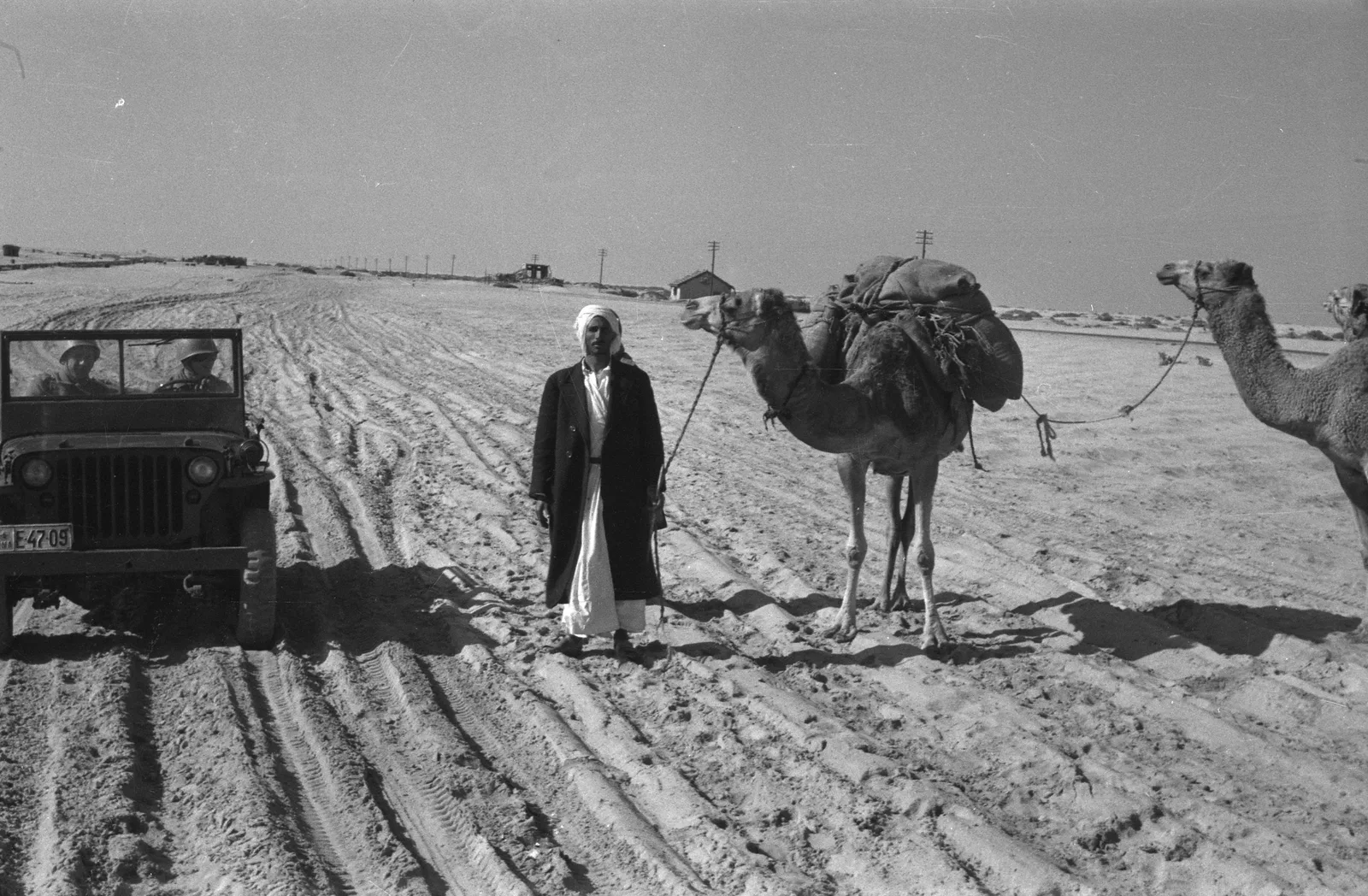
Seventy Years Since the Tripartite Aggression: Nine Days That Birthed the First Peacekeeping Force
In the autumn of 1956, it wasn't just the map that changed but the rules of the game: the UN General Assembly met in emergency session, Resolution 998 demanded a plan for an emergency force within forty-eight hours, and the first blue-helmeted soldiers reached Egypt by mid-November. A story documented in dates, whose protagonists are international law and a city called Port Said.
October 29, 2026 · 8 min read