Eighty Million Years Before the Pharaohs: Mansoura's Dinosaur and the Oasis Fossils the War Burned
Egyptian students from Mansoura University pulled from the rocks of Dakhla Oasis the bones of Mansourasaurus, the most complete Late Cretaceous dinosaur skeleton ever found in Africa. A century before them, a German scientist laid the dinosaurs of Bahariya Oasis to rest in Munich, and the war burned them. The story of the Earth's archive in Egypt's desert, and of a science your child can study here.
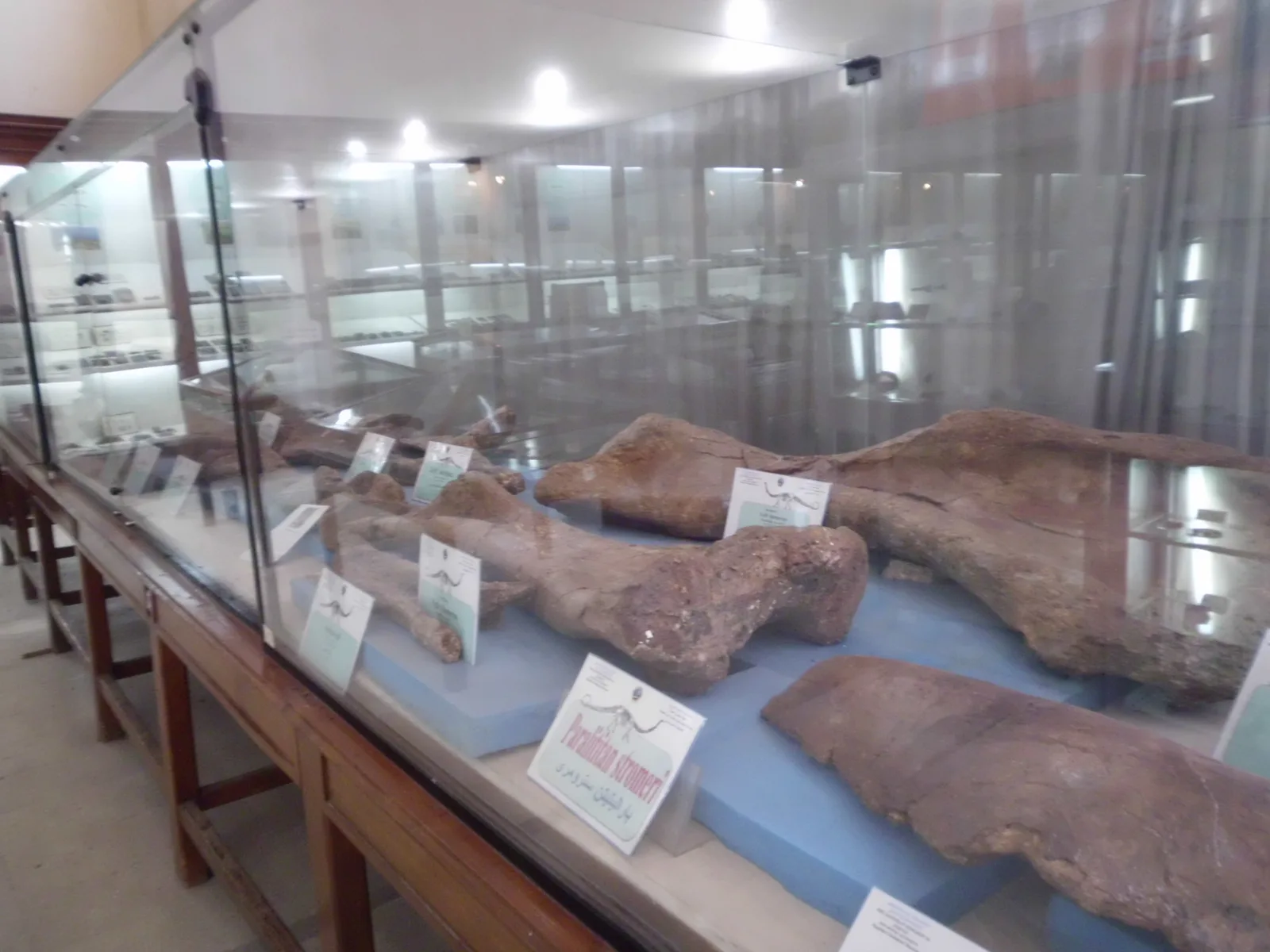
In a car heading down the Oases Road, the children are asleep in the back while the Western Desert stretches away on either side like a sea of gravel and yellow sand. The father is thinking about the cost of petrol and when they will arrive; the mother is thinking about the food she packed in the bag. It occurs to no one in the car that this parched ground was once a warm coastline where rivers ran and creatures the length of a school bus walked, or that what lies directly beneath the tyres are pages of a book far older than the temples, the tombs and everything else we call antiquities.
When we say "antiquities" in Egypt, we automatically mean the traces of human beings: a statue, a tomb, a papyrus. But there is another kind of heritage no less valuable, the traces of life millions of years before there were people, and Egypt is among the richest countries on earth in it. This is the story of that second kind: of two generations of scientists separated by a world war, and of Egyptian students who put their university's name on a dinosaur now taught by name in universities around the world.
Let us begin with the most recent chapter. In Dakhla Oasis, hundreds of kilometres south-west of Cairo, a team from the Mansoura University Vertebrate Palaeontology initiative, led by Dr Hesham Sallam, worked to extract bones from the rock. On 29 January 2018 the discovery was published in Nature Ecology & Evolution, a scientific journal of the Nature group, and the animal was given the name Mansourasaurus shahinae: the first half for Mansoura University, the second in honour of Mona Shahin, one of the founders of the university's vertebrate palaeontology centre.
Mansourasaurus is a titanosaur, a member of the group of long-necked, plant-eating dinosaurs. It lived around eighty million years ago, in the Late Cretaceous, and was about as long as a school bus and roughly as heavy as an adult African elephant, which is modest by titanosaur standards. What makes it important is not its size but the fact that it is the most complete dinosaur skeleton ever found on the African continent from the late part of that period: pieces of the skull and lower jaw, vertebrae from the neck and back, ribs, most of the shoulder and forelimb, part of a hind foot, and fragments of the bony plates that studded its skin.
Why does that matter? Because the Late Cretaceous in Africa was a gaping hole in the fossil record. The continents had begun to drift apart, and many scientists assumed that Africa had spent those millions of years in isolation, with its creatures evolving on their own. The bones of Mansourasaurus said otherwise: their analysis showed that its closest relatives were the dinosaurs of Europe and Asia, not those of southern Africa or South America. Animals, in other words, were moving between Africa and Europe at the time, and the continent was not the cut-off island it had been taken for. One line in the map of the Earth's history was rewritten with bones lifted out of the rocks of Dakhla.
More important than the scientific line is who wrote it. The official announcement of the discovery noted that the students Iman El-Dawoudi, Sanaa El-Sayed and Sara Saber were part of the field team and took part in the study of the new dinosaur, and that El-Dawoudi played a particular role in analysing the skeleton and recording many observations on it, working as researchers in an international team that included scientists from the Field Museum in Chicago, the Carnegie Museum and Ohio University. That detail deserves a pause from every father and mother in Egypt: young Egyptian women from a provincial university, not a foreign laboratory, stood in the desert and pulled from its rocks a dinosaur that carries their university's name. The science here was not imported. It was made.
Now we go back a century, to the first chapter, and the most bitter. At the start of the twentieth century, between 1910 and 1911, the German palaeontologist Ernst Stromer arrived at Bahariya Oasis and found there the first dinosaur bones ever unearthed on Egyptian soil. In 1915 he published his description of an astonishing creature he named Spinosaurus aegyptiacus, the Egyptian spined lizard: a giant predatory dinosaur carrying a sail of bone on its back, counted among the largest predators ever to walk the earth, and possibly longer than Tyrannosaurus itself. Today every child who loves dinosaurs knows the shape of Spinosaurus; few know that its full name carries the word "Egyptian".
The bones were shipped to Munich and kept in the Bavarian State Collection of Palaeontology. Then came the Second World War. Sources relate that Stromer, an opponent of the Nazis, begged the museum's director to move the collection to a safe place outside the city; the director, a supporter of the regime, refused, confident that the German air force would protect the cities. In late April 1944 the Royal Air Force bombed Munich, the Academy building took a direct hit, and the entire collection burned. Every Bahariya fossil known at the time, including the first skeleton of Spinosaurus, then the only one in existence, was reduced to ash. Creatures that went extinct twice: once millions of years ago, and once by human fire.
All that survived of those fossils were Stromer's drawings and published descriptions, and for decades Bahariya remained more a name in books than a site yielding new dinosaurs. Then came the year 2000, when an American expedition went to Bahariya and found, at Gebel Fagga, the partial skeleton of a colossal sauropod. In June 2001 Joshua Smith and his colleagues published their description in Science, volume 292, and named it Paralititan stromeri, which means roughly "Stromer's giant of the tidal flats". Fifty-seven years after his work went up in flames, the man's name was back in print on one of the most massive creatures ever to walk the earth, with studies putting its weight at tens of tonnes.
A single thread runs from the ashes of Munich to the bones of Dakhla: Egypt's rocks never ran empty; what they lacked was someone to dig into them with the tools of this age. Today, as far as we know at the time of writing, the same Mansoura University team is working at Stromer's old sites in Bahariya, and has announced the bones of the first flying reptile ever found in Egypt, along with a vertebra from a predatory dinosaur, from the very rock formation in which Stromer worked. What was lost in the war will not come back, but the ground that gave it up is still here, and it is still giving.
For anyone who wants to see this archive with their own eyes rather than in photographs, Wadi El Hitan, the Valley of the Whales, in Fayoum, on UNESCO's World Heritage List since 2005, preserves fossils some forty million years old that you can walk among; a full travel feature on it will be published on this site on 24 September.
The message we take from this story is simple and weighty at the same time. Egypt is an archive of the Earth's history, not of human history alone. Its rock strata preserve coastlines that receded, rivers that dried up and creatures that resemble nothing alive today, and those strata are not guarded by gates and tickets but by people knowing what they are worth. A stone holding a fossilised bone might be broken up to build a wall, sold for a pittance to a tourist, or left where it lies to wait for someone who can read it. The only difference between the three outcomes is awareness.
And there is a message closer to home. Palaeontology is no longer something studied abroad and then recounted to us. The young women who wrote Mansoura's name on a dinosaur studied at an Egyptian university, trained in the Egyptian desert and published in an international journal from Egypt. The child asleep on the back seat of the car crossing the Oases Road could, fifteen years from now, be the one who pulls the next name out of these rocks, and that is not an imported dream but a path that already exists.
So when that car comes home from its trip and the father glances in the mirror at the desert receding behind him, it might be fitting to tell the children something simple when they wake: this land that looks empty to you was, eighty million years ago, full of life; some of what lived on it is still asleep beneath it; and at a university near you there are people who know how to wake it. That sentence could be the first lesson in a science that deserves to be taught in our homes before it is taught in our schools.
Related Stories

Egypt in Space: A National Agency and the Satellites Watching Land and Water
The Egyptian Space Agency was created by law in 2018, but Egypt's satellite story is older: from EgyptSat-1 to Tiba-1 and NExSat. Why does a farming country need a space programme? The answer lies in its fields, its water and its remote villages.
August 18, 2026 · 6 min read
Zohr: The Discovery That Redrew the Eastern Mediterranean's Energy Map
In the summer of 2015, Eni announced the discovery of the Zohr field off Port Said — described at the time as the largest gas find in the Mediterranean's history. This is the story of the discovery, how gas is produced from the deep sea, and why it changed Egypt's place on the regional energy map.
August 18, 2026 · 6 min read
A Camera Over the Wounded: Filming and Sharing Accident Victims Is Not “Documentation” but a Violation Punishable by Law
Raised phones ring the injured man before paramedics do, and the video reaches family group chats before the news reaches his relatives. Kedda Ghalat (“that’s wrong” in Egyptian Arabic) names the behaviour, explains why it obstructs rescue and strips dignity, what the Constitution, Law 175 of 2018 and the Telecommunications and Intellectual Property Laws say, why Article 309 bis does not apply on a public road, and what to do instead.
September 7, 2026 · 8 min read