Egyptian Blue: History's First Synthetic Pigment Is Back, Lifting Fingerprints and Lighting Up Cells
A blue that Egyptian chemists made from sand, copper and lime thousands of years ago turned out, in 2013, to break apart into nanosheets that glow in the infrared. It has since become a powder that reveals fingerprints in Australia and a probe that lights up fly embryos and plant leaves in Germany. The story of an ancient material with a thoroughly modern property, and a question about our own laboratories today.
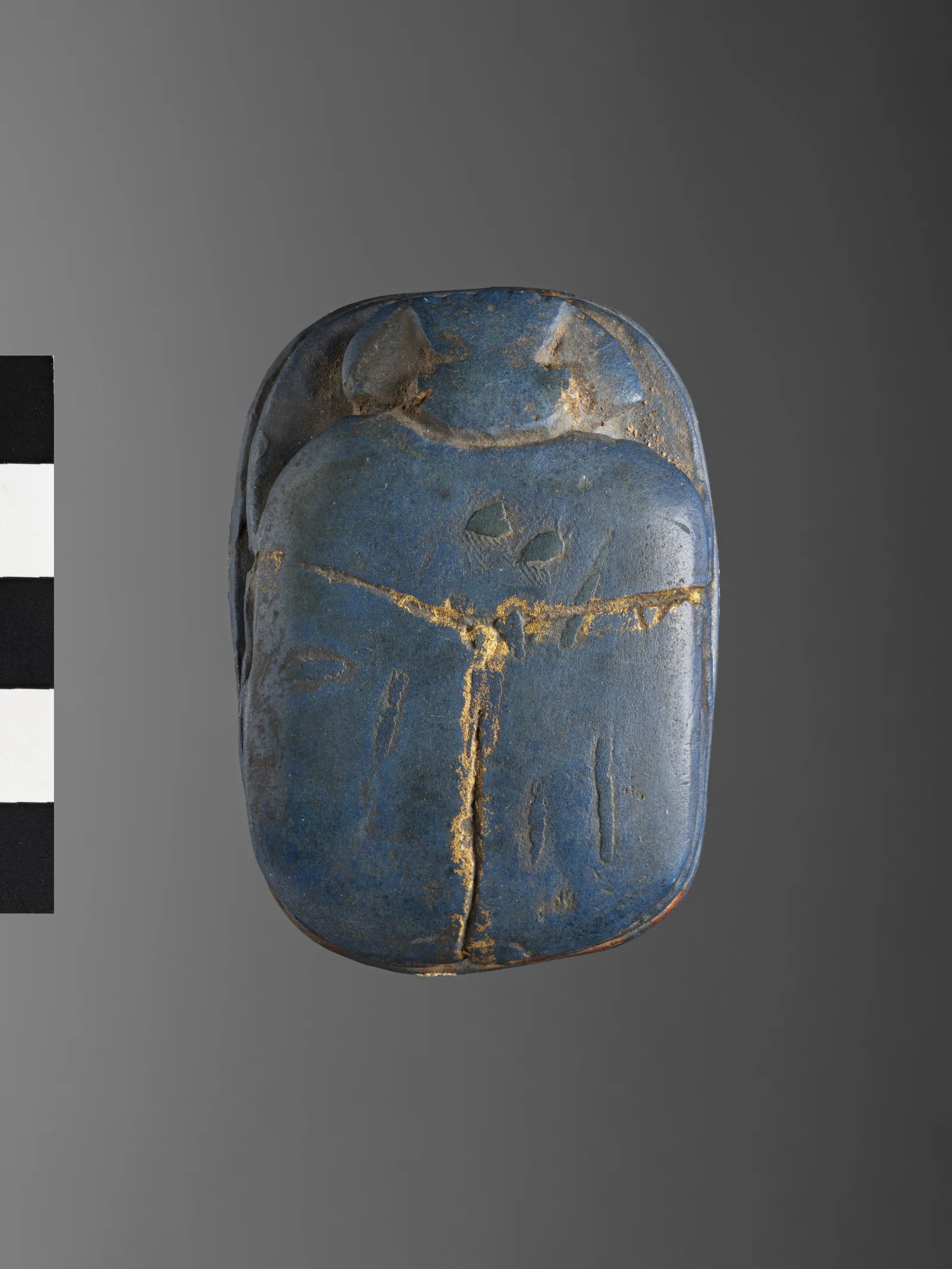
In one of the halls of the Egyptian Museum, a visitor stops in front of a painted wooden coffin or a fragment of an ancient wall painting, held by a patch of blue that is still vivid after all these centuries. He leans in, reads the small label, then moves on to the next piece. He most likely has no idea that this blue came from neither a gemstone nor a plant, but was manufactured in Egyptian kilns, or that scientists in far-off universities are today chasing its secrets under the microscope.
The material scientists call Egyptian blue is, chemically, calcium copper silicate. The ancient Egyptians ground sand, lime and copper or its ores, then heated the mixture in a kiln until it fused into a blue mass, which was ground in turn into a pigment. The scientific literature describes it as the first synthetic pigment ever made by humans: the first colour that did not exist ready-made in nature but was created by people, with their hands and their knowledge.
On its age, the sources differ slightly. A press release from the University of Georgia in the United States puts it at around 5,000 years, while Australia's Curtin University says it was first made before 3200 BC. Whatever the exact figure, it is certainly at least 4,000 years old, and according to the same Australian release it remained in use until about the fourth century AD, before its recipe faded from memory for centuries.
Here we need to choose our words carefully. The ancient Egyptians knew nothing called "nano", and they never set out to achieve what scientists have recently discovered. But they were, without exaggeration, history's first materials engineers: they learned that a specific blend of specific raw materials yields a specific colour once the fire reaches the right temperature, and they mastered reproducing it consistently over centuries. That in itself is science, even if it was never written down as equations.
The modern story began in February 2013, when a University of Georgia team led by the researcher Tina Salguero published a study in the Journal of the American Chemical Society. The team found that calcium copper silicate breaks down into nanosheets so thin that thousands of them would fit side by side across the width of a single human hair, and that these sheets emit near-infrared radiation invisible to the eye, the same kind of radiation used by remote controls and car key fobs.
The paradox that caught scientists' attention was that a material which had survived thousands of years on tomb walls turned out to fall apart easily when stirred in hot water, as Scientific American reported. The researchers even managed to print these sheets with ordinary inkjet printers, which opened the door to the idea of a "nano ink" that looks unremarkable to the eye but gives off an infrared signal that can be picked up with a suitable device.
The material also has an economic advantage no less important than its physical one. Most materials that emit in the infrared range depend on rare-earth elements, which are expensive and unevenly distributed around the globe. Egyptian blue, by contrast, is made of calcium, copper, silicon and oxygen, cheap and abundant elements, which the researchers saw as a potential economic and environmental benefit.
The first application to move out of the laboratory and into the tangible world came from Australia. On 24 May 2016, Curtin University announced a study published in the journal Dyes and Pigments, in which a team led by Professor Simon Lewis used finely ground Egyptian blue powder to detect latent fingerprints on patterned and reflective surfaces where conventional powders usually fail, among them, according to reports on the study, polymer banknotes. All an investigator needs is a cheap white light source and an ordinary digital camera with a simple modification to capture what the pigment emits in the infrared range.
Then came the biggest leap, in 2020, when a team from the University of Göttingen in Germany, together with partners from the University of California, Riverside, published a study in Nature Communications. The team measured the emission of Egyptian blue nanosheets and found it at around 910 nanometres. More importantly, this emission does not fade with prolonged exposure to light, unlike the usual organic dyes such as rhodamine, which bleach quickly under a laser. In practical terms, that means a researcher can watch a sample for hours without the marker going dark.
The team used these sheets as fine probes inside fruit fly embryos, tracking the movement of each individual particle in the space between cells to read off the mechanical properties of the tissue. They noticed that particles closer to the cell nuclei moved within a narrower range, which the researchers interpreted as the medium around the nuclei being denser. They also introduced the sheets into the leaves of the plant Arabidopsis by infiltrating the solution into the leaf with a needleless syringe, a routine technique in plant laboratories, and the sheets remained visible by their distinctive signal. All of this was captured with ordinary, low-cost silicon cameras, not the nitrogen-cooled cameras that many infrared materials require.
Why does this matter? Because near-infrared light penetrates living tissue better than visible light, which is why researchers are betting on it for biomedical imaging, for security inks that protect documents against forgery, and for optical communications devices. Honesty requires saying, however, that everything above, as of the time of writing and to the best of our knowledge, remains within the realm of research and laboratory experiments, and has not yet become a medical product used on patients.
Which brings us back to the question of pride, because it is a conditional pride. The precise truth is that a modern property was discovered in an ancient material, not that our ancestors deliberately hid a nano-secret in the walls. What genuinely deserves pride is that the ancient Egyptians chose the right raw materials, controlled their fire, and repeated their recipe thousands of times with one and the same result, leaving the world a material so stable that twenty-first-century scientists found in it what they could not find in materials designed in the most advanced laboratories.
And the question that comes back to the reader: where do today's laboratories stand in relation to this heritage? The three studies on which this article is built came out of Georgia, Perth and Göttingen, in collaboration with Riverside. But the picture in Egypt is not empty. Conservators in the wood laboratory of the Grand Egyptian Museum's Conservation Center used, in a study published in 2017, the infrared luminescence of Egyptian blue to map its distribution on a painted wooden coffin from the Late Period, even where its traces were faint or mixed with other pigments, which is the very same use of the property the world is chasing. And researchers from the National Research Centre and the Housing and Building National Research Center synthesised the pigment at the nanoscale in 2023 for decorative and anti-corrosion coatings. As for bio-imaging or fingerprint detection with nanosheets, we could find no published Egyptian study as of the time of writing, though that may reflect a gap in what has reached us rather than in what exists. The raw materials are still here, sand, lime and copper, and the chemistry and physics students in our universities deserve to be told that a material bearing their country's name holds an open field of research whose doors have not yet closed.
And when that visitor returns to the same hall on a future visit and stands before the same patch of blue, perhaps he will see it with different eyes: not merely a beautiful colour, but a message from an anonymous chemist who compounded the first synthetic colour in history, a message that still arrives, in a light we cannot see, at laboratories he could never have imagined.
Related Stories
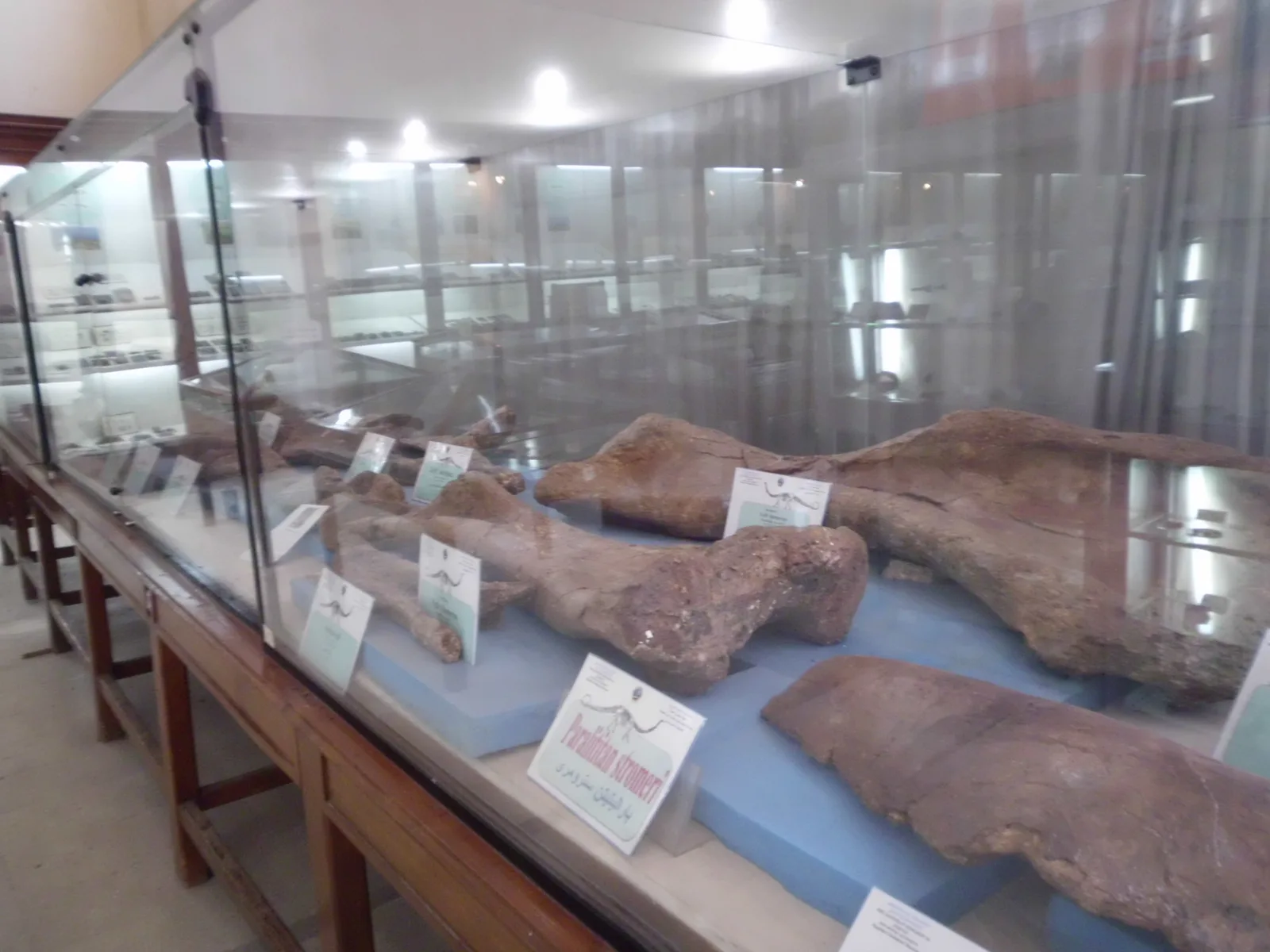
Eighty Million Years Before the Pharaohs: Mansoura's Dinosaur and the Oasis Fossils the War Burned
Egyptian students from Mansoura University pulled from the rocks of Dakhla Oasis the bones of Mansourasaurus, the most complete Late Cretaceous dinosaur skeleton ever found in Africa. A century before them, a German scientist laid the dinosaurs of Bahariya Oasis to rest in Munich, and the war burned them. The story of the Earth's archive in Egypt's desert, and of a science your child can study here.
September 8, 2026 · 7 min read

Egypt in Space: A National Agency and the Satellites Watching Land and Water
The Egyptian Space Agency was created by law in 2018, but Egypt's satellite story is older: from EgyptSat-1 to Tiba-1 and NExSat. Why does a farming country need a space programme? The answer lies in its fields, its water and its remote villages.
August 18, 2026 · 6 min read

Zohr: The Discovery That Redrew the Eastern Mediterranean's Energy Map
In the summer of 2015, Eni announced the discovery of the Zohr field off Port Said — described at the time as the largest gas find in the Mediterranean's history. This is the story of the discovery, how gas is produced from the deep sea, and why it changed Egypt's place on the regional energy map.
August 18, 2026 · 6 min read