From the Queue to the Screen: The Citizen, the Government Office and Digital Egypt
From the pre-dawn queue to the 'come back tomorrow' window, the journey through Egypt's government offices is a shared national experience. Now a documented digitisation drive — the Digital Egypt portal, home delivery of documents and electronic payment — is quietly rewriting the relationship between citizen and counter.

The scene is familiar in almost every Egyptian household. You wake before sunrise, gather a folder of photocopies, and head to the government office hoping to beat the crowd. There is a birth certificate to extract, a national identity card to renew, a signature to notarise, a pension paper to stamp. For generations this journey — the queue, the window, the stamp, and the instruction to come back tomorrow — has been among the most universal experiences of Egyptian public life, shared by rich and poor, by city dwellers and villagers alike.
The traditional route follows a script citizens know by heart. It begins at the photocopy shop that always operates beside the office, because no file is ever complete. It passes through the revenue-stamp window, then the clerk who inspects each paper, and it can end abruptly with a single missing document that restarts the whole journey on another day. The paperwork itself has its own vocabulary: the folder, the seal, the signature of the head of department, and the phrase that everything now awaits — pending approval.
This system did not appear by accident. Egypt has one of the oldest continuous bureaucracies on earth, and its modern form took shape in the nineteenth and twentieth centuries around paper records held in separate offices. The civil registry keeps births and deaths, the notary offices record contracts and powers of attorney, traffic departments hold licences, and supply offices manage ration cards. Because each authority historically kept its own ledgers, the citizen became the messenger, physically carrying stamped papers from one building to another to prove facts the state itself had recorded.
The cost of this journey has always been measured in more than patience. A worker loses a day's wages to renew a card. A villager travels to the district capital, sometimes more than once, for a paper that takes minutes to print. Elderly citizens and people with disabilities face buildings not designed for them. And wherever queues grow long and procedures grow opaque, a market appears for intermediaries who 'know someone inside' — a burden that falls hardest on those least able to pay.
This is the landscape that Egypt's digitisation drive is trying to change. The state's official online gateway, the Digital Egypt portal run under the Ministry of Communications and Information Technology, brings a growing bundle of everyday services onto a single website and application. Civil registry documents such as birth certificates can be requested online and delivered to the home. Notarisation services, supply-card procedures, some court-related requests and traffic services have all been brought, in whole or in part, into the electronic channel.
Using the portal follows a simple logic. The citizen creates an account with the national ID number and a mobile phone, chooses the service, fills in the details, pays electronically by card or mobile wallet, and receives the document by post or collects it from a designated outlet. For those without internet access or confidence online, the same services are offered through post offices and government service centres, where an employee completes the electronic request on the citizen's behalf — the counter remains, but the paperwork behind it has changed.
None of this would be possible without an older foundation: the national ID number. Since Egypt modernised its civil registry and issued computerised identity cards, every citizen has carried a single number that links records across authorities. That number is the thread on which digital services hang. When databases can speak to each other, the state no longer needs the citizen to carry proof of facts it already holds — and that, more than any website, is the real revolution under way.
The difference shows in small, concrete ways. A birth certificate once required a journey to the registry office of the place of birth — a serious trip for someone born in Aswan and living in Alexandria. Today it can be ordered from a phone and arrive by mail. A power of attorney can be booked by appointment instead of costing a full morning's wait. Each service moved online is measured not in technology but in recovered hours of people's lives.
The honest picture also includes the limits. Not every Egyptian has a smartphone, reliable internet, or the digital confidence to complete a form online, and older citizens in particular can find the new channel harder than the old queue. Some procedures still legitimately require presence — fingerprints, photographs, original signatures. And any electronic system is only as good as the data behind it; a mistake in a record still needs a human being to correct it. Digitisation shortens the journey; it has not yet abolished it.
For the citizen, a few habits make the new system work better. Official fees for each service are published on the portal itself, which is the surest defence against being overcharged. Every electronic request produces a reference number that should be kept until the document arrives. The post office, present in nearly every village, is the fallback counter for anyone who prefers a human face. And when a service exists online, asking for it there first often saves the trip entirely.
The queue in front of the government office will not vanish overnight; habits and systems built over a century do not dissolve in a decade. But the direction of travel is clear and documented: more services online, more delivery to the door, fewer journeys with a folder under the arm. The deeper change is in the relationship itself — from a citizen who petitions a window to a citizen who orders a service and expects it to arrive. That expectation, once planted, does not easily go away.
Related Stories
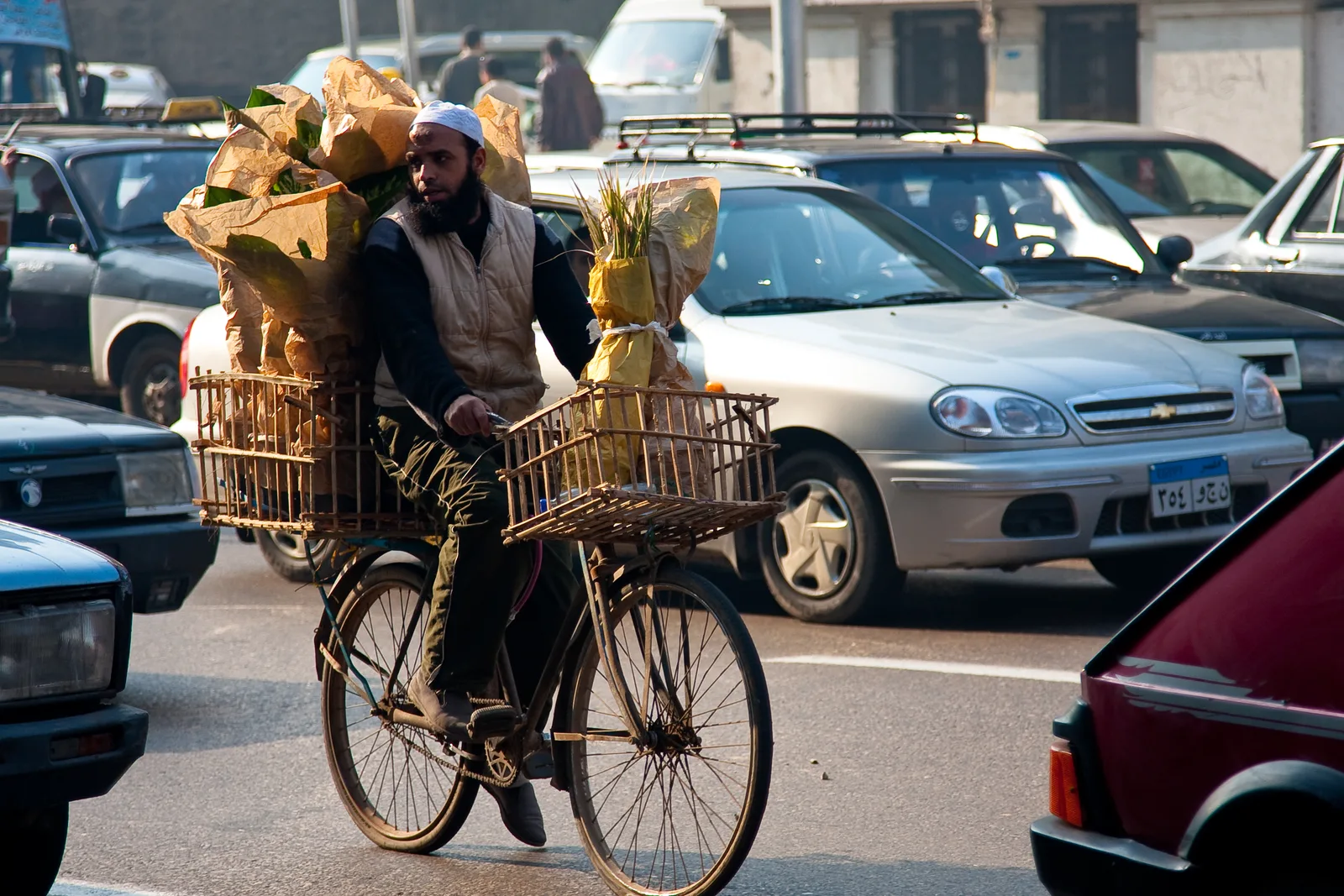
Two Wheels in the Gridlock: Where Does the Bicycle Stand on Egypt's Streets on Car-Free Day?
On 22 September the world marks Car-Free Day, while on our streets the bicycle threads its way between microbuses and along a painted lane with a car parked on it. From Cairo Bike to the "Your Bike, Your Health" scheme to a boy carrying a tray of bread on his head down a side street: a report on what any passer-by can see, and a single question: whom is the bicycle for in Egypt, and why does a safe lane remain a dream?
September 22, 2026 · 8 min read

Keda Ghalat (That's Just Wrong): Harming an Animal Has Been a Crime Under Egypt's Penal Code Since 1937
A neighbour sets out poisoned bowls beside the school wall; a cart driver beats his donkey across the face to make it haul a load beyond its strength. Many assume that "just an animal" means no law protects it. In fact, Articles 355, 356 and 357 of the Penal Code punish killing, poisoning and harming animals with penalties that go as far as prison. On the eve of World Animal Day, we explain what the law says and what the right thing to do is.
October 3, 2026 · 6 min read

Pink October: a free check-up at the nearest health unit – why early detection is changing the fate of Egyptian women
“Nothing hurts” is no reason to put it off. Since July 2019, Egypt's health units have opened their doors free of charge to every woman aged 18 and over, and by June 2026 the share of cases caught at a late stage had fallen from 60% to 19.5%. We explain what happens at the unit, which signs call for a visit, and why fear and stigma keep delaying this check-up.
October 2, 2026 · 7 min read