"That's Just Wrong": The Siren Is Right Behind You, and No One Moves
The siren draws closer, then stalls behind two lines locked bumper to bumper, as every driver waits for the other to move first. Article 7 of the Traffic Law's regulations obliges drivers to clear the way for emergency vehicles, and the WHO says a delay of minutes can mean the difference between life and death. So how is the lane actually made — and why is tailing an ambulance a hazard, not a clever move?
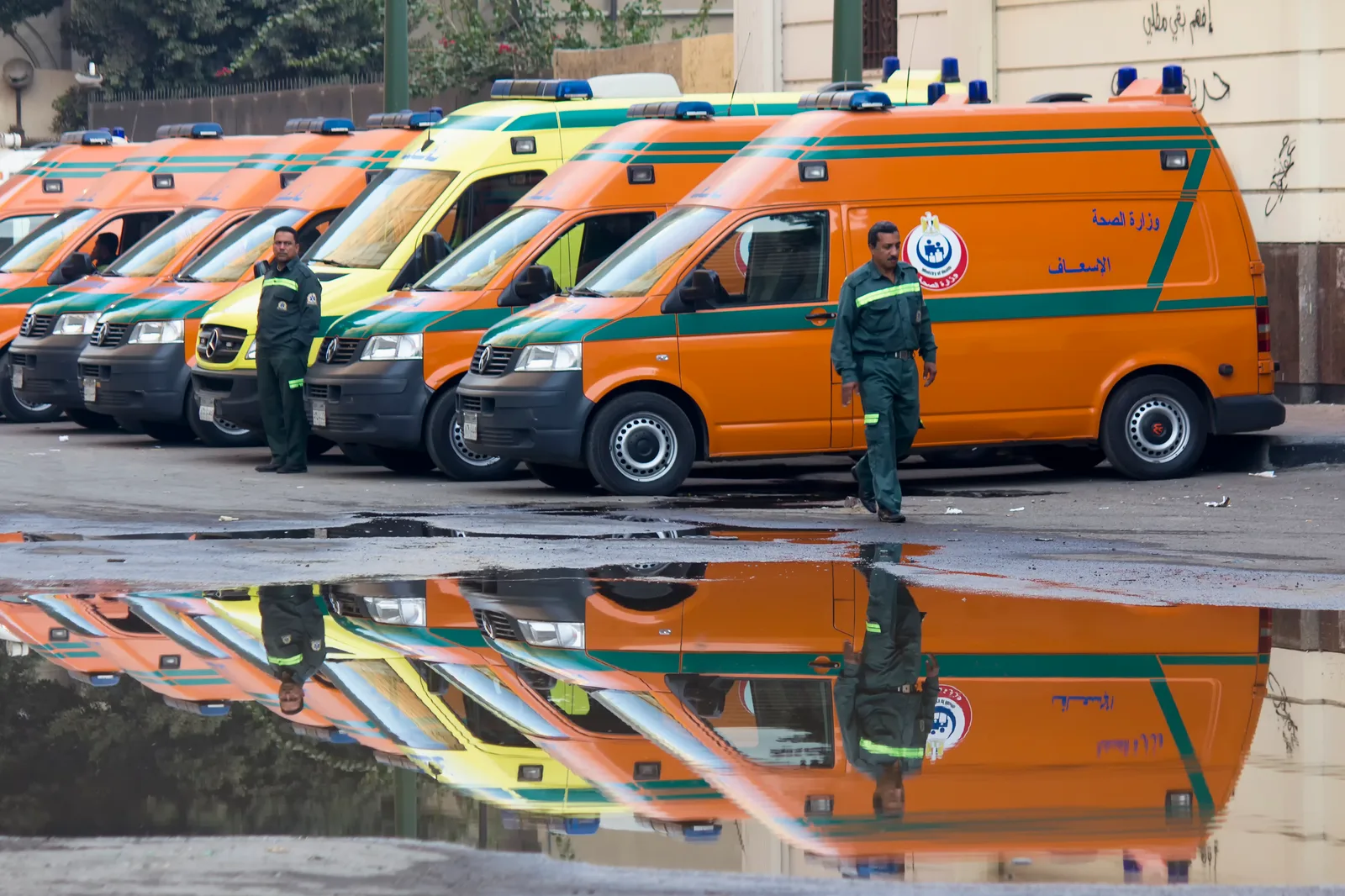
It's a scene that plays out almost every day: on an overpass familiar to anyone living on the outskirts of Greater Cairo, at half past five in the afternoon, two lines of cars sit locked together until the gap between them is no wider than a hand's breadth. Then, from a distance, a siren creeps closer until it is suddenly right behind the mirror, red and blue light flashing across the windshield. No one moves; each driver is convinced there is nowhere to move to, and that it should be the other one who goes first. Behind the back door of that white vehicle is a human being whose time is now counted in seconds, not minutes.
The behavior we're naming here plainly is not malice; most of the drivers stuck on that overpass would, if asked, carry the patient on their own shoulders. It has a simple name: the missing ambulance lane. It is a collective failing, not an individual one, and it begins with a single thought lodged in every driver's head: "I alone can't open the road." That thought is both true and false at once — true because one car cannot make a lane, and false because a lane is made by an entire line of cars each shifting half a meter, together.
The idea every driver needs to hold onto is this: the road doesn't need one whole lane cleared, just half a meter from each driver. When the cars in the left lane drift left and the rest drift right, a thread of open space opens between them — enough for an ambulance to pass through carefully. No one leaves their lane or mounts a curb; everyone shifts at the same moment. This arrangement is written into specific laws elsewhere: Section 11(2) of Germany's road traffic regulations (StVO) obliges drivers to form a "rescue lane" (Rettungsgasse) between the far-left lane and the one next to it on motorways and multi-lane roads outside built-up areas whenever traffic is moving at walking pace or has stopped. As far as we know, this exact arrangement is not spelled out word for word in Egypt's own regulations, but its spirit is precisely what Egyptian law asks for.
Article 7 of the executive regulations of Traffic Law No. 66 of 1973 states, according to the text published in the legal compendiums, that "drivers of vehicles and other road users must clear the way for the passage of authorized emergency vehicles" — fire trucks, ambulances and police cars — while they are moving on an emergency call. It permits them to use audible warning devices with distinctive tones, and red or blue light devices that "radiate for a distance of no less than 150 meters." But that condition applies only to the light: the flashing is designed to be seen from far away, not to guarantee the warning always reaches you in comfortable time — a bend, a tunnel or a row of buses can block it. The siren and the light together are a legal notification, not a display. Failing to clear the way is a punishable offense, and the size of the fine shifts with each amendment, so the reference point is whatever law is currently in force; what the newspapers reported in early 2026 about proposed amendments remains, as of this writing, draft legislation under discussion, not law in effect.
Why all this insistence? Because here, time is not a luxury. The World Health Organization, in its fact sheet on road traffic injuries — which we consulted in September 2026 — states that about 1.16 million people die every year in road crashes worldwide, and that more than half of them are the most vulnerable road users: pedestrians, cyclists and motorcyclists. It describes post-crash care as extremely time-sensitive, stating verbatim that "a delay of minutes can mean the difference between life and death." We do not cite a figure for ambulance response time in Egypt, because we know of no published official source for one.
The lane usually doesn't close for one single reason, but through layers of small habits: a street that's narrow to begin with, a second row of parked cars swallowing half its width, cars entering an intersection knowing they won't clear it and stopping dead in the middle like a dam, rolled-up windows and a loud radio that delay the siren's arrival by precious seconds. Each habit is small on its own; together they form a wall in front of a car carrying a human being.
But the most dangerous part of this scene comes after the lane opens, not before. The moment the ambulance passes through, one driver tells himself the road has cleared, and tucks in right behind it as if joining a motorcade. He thinks it's a clever move; it is in fact one of the most dangerous things a driver can do on the road. The first reason is that the lane doesn't stay open — it closes again right behind the ambulance, because the drivers who shifted aside move back to where they were, and the tailgater finds himself inside a lane that no longer exists, squeezed between two cars closing in on him.
The second reason is that the ambulance may suddenly slow at an intersection or a speed bump the tailgater cannot see from behind it, and he rear-ends it; what gets hit here is not a sheet of metal but a patient, a paramedic and equipment. The third is that the following driver holds no privilege at all — no siren, no lights, no emergency status. Article 7 itself lifts the traffic rules only for the authorized emergency vehicle on its mission, and even then only on condition it exercises the utmost care and doesn't endanger people or property; the exemption even lapses once it is returning from its mission, so all the more reason an ordinary driver has no business borrowing it. The fourth is that the cars that had pulled aside start moving again the instant the ambulance has passed, colliding without warning with whoever came right behind it, so the crash happens in the middle of the lane and shuts the road to the next ambulance.
It's worth remembering who is working inside that vehicle. The paramedic is not sitting belted in, watching the road; he is bent over a moving stretcher, securing an IV line, pressing on a wound, or monitoring a pulse. Every sudden jolt caused by a reckless maneuver behind or ahead of the ambulance is a shock that hits the patient and the paramedic alike. Clearing the way, then, is not a courtesy to the ambulance driver — it is protection for the person on the stretcher and for the person trying to save them.
So what should you actually do when you hear the siren? Start with early awareness: turn the radio down, and check both mirrors to work out where the sound is coming from — the worst response is one that comes only after the vehicle is already alongside you. Then ease calmly to the right if you're in a middle or right-hand lane, or to the left if you're in the left lane, using your turn signal to tell the drivers behind you what you intend to do. Don't brake suddenly, don't run a red light, and don't mount the curb; you hold no legal exemption, and a single crash caused by you closes the road instead of opening it.
If you're first in line at a red light with no space ahead of you, pull aside and hold your position, letting the ambulance maneuver through the gap you've created, rather than pushing forward into the intersection. If you're on a motorcycle, don't use the lane as a shortcut, and if you're on foot, don't cross in front of a vehicle approaching with its lights and siren on. And don't try to play hero by getting out to direct traffic with your hands; an ambulance can thread through narrow gaps if it finds them, but your body standing in the road is just one more obstacle.
If you are the one calling for an ambulance, Egypt's unified emergency number is 123, staffed around the clock and run by the Egyptian Ambulance Authority under the Ministry of Health and Population. When you call, give an actual address, not a general description: the street name and the nearest landmark, such as a mosque or a pharmacy, plus the building number and floor. More important than the call itself: send someone to stand at the entrance of the street or alley to flag the vehicle down, move your own car if it's narrowing the entrance, open the building's front door and the elevator, and keep your phone line free, since the paramedics may call you back.
In the end, the ambulance lane is not a favor we're doing the ambulance driver. It is closer to a collective insurance policy, one where each of us pays the premium, half a meter at a time, and then cashes it in fully on the day it's him lying on the stretcher, or his son, his mother, or his neighbor on it. And because no one knows when that day will come, the cheapest thing we can pay today is that small shift to the side.
The next time you hear the siren on a jammed overpass, don't wait for the driver ahead of you to move first. Check the mirror, signal, and ease half a meter aside, calmly. You'll likely find that the car in front of you has done the same, and that the whole line has shifted as though it had just been waiting for someone to start. And when the white vehicle passes through the thread of space you built together, don't tuck in behind it; let it go, and pull back into place. You may never know who was behind that door, and that alone is enough: you gave two minutes to a person you never saw, in a city where those two minutes might be an entire lifetime.
Related Stories
“That’s Wrong”: One Glance at the Screen — WHO Says Drivers Who Use Phones Are About Four Times as Likely to Crash
On the World Day of Remembrance for Road Traffic Victims, marked today on the third Sunday of November, we look at a habit seen on every street that seems harmless: the phone in hand behind the wheel. The World Health Organization says drivers who use a phone are about four times as likely to crash, and that hands-free kits are not much safer, because the problem is attention, not the hand.
November 15, 2026 · 8 min read
“Kida Ghalat”: Loudspeakers on a Residential Street After Midnight. Your Joy Is a Right, and So Is Your Neighbour’s Rest
A wedding marquee, a band and a loudspeaker beneath balconies where a student is revising, a sick woman is resting and a two-month-old baby is sleeping: when does a legitimate celebration become noise the law asks about? We separate a licensed hall, bound by the sound limits of the environment law, from a private street party, and propose an announced finishing time and sound aimed inward, so the joy and the neighbours’ night can both be kept.
November 6, 2026 · 8 min read
"That's Just Wrong": Digging Under the House for Treasure Finds No Gold — Only a Collapsing Roof and Years in Prison
The summer of 2026 alone brought a string of illegal digs that collapsed on people searching for buried treasure: five dead in Al-Qusiya, Assiut, in June; ten deaths in Assiut alone within less than a month, according to Masrawy; then three in Fayoum and one under an old house in Bilbeis in August. We tell what happened, explain what Egypt's Antiquities Protection Law says, and show how legitimate archaeological excavation actually works.
November 3, 2026 · 8 min read