'Baladi Is Better, White Is All Hormones': A Practice Banned 50+ Years Ago, the Real Risk Lies Elsewhere
A line repeated at nearly every Egyptian dinner table. Our verdict, after fact-checking: false. Growth hormones are proteins that break down in the stomach, and injecting twenty thousand birds several times a day is practically impossible; the real explanation is genetic selection and feeding programs. Consumer concern isn't misplaced, though: the real risk lies in veterinary drug residues and the withdrawal period before slaughter.
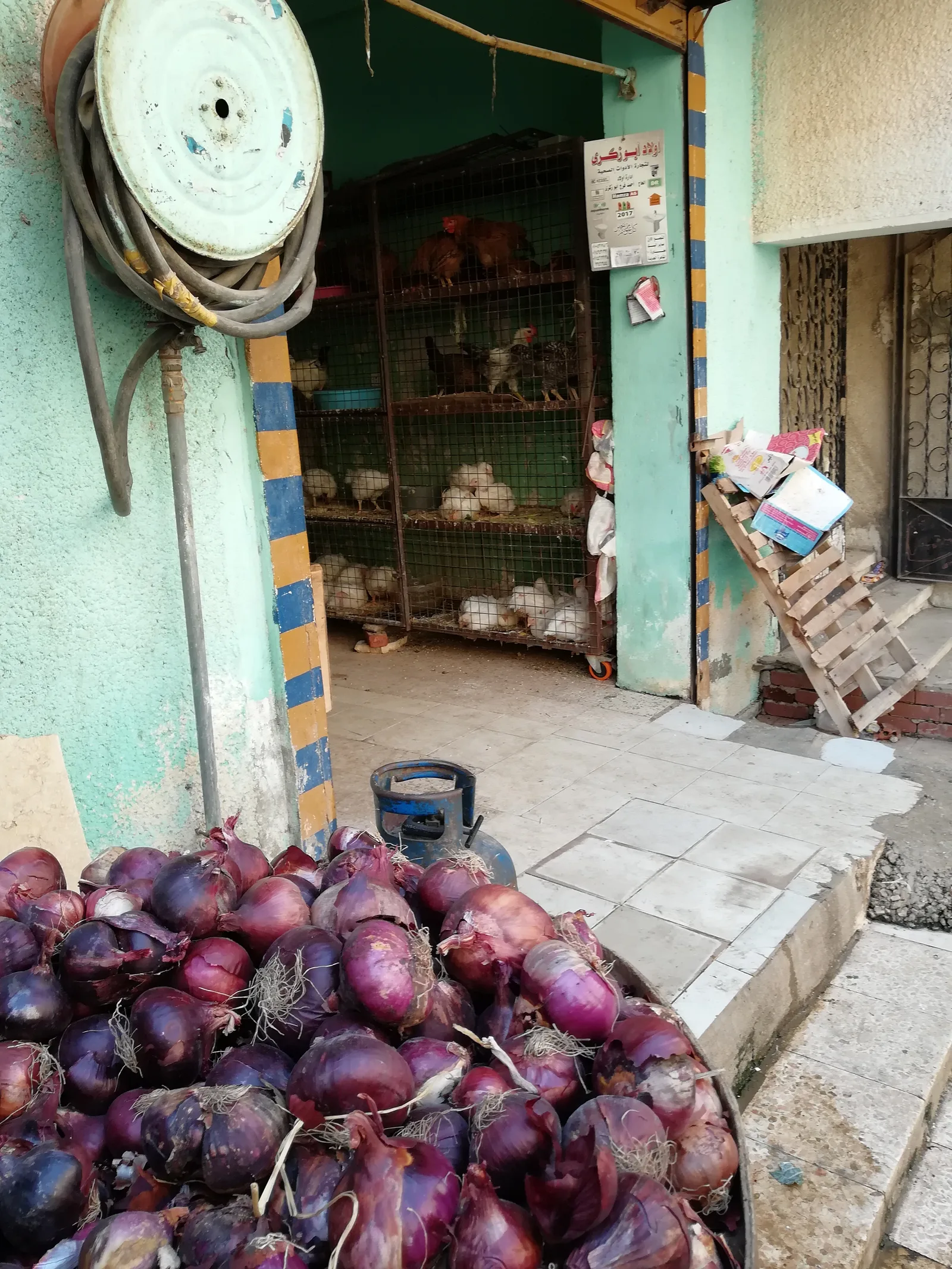
The scene repeats in countless kitchens: a mother returns from the market with a bag holding a plump white chicken, sets it on the counter, and hears the line she knew was coming: "You used to bring baladi — it was better. This white one is all hormones." (Baladi is Egypt's native, slow-growing chicken breed.) The grandmother says it with the confidence of forty years in the kitchen, while the little girl looks at the price gap between the two birds and can't understand how the cheaper one could be the more dangerous one. In many households the conversation ends right there: an inherited belief, a budget that can't stretch much further, and a quiet doubt that sits down with the family at the table every week.
The claim we're examining is specific: that white broiler chickens are given growth hormones to speed up their fattening, and that this explains their large size and how quickly they reach slaughter weight compared with baladi chicken. Our verdict, after reviewing the scientific and official sources available as of this writing: false. It isn't false because the industry is innocent of everything — we'll get to what should actually concern consumers shortly — but because hormones specifically don't serve the purpose attributed to them, neither biologically nor practically.
Start with the history. Mississippi State University's Extension Service notes that the use of hormones in poultry production was banned in the United States in the 1950s — roughly seventy years ago. The source speaks only about the United States, but the commercial breeds developed there are the same ones that spread worldwide, including those raised in Egypt — meaning they were shaped inside a production system where growth hormones aren't permitted, and as of this writing we are not aware of any licensed growth-hormone product for fattening poultry. The rumor, then, is older than most of the people who repeat it, and it has endured because it offers an easy explanation for something people see with their own eyes: a bird that grows at astonishing speed.
The first reason the story doesn't hold up is biological: growth hormones are proteins, and when a protein enters the stomach, enzymes break it down into its smaller units, stripping it of its ability to function in the body. That is why insulin isn't swallowed as a pill but injected — because the digestive system would neutralize it before it ever reached the bloodstream. So if someone mixed a growth hormone into chicken feed, it would be like pouring money into the feeders with no meaningful effect: the bird digests the substance like any other protein, gaining nothing from it in extra weight.
The second reason is purely practical. If a producer wanted to actually deliver the hormone into a bird's bloodstream, it would have to be injected — and the same source notes this would require repeated injections several times a day. A single broiler house holds twenty thousand birds or more, and a farm has several such houses. Imagine who would catch every one of those twenty thousand birds, several times a day, for the entire rearing cycle — then factor in the labor cost alone. No poultry industry in the world does this, and no economy could bear the cost in the first place.
So what makes a bird reach market weight in just a few weeks? Three factors combined: first, genetic selection — breeding companies have spent decades selecting the fastest-growing parent stock, to the point that the time needed to reach a target weight has been estimated to shorten by about one day every year. Second, feeding programs calibrated precisely to the breed's needs for energy, protein, and vitamins at each stage of life. Third, the housing environment itself: temperature, ventilation, lighting, and enough feeder and drinker space to let the bird express the full potential of its genetics. It is a slow accumulation across generations, not a magic injection.
On the Egyptian side, in late January 2026 the Egyptian press quoted a statement from the Ministry of Agriculture and Land Reclamation, issued in response to claims circulating on social media, saying that the use of hormones in poultry production is legally banned in Egypt and economically unviable, that the rapid growth is due to genetic improvement and advanced feeding programs, that farms are subject to periodic oversight by the General Authority for Veterinary Services, and that poultry is released for trade only after a permit following laboratory test results. We did not review the text of any specific ministerial decree, so we present what was reported as a declared official position — not a legal text we can cite by number.
That leaves the grandmother's question: so why does baladi taste and feel different? The difference is real, but the explanation isn't hormones. Baladi chickens typically come from slow-growing breeds, are slaughtered at an older age, move around more, and eat a more varied diet; it is generally understood that a later slaughter age, the bird's activity level, and its diet all show up in muscle composition, fat ratio, and flavor intensity — and in price too, since every extra day in the bird's life is paid for out of the farmer's pocket. Preferring baladi for its taste is a legitimate choice; avoiding white chicken out of fear of hormones is fear of something that doesn't exist.
But ruling out hormones doesn't mean handing a clean bill of health to everything that reaches the kitchen. The risk documented in the scientific literature lies elsewhere: veterinary drug residues, chief among them antibiotics, in poultry meat. We already devoted a separate fact-check to the claim that antibiotics treat the common cold, last August, so we won't repeat it here; what concerns us today is a chapter that touches consumers directly: what remains in the meat by the time it reaches the shop, and who is responsible for making sure nothing remains.
In a peer-reviewed study published this year in Scientific Reports, researchers examined one hundred eighty broiler chicken samples — sixty breast, sixty thigh, and sixty liver — collected from poultry shops in the city of Mit Ghamr over six months ending in March 2025. The study found oxytetracycline residues in 71.67% of samples, enrofloxacin in 51.67%, and sulfadimidine in 16.67%. More significant than the detection rates is that a considerable share of the positive samples exceeded the maximum permissible limits: 55.81% for oxytetracycline, 54.84% for enrofloxacin, and 70% for sulfadimidine.
Before anyone slams the fridge door shut, these figures need to be read for what they are: a local sample from one city over a defined period — an indicator that calls for wider surveillance and tighter oversight, not a blanket verdict on every chicken in Egypt. The researchers themselves note an explicit limitation: measurement relied solely on high-performance liquid chromatography, without mass spectrometry confirmation, and they recommend follow-up studies to confirm the identity and concentrations of the residues. Their most important recommendation is the heart of the story: that the relevant authorities monitor the dispensing and use of veterinary drugs, and that farms observe the "withdrawal period" — the time that must pass after the last drug dose before the bird's body clears what remains of it. Shortening that period, whether by oversight or haste to sell, is the door through which residues enter the meat.
While waiting for broader oversight and published survey results, what can an ordinary Egyptian household actually do? To be precise: good cooking doesn't remove veterinary drug residues — that is a regulatory responsibility no oven or pot can solve — but it does settle a different risk, one closer to the table and far more widespread: microbial contamination. The U.S. Centers for Disease Control and Prevention advises cooking chicken until its internal temperature reaches 74°C (165°F) to kill Salmonella and Campylobacter, and against washing raw chicken — advice that clashes with a deeply rooted habit in our kitchens, but its rationale is that water splashes spread germs across the sink and its surroundings — as well as keeping the cutting board and dishes that touched raw chicken separate from ready-to-eat food, and storing it wrapped at the bottom of the fridge so its juices don't drip onto anything else.
Now go back to the table where we started. The sentence that deserves to replace "white chicken is all hormones" isn't blind reassurance — it's a more precise one: hormones are a practice that ended in this industry more than half a century ago, and the real question is who monitors the dispensing of veterinary drugs, who verifies the withdrawal period before slaughter, and when test results get published for markets to see. In your own kitchen, though, the battle is simpler: enough heat, a knife and board that never mix raw with cooked, and a tidy fridge. Buy baladi if you love its taste, and white chicken if it suits your budget — and don't let a rumor about a practice that ended before most of the people repeating it were even born choose your dinner for you.
Related Stories

‘The Tower on Our Building Causes Cancer’ — What the Measurements and the WHO Actually Say
A signature sheet at the building entrance, and WhatsApp messages warning the rooftop antenna “will give our children cancer.” We checked the claim: WHO says exposure near base stations is 0.002%–2% of international guidelines, and a 2024 review it commissioned found no likely rise in childhood leukaemia near fixed transmitters. Verdict: no scientific basis — with an honest account of the 2B classification and the legitimate route for residents.
October 8, 2026 · 8 min read

“The Americans never landed on the Moon”: an annual claim, answered by flags and footprints seen from orbit
As World Space Week opens, the short clips swearing that the Apollo landing was filmed in a studio are back. We examine the claim not through the astronauts’ testimony but through what any scientist in the world can check today: photographs from orbit, lunar rocks in laboratories, and the reflectors used every night to measure the distance to the Moon.
October 4, 2026 · 7 min read

"Cough Hard to Survive a Heart Attack Alone": A WhatsApp Message Egyptian Homes Pass Around, and Medicine Says Otherwise
A chain message reaches nearly every phone in Egypt: if you have a heart attack alone, cough hard and in rhythm until your heart steadies. The American Heart Association flatly rejects "cough CPR," the message confuses a heart attack with cardiac arrest, and every minute spent coughing instead of calling the free 123 ambulance line is taken from the patient's life. This is what medicine says.
September 28, 2026 · 7 min read