October 12, 1999: The Day a Son of Damanhur Watched Atoms Move — Ahmed Zewail and Femtochemistry
Twenty-seven years ago today, the Royal Swedish Academy of Sciences announced that Ahmed Zewail had won the Nobel Prize in Chemistry for "his studies of the transition states of chemical reactions using femtosecond spectroscopy." Here, in everyday language, we explain what a femtosecond is, how scientists managed to capture the instant a chemical bond breaks, and what Law 161 of 2012 and its 2019 amendment say about the city that bears his name.
At a small birthday party in an Egyptian home, the lights go out, the candles are lit, and someone raises a phone to catch the instant the first breath blows them out. You press the button, then look at the photo and find it blurred: the child's cheek is a smear of light, the candle a stretched thread of smoke. You tell yourself the camera was too slow, that the moment moved faster than the shutter. That passing thought, which will not occupy you for more than two seconds, is exactly the question that puzzled chemists for a full century: how do you photograph something moving faster than your lens?
Everything around you, if you look closely, is a chemical reaction: a match bursting into flame, dough rising under a kitchen towel, a leaf making its food from sunlight, a painkiller working loose the knot of pain in your body. Science knew the beginning of the story and its end: reactants going in, products coming out, heat that could be measured. But what happens in between — the instant when the bond between two atoms slackens before it finally snaps — was a locked door: we saw it shut, then saw it open, but never saw the hand turning the key.
Chemists gave that fleeting configuration — neither the starting material nor the final product — a name: the "transition state." For decades it remained a theoretical concept whose effects could be calculated but never seen, like a footprint in sand that tells you someone passed by without your ever glimpsing them. Then came October 12, 1999, when the Royal Swedish Academy of Sciences announced that the Nobel Prize in Chemistry would go to an Egyptian scientist named Ahmed Zewail. The official citation published on the prize's website stated that it was awarded "for his studies of the transition states of chemical reactions using femtosecond spectroscopy." The California Institute of Technology (Caltech), announcing the news that day and quoting the Academy's own reasoning, said the work had proven that ultrafast laser technology could show how atoms move inside a molecule during a reaction, and that these reactions unfold in a millionth of a billionth of a second.
And "a millionth of a billionth of a second" is a phrase that means nothing until you put it in terms we actually use. A femtosecond is one part in a million billion of a second; its ratio to one second is roughly the ratio of one second to about thirty-two million years. Light itself, the fastest thing in the universe, covers only about a third of a micrometer in a femtosecond — a distance hundreds of times finer than the width of a human hair. And it is in exactly this span of time that atoms inside a molecule vibrate; a single vibration typically takes between ten and a hundred femtoseconds. Which means any "camera" watching the reaction has to be faster than the vibration itself, or the picture comes out blurred, just like the candle photo.
The idea underlying femtochemistry is elegant enough to explain to a high-school student. An ultrashort laser pulse is split into two: the first reaches the molecule and gives it the energy that starts the story, fixing the zero moment with precision. The second is fired after it with a calculated delay — and that delay is not set by any electronic circuit, since no electronic timer can slice time that finely, but by lengthening the path the light travels by a few micrometers, so that the extra distance itself becomes the extra time. The second pulse then reads the molecule's state at that instant. The experiment is repeated many times at different delays, and the readings accumulate like film frames, and from those frames a movie is built.
In fairness, we should say what did not happen: no one sat in front of a lens and saw a single atom with the naked eye, the way we see a face in a mirror. What was recorded was the fingerprint of light absorbed or emitted by the molecule at every instant — a fingerprint that changes as the arrangement of atoms and the distances between them change — and it is from these successive fingerprints that the picture of the motion is reconstructed. So the word "camera" here is an honest metaphor for the result, not a literal description of a lens and film; we insist on this distinction because simplifying science must never turn into claiming more than the scientists actually did.
What matters about this achievement is that chemistry was no longer a science of inference from "before" and "after." The path itself — not just its two ends — became measurable, and the transition state, once purely a hypothesis, became something you could question and get an answer from. Out of this was born an entire field called femtochemistry: how a bond breaks, why a reaction follows one path rather than another, and exactly where a catalyst intervenes. Whoever understands the decisive instant along the way can, in principle, steer it — and that, ever since, has been the essence of what researchers in catalysis, energy, and pharmaceuticals have been working on.
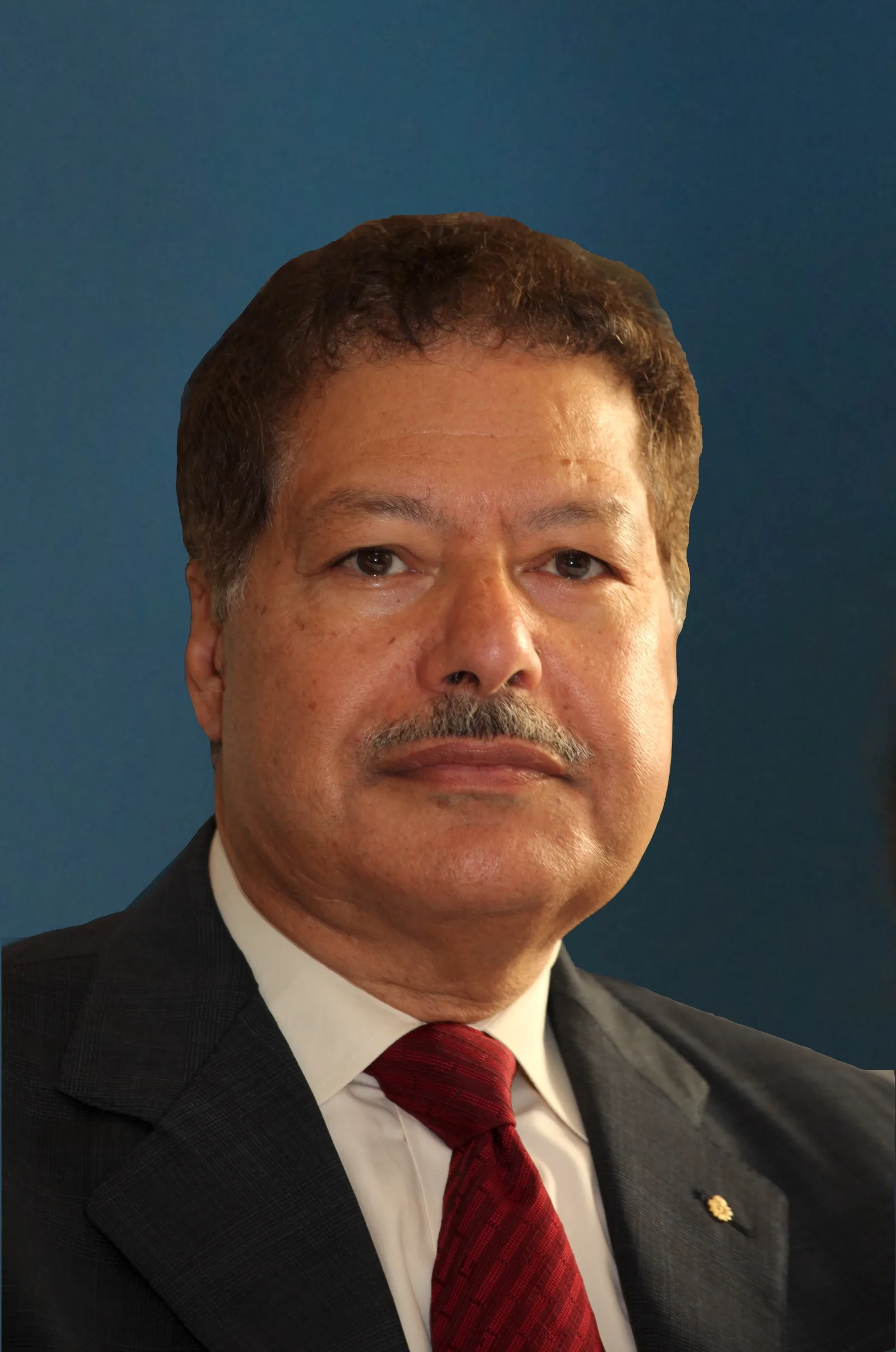
The man behind this work was born on February 26, 1946, in Damanhur, and grew up in Desouk. He graduated with honors from the Faculty of Science at Alexandria University, completed his master's there in spectroscopy — the study of the light matter emits — then left to earn his doctorate from the University of Pennsylvania in 1974. Two years later, after a fellowship with IBM at the University of California, Berkeley, he joined the faculty at Caltech in 1976, where he held the Linus Pauling Chair in Chemical Physics. In November 2009 he was named to the first group of United States Science Envoys — three scientists whose names were announced together — a group whose mandate covered North Africa, the Middle East, and South and Southeast Asia.
To anyone reading this biography in search of a miracle: there is no miracle in it. There is a public school in a small town, a science faculty at an Egyptian university, and what any student anywhere needs — a professor who pays attention, and long years of patience with an instrument that refuses to give a result on the first try. Ahmed Zewail was the third Egyptian to win a Nobel Prize, after President Anwar Sadat for Peace in 1978 and the novelist Naguib Mahfouz for Literature in 1988, and the first in the sciences. To the best of our knowledge, as of this writing, he remains the only Egyptian to have won a Nobel Prize in one of the natural sciences.
Then came the chapter Egyptians know better than the laser itself: Zewail City of Science and Technology. It was established by Law No. 161 of 2012, issued in December of that year, which at the time defined it as an independent scientific research institution with a public legal personality, not for profit, and set its headquarters in Sheikh Zayed in the city of 6th of October, Giza Governorate. Under the 2012 text, it comprised a university of science and technology, research institutes in fields such as energy, medicine, materials, the environment, space, nanotechnology and information systems, and a center for transferring research into practical application then named the "Technology Pyramid." The law placed it under the oversight of the Central Auditing Organization and exempted its surpluses and the revenue of its ongoing activity from taxes and fees.
Then Decree-Law No. 166 of 2019 was issued, amending the city's founding law, dated December 22, 2019, to take effect the day after its publication in the Official Gazette. The amendment deleted the phrase "Egypt's National Project for Scientific Renaissance" from the law's title, added the word "Innovation" to the city's name, making it "Zewail City of Science, Technology and Innovation," fixed its main headquarters in the city of 6th of October, Giza Governorate, and renamed the technology-transfer center from "Technology Pyramid" to "Science and Technology Valley" — the name that still appears on the city's own website today. It also replaced the text of Articles One through Seven, giving the city a board of trustees chaired by the minister in charge of higher education, with ten prominent scientists and five public figures as members, and a board of directors formed by a decision of the prime minister and chaired by the city's chief executive, who is appointed by a decision of the prime minister for a four-year term renewable once.
We note this amendment purely as a legislative fact; assessing the city's track record is a matter that requires figures and published reports, and as of this writing we do not have audited numbers on its students, graduates, and research output to put before the reader, so here we confine ourselves to what the law states and no more. What matters to us is that the idea of "a city for scientific research" now has, in Egypt, a legislative basis with a number and a year that any citizen can look up and read, and can then ask — as a right, not as a favor from anyone — what has actually been achieved.
Ahmed Zewail died on August 2, 2016, at the age of seventy. Every October 12, the anniversary of the Swedish announcement returns, and with it a question heavier than celebration: what do we do with the legacy of a man who made it his profession to look at the instant no one else sees? The answer, in our view, does not begin with budgets or buildings, but with a school laboratory whose tap actually works, with a teacher who lets a student get an experiment wrong twice, and with a family that does not consider its son to have "wasted two years" because he repeated a measurement whose result did not convince him.
So the next time you go back to that blurred candle photo on your phone, remember that you are facing the very question that occupied a scientist from Damanhur for half a century: that what looks to us like a single instant is, in reality, a story with a beginning, a middle, and an end, and that we fail to see it not because the story is slow, but because our eyes are. Show your child the photo, and tell them that an Egyptian man devised a way to watch something billions of times faster than that — and that he started out in a classroom just like theirs.
Related Stories
Egypt's Eye on the Sky: Kottamia Observatory's 74-Inch Mirror, Watching the Universe Since 1964
On a desert plateau east of Cairo, a dome has opened at sunset for more than sixty years. For World Space Week, we tell a story that begins with the Khedivial observatory at Abbassia, then Helwan and Halley's Comet, and reaches a giant mirror Egypt contracted for in 1948 and later upgraded with Japanese instruments. It is a reminder to every student that astronomy in Egypt is a living profession, not just heritage.
October 6, 2026 · 7 min read
Egyptian Blue: History's First Synthetic Pigment Is Back, Lifting Fingerprints and Lighting Up Cells
A blue that Egyptian chemists made from sand, copper and lime thousands of years ago turned out, in 2013, to break apart into nanosheets that glow in the infrared. It has since become a powder that reveals fingerprints in Australia and a probe that lights up fly embryos and plant leaves in Germany. The story of an ancient material with a thoroughly modern property, and a question about our own laboratories today.
September 17, 2026 · 7 min read
Eighty Million Years Before the Pharaohs: Mansoura's Dinosaur and the Oasis Fossils the War Burned
Egyptian students from Mansoura University pulled from the rocks of Dakhla Oasis the bones of Mansourasaurus, the most complete Late Cretaceous dinosaur skeleton ever found in Africa. A century before them, a German scientist laid the dinosaurs of Bahariya Oasis to rest in Munich, and the war burned them. The story of the Earth's archive in Egypt's desert, and of a science your child can study here.
September 8, 2026 · 7 min read