跳至正文

西奈高山:圣凯瑟琳、千年古修道院与贝都因人引路的步道

在西奈的海滨度假胜地之上,耸立着埃及的最高地:摩西山与凯瑟琳山,一座大门从未关闭过的六世纪修道院,高谷中的贝都因果园,还有“西奈步道”——一条由贝都因部落亲手开辟并亲自领队的长距离徒步线路。
发布于 2026年8月18日·5 分钟阅读
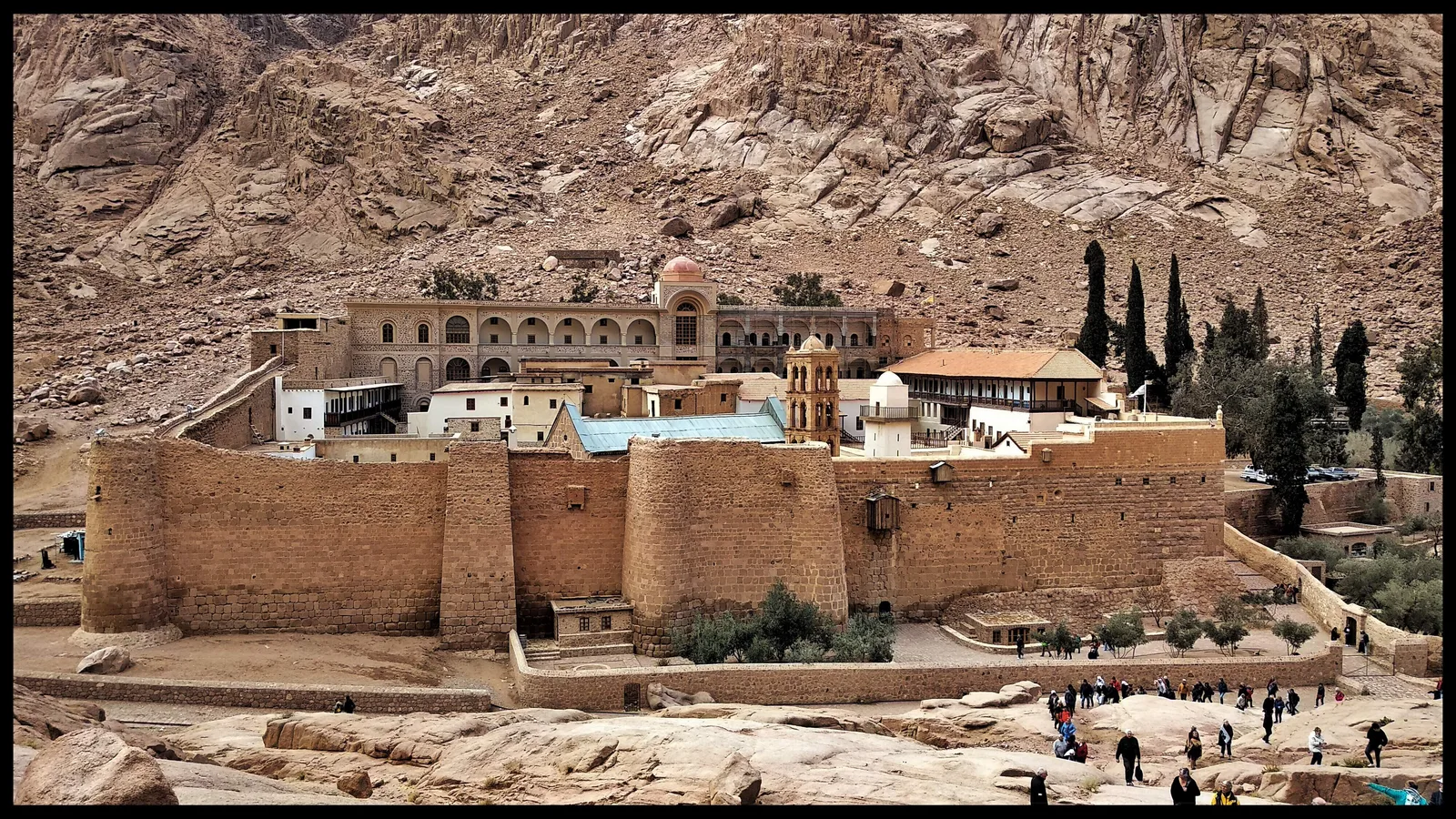
دير سانت كاترين بأسواره الحجرية المحصنة عند سفح جبال الجرانيت في جنوب سيناء

Most images of Sinai show its coastline: the resorts of Sharm el-Sheikh and Dahab, the diving jetties, the beach cafés. But the peninsula's interior tells a different story. In its southern heart, a knot of dark granite mountains rises to the roof of Egypt, and at roughly 1,600 metres above sea level sits the small town of Saint Catherine, the base for pilgrims, hikers and travellers drawn to one of the oldest continuously inhabited religious sites on Earth.

The numbers set the scene. Jebel Musa, the peak identified by long tradition as the Mount Sinai of scripture, rises to about 2,285 metres. Its neighbour Jebel Katherina, or Mount Catherine, reaches roughly 2,642 metres — the highest point in all of Egypt. Winters here are genuinely cold, and snow occasionally dusts the summits, a sight that surprises visitors who associate Egypt only with desert heat. Spring and autumn bring the mild days and cold, star-filled nights that hikers prize most.

At the foot of Jebel Musa stands the Monastery of Saint Catherine. Its fortified walls were built in the sixth century on the orders of the Byzantine emperor Justinian, enclosing a site that Christian tradition had already long associated with the burning bush of the Moses story. The granite fortress was designed to protect the monks of a remote frontier, and it succeeded to an extraordinary degree: the monastery has functioned continuously ever since, making it one of the oldest working Christian monasteries in the world.

That unbroken history produced an unmatched inheritance. The monastery's library, often described as one of the oldest continuously operating libraries anywhere, preserves thousands of manuscripts in Greek, Arabic, Syriac, Georgian and other languages. It was here in the nineteenth century that scholars identified the Codex Sinaiticus, a fourth-century manuscript that ranks among the earliest substantial copies of the Christian Bible; most of its surviving leaves are now held abroad, notably in the British Library. In 2002, UNESCO inscribed the Saint Catherine area on the World Heritage List.

The mountain is sacred ground for more than one faith. A mosque stands within the monastery walls, and the monks preserve a document tradition — the Ashtiname, a covenant attributed to the Prophet Muhammad — promising protection to the monastery, a tradition the community has cited across centuries of changing rulers. Jewish, Christian and Muslim travellers alike have climbed these slopes for centuries, and the area's story is often told as an example of long coexistence in a hard landscape.

Climbing Jebel Musa remains the classic experience. Two routes lead up: the long camel path, wide and gradual, and the Steps of Repentance, a staircase of roughly 3,750 stones traditionally said to have been cut by a monk. Most visitors start in darkness to reach the summit for sunrise, when the surrounding granite ranges turn from black to red to gold. A small chapel and a mosque share the summit, and the descent by daylight reveals the scale of what was climbed by torchlight.

None of this works without the Jebeleya, the Bedouin tribe whose history is intertwined with the monastery's. Tradition holds that their ancestors were sent centuries ago to serve and protect it, and the tribe has lived around Saint Catherine ever since, tending walled mountain gardens of almonds, olives and fruit in the high wadis. Guiding is now a mainstay of the local economy, and visitors trekking in the high mountains are expected to go accompanied by local Bedouin guides — a rule that protects both hikers and livelihoods.

The most ambitious expression of that guiding tradition is the Sinai Trail, launched in 2015 as a long-distance hiking route created and run by a cooperative of Bedouin tribes. The original route linked the Gulf of Aqaba coast to the Saint Catherine highlands over roughly a dozen days of walking; the project later expanded into a much longer network crossing the territories of several tribes, with each tribe guiding travellers through its own land. It is widely described as Egypt's first long-distance hiking trail.

The mountains themselves are a protected area. The Saint Catherine Protectorate covers a high-altitude ecosystem unlike anywhere else in Egypt, where relict plants survive on peaks that catch winter moisture. Endemic species cling on here, among them the Sinai baton blue, counted among the smallest butterflies in the world and dependent on the local Sinai thyme. Orchards, ibex and centuries-old water channels share the wadis, and conservation here is inseparable from the Bedouin gardens that shaped this landscape in the first place.

For travellers, the practical advice is simple. Come in spring or autumn for the kindest weather, and pack seriously for cold nights if you sleep on the mountain. Dress modestly at the monastery and check its visiting hours, which are limited and follow the monastery's calendar. Hire local guides, carry out your litter, and walk lightly: these mountains are not a backdrop but a living community of monks and Bedouin who have kept faith with this landscape for some fourteen centuries — and who now welcome those who treat it with the same respect.

相关报道