本班:埃及沙漠的烈日如何化身全球最大电站之一
在阿斯旺以北的西部沙漠,数十座紧密相连的太阳能电站汇成本班园区——地球上最大的光伏发电基地之一。这个项目,把埃及最严酷的自然力量——沙漠烈日——变成了可再生的国家财富。
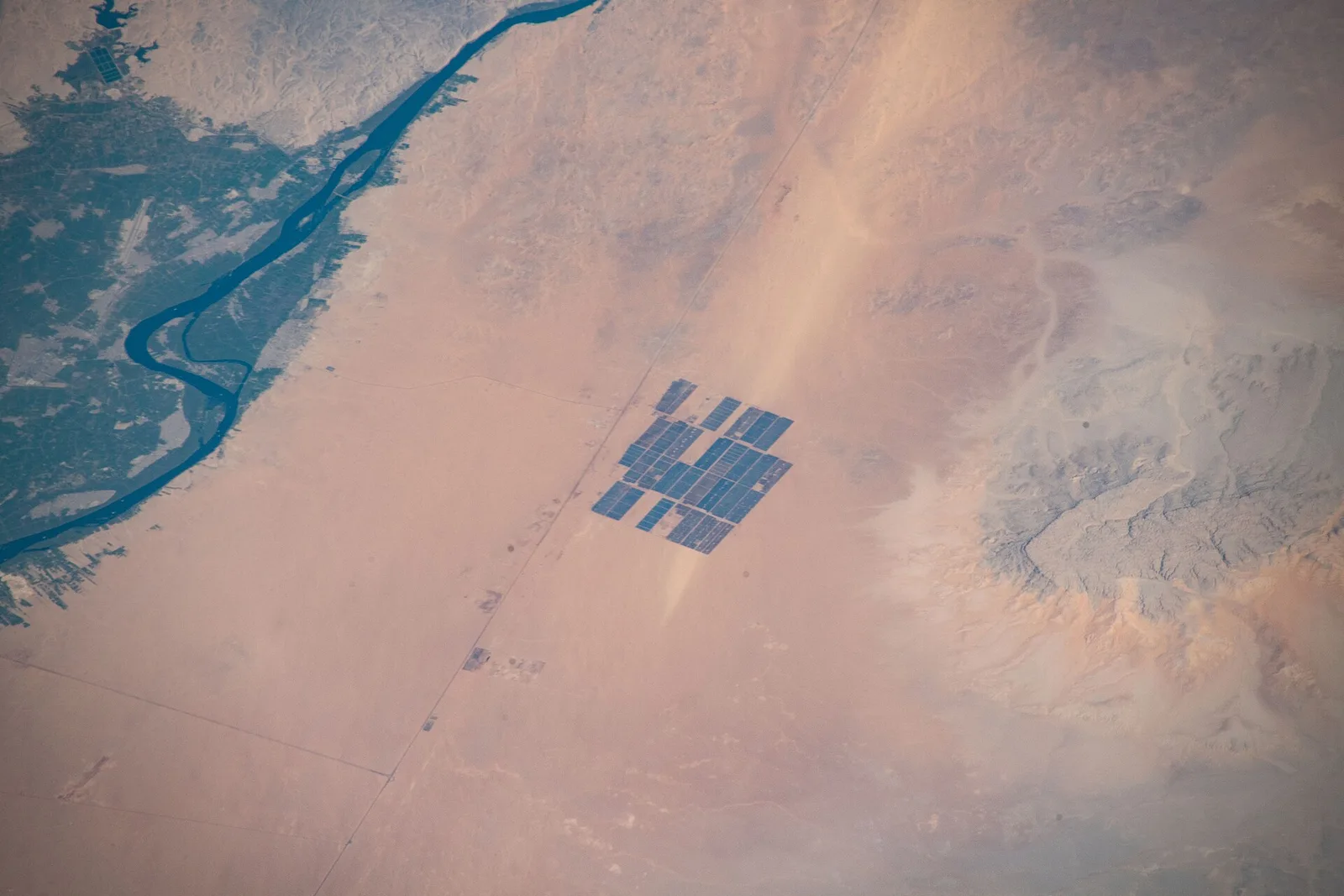
Tens of kilometres north of the city of Aswan, near a small village called Benban, lies a landscape unlike anything else in Egypt: endless rows of dark-blue solar panels covering vast tracts of the Western Desert, glinting under a sun that hardly ever hides. This is the Benban Solar Park, which since its completion at the end of the last decade has ranked among the largest photovoltaic complexes in the world, with a combined capacity of roughly 1.65 gigawatts spread across dozens of adjacent plants.
Benban was never conceived as a single giant station but as a mosaic of projects. Rather than build one mega-plant itself, Egypt's New and Renewable Energy Authority divided a huge stretch of desert into dozens of plots and offered them to private developers from Egypt and around the world under a feed-in tariff programme launched in the mid-2010s. Financing flowed in from major international institutions — the World Bank Group's International Finance Corporation and the European Bank for Reconstruction and Development among them — and the idea became reality within a few years.
Why Aswan? The answer lies in physics and geography together. Southern Egypt enjoys some of the highest levels of solar irradiance anywhere on the planet, with near-cloudless skies almost all year round. The flat, sparsely populated desert offers enormous low-cost land, and its relative proximity to the national grid made connecting the plants economically feasible.
The park runs on photovoltaic technology: silicon cells that convert sunlight directly into direct-current electricity, which devices called inverters then transform into alternating current suitable for transmission. Power from each plant is gathered at large substations that feed it into the national grid, lighting homes and factories hundreds of kilometres from the sands of Benban.
In everyday terms, the clean electricity the complex generates is enough to supply hundreds of thousands of Egyptian homes. It spares the burning of large quantities of fossil fuel that would otherwise be imported or drawn down from domestic reserves, with a corresponding cut in the carbon dioxide emissions that drive climate change.
The impact has been social as well as economic and environmental. During construction the project created thousands of jobs, many filled by residents of Aswan and the surrounding villages, and permanent operations and maintenance work has grown up around the park, requiring technicians and engineers in a governorate that for decades had few industrial opportunities.
Benban sits at the heart of a broader Egyptian energy strategy that targets renewables supplying about 42 per cent of the electricity mix by 2035. Alongside the sun, Egypt is betting on wind in areas such as the Gulf of Suez and Zafarana, and on the historic hydropower of the High Dam, in a drive to diversify sources and reduce dependence on natural gas.
But the desert does not give up its sun for free. Dust and sand accumulate on the panels and cut their output, requiring constant cleaning in a water-scarce environment — a challenge that has pushed operators toward dry-cleaning techniques and specialised robots. Extreme heat itself reduces cell efficiency, a well-known paradox of solar engineering, and there is the further task of integrating an intermittent source — absent at night — into a grid that must stay stable around the clock.
Those challenges have made Benban a living laboratory. Egyptian and international universities and research centres study how panels perform in hot, dusty climates and test solutions for storage, cleaning and output forecasting — expertise that grows more valuable as solar projects expand across the Arab region and Africa.
In the end, Benban's significance goes beyond electricity. The project offered a model of partnership between the state, private developers and international finance in a field once monopolised by conventional thermal stations, and it strengthened Egypt's position as a regional candidate for exporting clean power through grid interconnection projects with neighbouring countries. The sun that Egyptians long regarded as a climatic hardship has become, in the sands of Benban, a national resource to be reckoned with.
相关报道
埃及进军太空:国家航天局与守望土地、庄稼和水源的卫星
埃及航天局依据2018年的法律设立,但埃及与人造卫星的故事更为悠久:从“埃及卫星1号”(EgyptSat-1)到“提巴1号”(Tiba-1)和NExSat。一个农业国为什么需要航天计划?答案就在它的田野、水源和偏远村庄里。
2026年8月18日 · 6 分钟阅读
祖尔气田:重绘东地中海能源版图的大发现
2015年夏,意大利埃尼公司宣布在塞得港外海发现祖尔气田,当时被称为地中海历史上最大的天然气发现。本文讲述这一发现的经过、天然气如何从深海开采,以及它为何改变了埃及在地区能源版图上的位置。
2026年8月18日 · 6 分钟阅读

从月球上能看到中国长城吗?宇航员早已给出答案
教科书里有个人们津津乐道的说法:中国长城是从月球上唯一可见的人造建筑。但亲身登上太空的宇航员——包括中国首位航天员本人——都给出了否定答案,光学原理也支持他们。至于从太空真正能看到什么——从城市灯火到熠熠生辉的尼罗河三角洲——那是一个更精彩的故事。结论:错误。
2026年8月18日 · 5 分钟阅读