Le dossier du barrage de la Renaissance, tel qu'il est documenté : que veulent l'Égypte, le Soudan et l'Éthiopie ?
Depuis 2011, le dossier du Grand Barrage de la Renaissance éthiopien est passé des commissions tripartites à l'Union africaine, puis au Conseil de sécurité de l'ONU. Un guide neutre de ce que l'Égypte, le Soudan et l'Éthiopie ont réellement exigé — et des raisons pour lesquelles un accord contraignant reste hors de portée.
Rares sont les dossiers de la diplomatie africaine à avoir suscité autant de négociations, de médiations et de couverture médiatique que celui du Grand Barrage de la Renaissance éthiopienne, l'immense ouvrage hydroélectrique édifié par l'Éthiopie sur le Nil Bleu. Depuis l'annonce du lancement des travaux en 2011, le barrage a été débattu au sein de comités tripartites, lors de sommets présidentiels et à l'Union africaine, et il est même parvenu jusqu'au Conseil de sécurité des Nations unies. Le dossier n'en est pas moins souvent réduit à des slogans. Le comprendre correctement suppose de savoir ce que chacun des trois pays — l'Égypte, le Soudan et l'Éthiopie — a réellement déclaré vouloir, et où ces positions documentées s'affrontent.
Le barrage se dresse sur le Nil Bleu, dans la région éthiopienne du Benishangul-Gumuz, à une quinzaine de kilomètres de la frontière soudanaise. Il s'agit du plus grand projet hydroélectrique d'Afrique, conçu autour d'un réservoir d'une capacité d'environ 74 milliards de mètres cubes. Son emplacement compte autant que ses dimensions : le Nil Bleu, qui prend sa source sur les hauts plateaux éthiopiens, fournit la plus grande part des eaux qui parviennent en fin de course au Soudan et à l'Égypte. Ce qui se joue sur ce tronçon du fleuve se ressent donc, directement ou indirectement, tout au long de la vallée située en aval.
La position éthiopienne, exprimée sans variation depuis plus d'une décennie, repose sur deux piliers : le développement et la souveraineté. Des dizaines de millions d'Éthiopiens vivent sans électricité, et Addis-Abeba présente le barrage comme la locomotive de l'industrialisation et de l'électrification des campagnes, financée pour l'essentiel par des ressources nationales, dont des campagnes d'emprunt populaire. Les responsables éthiopiens soulignent qu'un barrage hydroélectrique ne consomme pas l'eau mais la fait passer par ses turbines, et ils récusent les accords sur le Nil conclus à l'époque coloniale, auxquels l'Éthiopie n'a jamais été partie. Dans leur récit, le projet relève d'un droit national exercé sur le sol éthiopien, sans intention, affirment-ils, de nuire aux voisins d'aval.
La position égyptienne part d'une donnée géographique exceptionnelle : l'Égypte est l'un des pays au monde les plus tributaires d'une source d'eau unique, puisqu'elle tire du Nil l'écrasante majorité de son eau douce alors que ses précipitations sont quasi nulles. Le Caire s'appuie sur l'accord de 1959 conclu avec le Soudan, qui lui attribue 55,5 milliards de mètres cubes par an, et invoque des droits historiques accumulés au fil de millénaires d'installation sur les rives du fleuve. L'Égypte assure ne pas s'opposer par principe au développement de l'Éthiopie ; ce qu'elle réclame, à chaque cycle de négociations, c'est un accord juridiquement contraignant encadrant le remplissage et l'exploitation du barrage, à commencer par les années de sécheresse.
La position soudanaise, telle qu'elle est documentée, est la plus nuancée des trois. Des responsables soudanais ont reconnu des bénéfices possibles : un Nil Bleu au débit régulé pourrait limiter les crues saisonnières dévastatrices, et le barrage peut fournir de l'électricité. Dans le même temps, Khartoum n'a cessé de soulever des inquiétudes en matière de sûreté et de coordination, car le barrage soudanais de Roseires se trouve à faible distance en aval et son exploitation dépend de la connaissance des volumes que l'ouvrage éthiopien relâchera et du moment où il le fera. Le Soudan s'est donc rangé aux côtés de l'Égypte pour réclamer un cadre juridique contraignant portant sur l'exploitation et sur un échange continu de données.
L'histoire des négociations remonte aux premières années du projet. Un groupe international d'experts, comprenant des membres des trois pays, a examiné les documents du barrage et recommandé en 2013 des études complémentaires sur ses effets pour les deux États d'aval. L'étape la plus marquante est venue en mars 2015, lorsque les dirigeants égyptien, soudanais et éthiopien ont signé la Déclaration de principes à Khartoum. Ce texte engageait les trois États sur des principes familiers du droit international de l'eau : la coopération, l'utilisation équitable et raisonnable, l'obligation d'éviter tout dommage significatif, et l'adoption de règles pour le premier remplissage du réservoir et son exploitation annuelle.
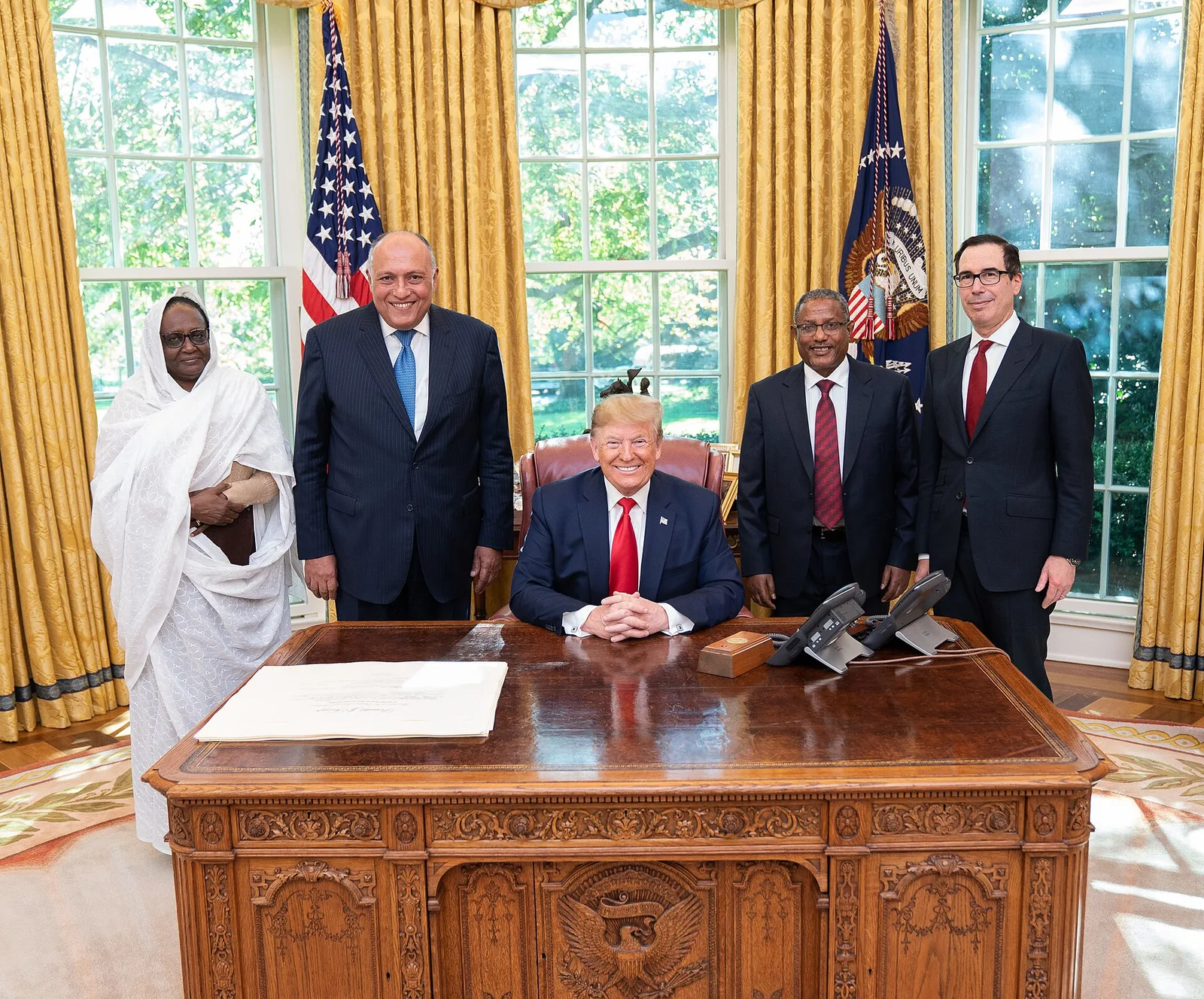
Traduire ces principes en accord d'exploitation s'est révélé bien plus ardu. Fin 2019, les trois pays ont engagé des pourparlers accueillis à Washington, en présence du département du Trésor américain et de la Banque mondiale comme observateurs ; un projet de texte a été préparé, mais l'Éthiopie n'a pas participé à la séance de clôture et n'a pas signé, jugeant le document déséquilibré. Les négociations sont ensuite passées sous l'égide de l'Union africaine, au fil de présidences successives. En 2021, le Conseil de sécurité des Nations unies s'est saisi du dossier et a adopté une déclaration présidentielle encourageant les parties à reprendre, sous conduite de l'Union africaine, des négociations devant aboutir à un accord acceptable par tous — laissant ainsi formellement le dossier entre des mains africaines.
Sur le terrain, l'Éthiopie a poursuivi seule le remplissage du réservoir, menant des phases successives pendant les saisons des pluies à partir de 2020 et annonçant l'achèvement de chacune d'année en année. Les premières turbines du barrage ont commencé à produire de l'électricité en 2022, l'Éthiopie a déclaré le remplissage achevé en 2023, puis l'ouvrage a été officiellement inauguré en septembre 2025. L'Égypte et le Soudan ont protesté contre chaque étape unilatérale dans des lettres adressées au Conseil de sécurité, faisant valoir que remplir et exploiter le barrage sans accord contraignant contrevenait à la Déclaration de principes de 2015. L'Éthiopie a rejeté cette lecture et affirmé que le remplissage n'avait causé aucun dommage documenté en aval.
La rhétorique mise de côté, le cœur du différend est juridique plus qu'hydrologique. L'Égypte et le Soudan veulent un traité contraignant assorti de protocoles clairs pour la sécheresse — des règles fixant les volumes que le barrage devrait relâcher si une sécheresse prolongée coïncidait avec son exploitation — ainsi qu'un mécanisme obligatoire de règlement des différends. L'Éthiopie privilégie au contraire des lignes directrices souples qu'elle pourrait ajuster, au motif que des obligations contraignantes de lâcher d'eau reviendraient en pratique à reconnaître des quotas fixes aux deux États d'aval et pourraient brider de futurs projets en amont. Chaque cycle de négociations effondré a fini par buter sur ce même clivage entre traité et lignes directrices.
Que signifie concrètement le remplissage pour les deux pays d'aval ? Sur ce point, on ne peut honnêtement que rapporter les positions documentées. Des responsables égyptiens ont averti qu'une sécheresse s'étalant sur plusieurs années pendant l'exploitation du barrage, en l'absence de règles convenues, pourrait imposer des réductions douloureuses de l'eau parvenant aux champs et aux villes d'Égypte. Des responsables éthiopiens répondent que les phases de remplissage ont eu lieu en saison humide et n'ont provoqué, selon leur évaluation, aucun déficit notable en aval. Les autorités soudanaises, elles, ont tantôt fait état d'un débit plus régulier, tantôt déploré des variations non annoncées qui ont compliqué la gestion de leurs propres barrages. Une évaluation indépendante de long terme reste largement suspendue à la pluviométrie des années à venir.
Le contexte juridique plus large explique la difficulté d'aboutir à un accord. Il n'existe aucun traité global liant l'ensemble des onze États du bassin du Nil. L'Accord-cadre de coopération, porté par les pays d'amont, a été rejeté par l'Égypte et le Soudan en raison de formulations touchant à la sécurité hydrique et à la notification préalable. Le droit international de l'eau propose deux principes en tension permanente : l'utilisation équitable et raisonnable d'un fleuve partagé, mise en avant par les pays d'amont, et l'obligation de ne pas causer de dommage significatif, mise en avant par les pays d'aval. Le dossier du barrage est, au fond, un test de l'équilibre à trouver entre ces deux principes.
Le dossier demeure donc ouvert même après l'inauguration du barrage, car c'est l'exploitation — et non la construction — qui fera se rencontrer les intérêts des trois pays, année après année. Les enjeux n'ont rien d'abstrait : la sécurité hydrique de plus de cent millions d'Égyptiens, les ambitions d'électrification et de développement d'un nombre comparable d'Éthiopiens, et, entre les deux, la sûreté et l'agriculture du Soudan. Que l'issue soit un traité contraignant, une coordination informelle ou la prolongation du blocage, suivre rigoureusement cette histoire commence par savoir ce que chaque capitale a réellement mis sur la table — ce que ce dossier a précisément tenté d'exposer.
À lire aussi
Un trou dans le ciel, refermé par un traité : le protocole de Montréal et le rôle de l'Égypte pour l'ozone
Le 16 septembre, le monde célèbre la Journée internationale de la préservation de la couche d'ozone : un traité ratifié par tous les pays du monde qui a réellement fonctionné. D'un article scientifique de 1974 à la signature de Montréal en 1987, la ratification de l'Égypte en 1988 et l'amendement de Kigali en 2023 : l'histoire de la bonbonne de réfrigérant dans la main d'un technicien, et pourquoi le ciel devrait guérir vers 2040.
16 septembre 2026 · 7 min de lecture
La Ligue arabe : la maison des Arabes, dont les fenêtres donnent sur la place Tahrir
À quelques pas de la place Tahrir se dresse « la maison des Arabes » : l'une des plus anciennes organisations régionales du monde, née au Caire avant la Charte des Nations unies elle-même. Comment fonctionnent ses sommets et son secrétariat ? Pourquoi ses résolutions n'engagent-elles que ceux qui les acceptent ? Et que raconte le départ à Tunis, puis le retour ? Visite chez un vieux voisin que nous croisons chaque jour sans presque le connaître.
2 septembre 2026 · 7 min de lecture
Sous le plafond bleu : comment fonctionne l'ONU et qui détient le « veto » au Conseil de sécurité ?
Dès qu'une crise éclate, on apprend que le Conseil de sécurité s'est réuni et qu'un État a brandi son « veto ». Mais que se passe-t-il vraiment sous le plafond bleu ? Voyage de la salle de l'Assemblée générale à la table en fer à cheval : comment naît une résolution onusienne, quand devient-elle contraignante, comment un seul mot la fait tomber, et quelle est la place de l'Égypte dans ce décor ?
26 août 2026 · 8 min de lecture